Specialty Guides: Mental Health Note Template Guide: Free Resources & Setup
Learn how to build a mental health note template pack to save time and improve clinical accuracy. Get tips on H&P, SOAP, and progress note workflows.
The Hidden Burden of Mental Health Documentation
For mental health professionals, the weight of the workday doesn’t end when the last patient leaves the room. Often, the most taxing part of the job begins after hours: the meticulous recording of patient encounters. Whether you are a psychiatrist in a large university clinic or a therapist in private practice, the pressure to produce accurate, HIPAA-compliant documentation can lead to significant burnout. Rushed notes often lack the nuance required for complex mental health cases, increasing medico-legal anxiety and reducing the quality of the longitudinal record.
This guide provides a comprehensive roadmap for developing a mental health note template pack. We will explore how to move beyond basic SOAP notes to sophisticated documentation structures that match the reality of behavioral health. You will learn how to streamline your clinical workflow, ensure privacy compliance, and roll out a standardized system across your clinic or department. By the end of this guide, you will have a clear blueprint for organizing your patient encounters effectively.
What a medical scribe solves in modern practice
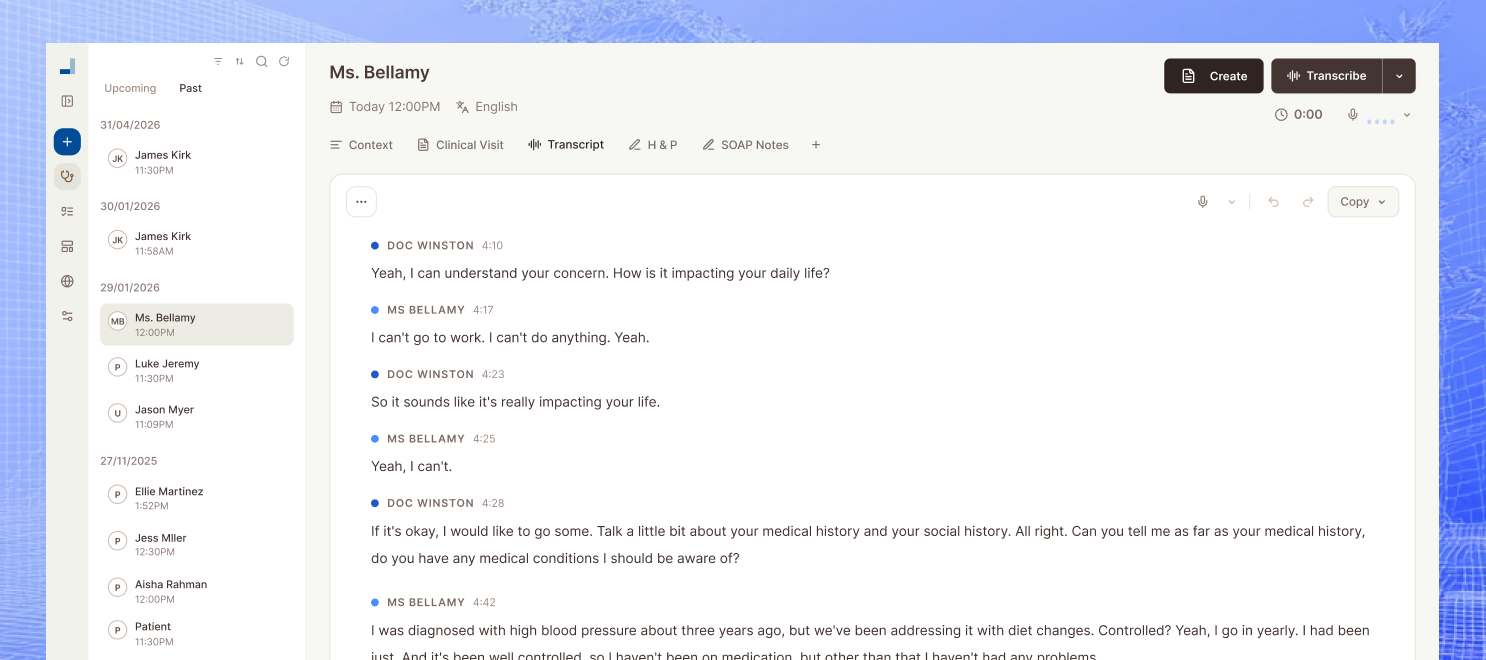
The cognitive load of trying to remember every detail of a 50-minute therapy session or a high-stakes psychiatric evaluation is immense. Clinicians often find themselves choosing between active listening and frantic note-taking. An AI medical scribe bridge this gap by capturing the dialogue in real-time, allowing the provider to focus entirely on the patient’s emotional state and verbal cues. The goal is to eliminate the ‘pajama time’ spent on documentation while maintaining a highly professional record.
It is important to remember that these tools are assistive. While they transcribe and organize data with incredible speed, the clinician remains the ultimate authority. The scribe provides the raw material and initial structure, but the provider reviews the output to ensure clinical accuracy and professional judgment are reflected. This partnership reduces the time to completion for notes and prevents the ‘delayed note’ syndrome that plagues many mental health facilities.
- Reduces the administrative burden that leads to clinician burnout.
- Ensures that subtle patient details and verbal quotes are not lost to memory.
- Allows for improved eye contact and therapeutic alliance during the session.
- Speeds up the turnaround time for insurance or referral documentation.
- Acts as a supportive assistant, leaving the final clinical oversight to the provider.
Note types you can generate beyond SOAP (H&P and more)
While the SOAP format is a staple in medicine, mental health often requires more specialized structures. A comprehensive mental health note template pack should include robust History and Physical (H&P) formats tailored for psychiatric intake, as well as specific consult and progress notes. These notes need to capture mental status examinations, risk assessments, and medication responses in a way that a generic SOAP note simply cannot accommodate.
Structure is not just about tidiness; it is critical for continuity of care. When a patient moves between providers or requires a referral, the quality of the transition relies on the clarity of the documentation. Detailed procedure notes for interventions like TMS or ketamine therapy, along with clear discharge summaries, ensure that the entire care team is aligned and that the clinic is always audit-ready. Having a variety of templates ensures that the right tool is always available for the specific clinical situation.
- Intake H&P notes covering family history, social determinants, and trauma history.
- Detailed Mental Status Exams (MSE) integrated into daily progress notes.
- Standardized risk assessments for suicidality and self-harm.
- Consultation and referral letters that summarize complex histories for other specialists.
- Discharge summaries that clearly outline follow-up care and crisis plans.
How to implement a mental health note template pack step-by-step in a real clinic
To begin implementing your mental health note template pack, start by selecting one specific visit type—such as initial intakes or routine medication management—to pilot the new system. This prevents your staff from feeling overwhelmed by a total overhaul of their documentation process. Focus on perfecting the workflow for this single visit type before expanding to more complex scenarios.
Next, you should customize your templates to match your specialty. A geriatric psychiatrist will need different prompts than a school-based counselor. Once these are set, practice capturing the encounter. Whether you are conducting an in-person session or a telehealth appointment, ensure the recording device or software is properly positioned to capture clear audio without being intrusive to the therapeutic space.
After the session, develop a habit of rapid review. Instead of letting notes pile up, spend five minutes immediately following the encounter to edit the generated note. This ensures the details are fresh in your mind. Finally, utilize the outputs to generate secondary documents. The information from a well-structured progress note can easily be converted into a referral letter or a school accommodation form, saving hours of redundant typing.
- Choose one high-volume visit type to start your template pilot.
- Customize templates with specific fields for mental status and risk.
- Capture audio consistently across both in-person and virtual settings.
- Review and edit notes immediately to maintain high data integrity.
- Repurpose note content for automated letters and clinical forms.
How to keep note quality high and reduce mistakes
High-quality notes in mental health are those that are concise yet descriptive. A common failure point is ‘note bloat,’ where irrelevant details are included, obscuring the actual clinical picture. To prevent this, your templates should prompt for specific behavioral observations rather than just transcribing everything the patient says verbatim. Standardizing how medications and dosages are recorded is also vital to avoid errors.
Developing a lightweight review habit is the best defense against inaccuracies. Team leaders should encourage a culture where notes are checked for clinical logic—does the assessment actually match the subjective reports? Setting clinic-wide standards for documentation helps ensure that every provider is working from the same playbook, which is especially important in multidisciplinary university clinics.
- Focus on objective behavioral observations to avoid narrative bloat.
- Implement a ‘Double-Check’ habit for all medication and dosage entries.
- Align team standards so documentation is consistent across providers.
- Ensure the assessment section directly supports the proposed treatment plan.
- Periodically audit a small sample of notes to maintain quality control.
Privacy, consent, and patient trust (plain English)
Privacy is the cornerstone of mental health care. When introducing recording or transcription into a session, you must follow your local and regional regulations regarding consent. Patients need to know exactly how their data is being used and stored. While we do not provide legal advice, the general rule is to be transparent and offer patients the option to opt-out at any time without it affecting their care.
Explaining this to a patient doesn’t have to be complicated. You might say: ‘I use a specialized tool to help me document our sessions more accurately so I can focus entirely on listening to you. It records our conversation and turns it into a clinical note, which I then review and edit. Your data is encrypted and handled with the highest security standards. Is that okay with you?’ Most patients appreciate the increased focus they receive when the doctor isn’t typing.
- Always adhere to local HIPAA or GDPR regulations for patient consent.
- Provide a clear, simple script for clinicians to explain the technology.
- Ensure patients know they have the right to decline recording.
- Maintain strict data retention and deletion policies to protect privacy.
- Focus on the benefit to the patient: better focus and more accurate records.
Rolling it out across a clinic without disruption
Introducing a new documentation system requires a strategic rollout. A two-week pilot program involving a few ‘tech-forward’ clinicians is often the best approach. This allows you to identify any friction points in the workflow before the entire clinic adopts the system. During this time, collect feedback on the templates and make adjustments to the fields and prompts based on real-world usage.
Track specific metrics to prove the value of the new mental health note template pack. Measure the reduction in ‘after-hours’ charting and the time elapsed between a visit and note completion. When other staff see their colleagues leaving on time with completed, high-quality notes, the adoption of the new system usually happens naturally and with less resistance.
- Launch with a two-week pilot phase to iron out workflow kinks.
- Track time savings as a key metric for success.
- Gather clinician feedback to refine specialty-specific templates.
- Schedule brief training sessions to demonstrate the ‘Review and Edit’ flow.
- Align templates with billing requirements to simplify the revenue cycle.
Mcoy AI is an AI medical scribe that records and transcribes patient encounters, then generates multiple clinical note types (H&P, progress notes, consult notes, follow-up notes, procedure notes, discharge summaries, referral letters, and more). It features 200+ customizable templates and an AI chat interface to help clinicians create custom letters, forms, and documents efficiently. By focusing on the clinical formats that practitioners actually need, it helps reduce administrative strain across various medical specialties.
Frequently Asked Questions
Below are some of the most common questions regarding the implementation and use of a mental health note template pack in a clinical setting.
How accurate are AI medical scribes in real clinics?
AI medical scribes have become highly accurate, especially in understanding medical terminology and psychiatric jargon. Most modern systems can distinguish between different speakers and accurately capture the nuance of a clinical conversation. However, they are designed to assist the clinician, not replace them. The accuracy remains highest when the clinician performs a quick final review to ensure the nuances of the session are perfectly reflected in the text.
Do I still need to review every note?
Yes, reviewing every note is a fundamental clinical and legal responsibility. While an AI scribe can do 90% of the heavy lifting, the final 10% requires your professional judgment to ensure the assessment and plan are accurate. A thorough review usually takes only a few minutes and is much faster than writing a note from scratch. Consistently reviewing your notes also helps the AI learn your specific style and preferences over time.
What note types can an AI scribe generate besides SOAP?
A sophisticated scribe system can generate a wide range of documents including H&P (History and Physical), intake assessments, progress notes, and consultation letters. For mental health, this includes Mental Status Exams and specialized risk assessments. You can also generate discharge summaries and referral notes. This flexibility ensures that all aspects of patient care are documented in the most appropriate format for the situation.
Will this work for telehealth and in-person consults?
Most AI scribe tools are designed to work seamlessly in both settings. For in-person visits, a smartphone or tablet can capture the audio. For telehealth, the system can often integrate directly with the video platform or record the audio from your computer. The goal is to provide a consistent documentation experience regardless of how you interact with your patients. This versatility is crucial for modern clinics that offer hybrid care models.
How do I explain recording/transcription to patients?
The best approach is to be brief and emphasize the benefit to the patient. Explain that the tool helps you keep more accurate records and allows you to listen more closely to them instead of looking at a computer screen. Most patients are very supportive when they realize it improves the quality of the therapeutic interaction. Always respect their privacy and offer them the choice to opt-out if they feel uncomfortable.
How do clinics prevent note bloat?
Clinics prevent note bloat by using structured templates that prioritize essential clinical data over verbatim transcription. By setting character limits in certain fields or using templates that focus on ‘findings by exception,’ you can keep the notes concise. Training clinicians to summarize their thoughts aloud at the end of a session can also help the AI capture a clear, succinct plan. Clear clinic-wide standards are the most effective way to maintain brevity.
How long does template setup take?
Setting up a basic mental health note template pack can take as little as 30 minutes if you are using pre-built templates as a starting point. Customizing them to your specific needs might take a few hours of testing and refinement. Most clinicians find that the time invested in setup pays for itself within the first few days of use. Once the templates are established, they function as a repeatable system that requires very little maintenance.
What’s the safest way to start if I’m skeptical?
The safest way to start is by using the tool for your most routine, low-risk follow-up appointments. This allows you to see how the system handles your workflow without the pressure of a complex intake session. By starting small, you can evaluate the accuracy and the security of the tool personally. Once you’ve gained confidence in the system’s output and how it saves you time, you can gradually expand its use to all of your patient encounters.
Conclusion
Transitioning to a modernized documentation workflow is one of the most effective ways to combat clinician burnout. By building a comprehensive mental health note template pack, you can move away from the stress of manual entry and toward a more focused, patient-centered practice. Whether you utilize advanced H&P formats or streamlined progress notes, the key is consistency and a commitment to quality. Start your pilot today and see how much time you can reclaim for yourself and your patients. Implementing a mental health note template pack is the first step toward a more sustainable and efficient clinical future.
What a serious review table should cover
| Decision area | Common mistake | Better clinic-ready approach | Metric to watch |
|---|---|---|---|
| Workflow design | Treat mental health note template guide: free resources & setup as a one-off documentation task | Build a repeatable process with clear ownership and review points | Time to complete documentation |
| Team adoption | Assume every clinician will naturally use the same process | Train for consistency and define exception handling early | Active user adoption |
| Quality review | Only check notes when a problem is reported | Audit a sample of notes weekly and review edge cases | Edit rate per note |
| Operational follow-through | Leave admin actions outside the documentation workflow | Use the same encounter data for referrals, letters, and follow-up tasks | Completion rate for next-step tasks |
Related reading
If you are working through mental health note template guide: free resources & setup, it helps to read this alongside Specialty Guides: How to Run a More Efficient Medical Practice in 2026, Specialty Guides: How to Improve Patient Encounters, and Admin Management: Improve Continuity of Care with an AI Medical Scribe. Those guides cover adjacent workflow, implementation, and evaluation questions so the decision does not sit in isolation.
FAQ
How accurate are AI medical scribes in real clinics?
AI medical scribes are highly accurate in capturing clinical terminology and speaker nuances. They are designed to assist, so a quick clinician review ensures the highest data integrity.
Do I still need to review every note?
Yes, reviewing notes is a clinical and legal requirement. It ensures the final plan matches your professional judgment and only takes a fraction of the time compared to manual typing.
What note types can an AI scribe generate besides SOAP?
AI scribes can generate H&Ps, intake assessments, consult letters, discharge summaries, and specialized mental status exams, providing a full suite of clinical documentation.
Will this work for telehealth and in-person consults?
Most systems are compatible with both formats, capturing audio via mobile apps for in-person visits or via computer audio for virtual telehealth sessions.
How do I explain recording/transcription to patients?
Explain that it allows you to listen better and maintain more accurate records. Most patients are comfortable with it once they realize the focus is on their care.
How do clinics prevent note bloat?
By using concise templates and training clinicians to summarize findings aloud, clinics can ensure notes remain brief, relevant, and easy to read.
How long does template setup take?
Initial setup takes about 30 minutes with pre-built options. Customizing them for specific psychiatric or counseling needs usually takes just a few hours of refinement.
What’s the safest way to start if I’m skeptical?
Start by using the tool for routine follow-up appointments. This low-risk approach lets you test the system’s accuracy and workflow before using it for complex intakes.