Admin Management: Improve Continuity of Care with an AI Medical Scribe
Learn how an AI medical scribe improves continuity of care, reduces burnout, and streamlines documentation for clinics and private practices.
The Hidden Hurdle in Modern Patient Care
Many clinicians find themselves stuck in a cycle of after-hours charting, where the burden of documentation leads to burnout and rushed notes. When a doctor is typing away during an exam, they miss the subtle cues that define a patient’s experience. This disconnect doesn’t just impact the provider’s mental health; it creates gaps in the patient record that can lead to medico-legal anxiety and a lack of clinical consistency.
This guide will teach you how to implement a high-quality transcription workflow that expands beyond simple SOAP notes. We will explore how to maintain privacy, manage quality control, and execute a seamless rollout plan for your practice. Whether you are a general practitioner, a specialist in a private clinic, or part of a large university health system, mastering these digital tools is the key to reclaiming your time and focus.
What a medical scribe solves in modern practice
The real cost of medical documentation isn’t just the hourly rate of a human scribe; it is the cognitive load placed on the clinician. When you have to remember every detail while simultaneously engaging with a patient, the risk of missing critical information increases. AI medical scribes act as an assistive layer, capturing the conversation in real-time so that the provider can maintain eye contact and focus on clinical reasoning rather than keyboard shortcuts.
It is important to understand that an AI medical scribe is an assistant, not a replacement for clinical judgment. The clinician remains ultimately responsible for the accuracy and signing of every note. However, by automating the heavy lifting of transcription and summarization, these tools ensure that notes are completed promptly, preventing the “knowledge decay” that happens when charts are left until the end of a long shift.
- Significantly reduces after-hours charting time and cognitive fatigue.
- Captures nuanced patient details that are often forgotten during manual entry.
- The clinician maintains full oversight and final approval of all documentation.
- Ensures clinical notes are ready for review immediately after the encounter.
Note types you can generate beyond SOAP (H&P and more)
While the SOAP format is a staple in medicine, it isn’t always the most efficient way to document complex encounters. Depending on the setting—whether it’s an initial History & Physical (H&P), a surgical procedure, or a simple follow-up—different structures are required. Using a versatile documentation system allows clinics to generate comprehensive consult notes and discharge summaries that fit the specific needs of the patient’s journey.
Structure matters deeply for continuity of care. When a patient moves from a specialist back to their primary care provider, the quality of the referral letter or handover note determines the safety of the transition. Well-structured notes ensure that the practice is audit-ready and that every member of the care team has a clear, legible roadmap of the patient’s history and current treatment plan.
- Generate diverse formats including H&P, progress notes, and consult notes.
- Create professional referral letters and discharge summaries automatically.
- Standardize procedure notes to meet specific billing and compliance needs.
- Improve handover quality between different healthcare providers and specialties.
How to implement an AI medical scribe step-by-step in a real clinic
Starting with a new technology can feel overwhelming, so the best approach is to begin with a single visit type. Choose a standard encounter, like a routine follow-up, to get a feel for how the AI captures the flow of conversation. This allows you to calibrate your voice and the system’s output without the pressure of a complex multi-system case.
Once comfortable, begin setting up templates tailored to your specific specialty. A dermatologist needs different data points than a psychiatrist. By selecting or customizing templates early, you ensure the AI knows exactly which clinical markers to prioritize. During the encounter—whether in-person or via telehealth—simply let the system capture the audio naturally while you interact with the patient as you normally would.
Immediately after the patient leaves, review and edit the generated draft. Because the encounter is fresh in your mind, this step takes seconds rather than minutes. Finally, take those outputs and reuse them to instantly populate referral forms or patient instructions. This integrated narrative flow turns a single recording into a suite of useful clinical documents.
- Pilot the system with one specific encounter type before full implementation.
- Select specialty-specific templates to ensure relevant data capture.
- Review and finalize notes immediately to maintain high accuracy.
- Leverage the AI output to quickly generate secondary documents like letters.
How to keep note quality high and reduce mistakes
The most common failure points in AI-assisted documentation often involve missing medications, incorrect numerical values, or “note bloat”—where the AI includes irrelevant chatter. While modern systems are highly advanced, they still require a human touch to ensure that the final problem list is clinically sound and free of hallucinations. Establishing a lightweight review habit is the best defense against these errors.
Creating team-wide standards for note verification ensures that every practitioner in the clinic is meeting a baseline of quality. You should check for the presence of specific diagnostic reasoning and ensure that any changes in therapy are clearly articulated. By making review a standard part of the workflow, the clinic maintains a high level of professional integrity while still benefiting from the speed of automation.
- Perform a quick manual check for medication dosages and specific values.
- Encourage a “concise-first” approach to prevent unnecessary note length.
- Establish a 60-second review protocol for every AI-generated document.
- Train staff on identifying and correcting common transcription nuances.
Privacy, consent, and patient trust (plain English)
Patient trust is the foundation of any clinical practice, and transparency regarding technology is essential. Consent requirements for recording or transcribing conversations vary significantly by region and local policy; always ensure you are following the specific guidelines of your jurisdiction. However, most patients are receptive to the technology when it is explained as a tool to help the doctor focus more on their health.
A simple script for patients might look like this: “I’m using an AI assistant today to help me capture our conversation so I can focus on listening to you instead of typing on my screen. It helps me make sure your records are perfectly accurate. Is that okay with you?” This approach frames the technology as a benefit to the patient’s care rather than an invasive data collection tool.
- Always verify local and regional consent laws before recording.
- Use a simple, patient-centered script to explain the benefits of the AI scribe.
- Ensure your chosen platform follows strict data security and retention principles.
- Normalize the technology as a standard part of a modern, patient-first clinic.
Rolling it out across a clinic without disruption
A successful rollout requires a structured pilot phase, typically lasting about two weeks. During this time, a small group of “super-users” can test the system, refine the templates, and identify any workflow bottlenecks. This prevents the frustration that comes with a full-clinic launch where no one is yet an expert on the new software.
During the pilot, track specific metrics to measure success, such as the total time saved per day and the reduction in after-hours charting. If clinicians find they are leaving the office 30 minutes earlier, the project will gain immediate buy-in. Once the pilot is successful, align the rest of the staff through brief training sessions that focus on template consistency and documentation standards.
- Start with a 2-week pilot involving a small group of tech-savvy clinicians.
- Monitor time-saving metrics and note completeness to prove ROI.
- Standardize templates across the clinic to ensure a unified patient record.
- Hold brief, peer-led training sessions to ease the transition for all staff.
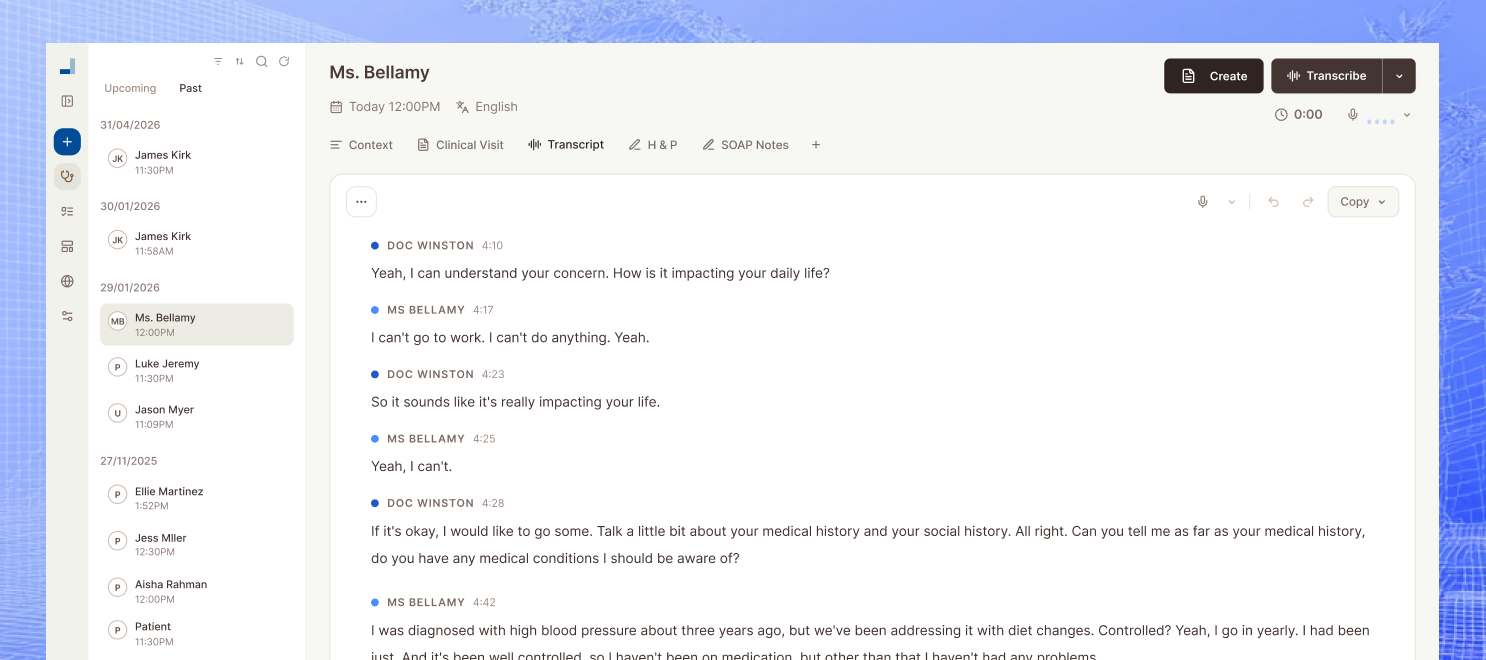
Mcoy AI is an AI medical scribe that records and transcribes patient encounters, then generates multiple clinical note types (H&P, progress notes, consult notes, follow-up notes, procedure notes, discharge summaries, referral letters, and more). It features 200+ customizable templates and an AI chat to create letters, forms, and secondary documents, helping to reduce administrative burdens across a variety of medical specialties without complicating the workflow.
In conclusion, choosing to use an AI medical scribe is a strategic move for any clinic looking to improve continuity of care while protecting the well-being of its providers. By automating the transcription process, practitioners can focus on what matters most: the patient sitting in front of them. It’s time to move toward a more efficient, accurate, and human-centered documentation process. Start your pilot today and experience the difference a streamlined workflow makes in your daily practice.
What a serious review table should cover
| Decision area | Common mistake | Better clinic-ready approach | Metric to watch |
|---|---|---|---|
| Workflow design | Treat improve continuity of care with an ai medical scribe as a one-off documentation task | Build a repeatable process with clear ownership and review points | Time to complete documentation |
| Team adoption | Assume every clinician will naturally use the same process | Train for consistency and define exception handling early | Active user adoption |
| Quality review | Only check notes when a problem is reported | Audit a sample of notes weekly and review edge cases | Edit rate per note |
| Operational follow-through | Leave admin actions outside the documentation workflow | Use the same encounter data for referrals, letters, and follow-up tasks | Completion rate for next-step tasks |
Related reading
If you are working through improve continuity of care with an ai medical scribe, it helps to read this alongside Admin Management: How to Reduce Admin Errors in Clinical Notes, Admin Management: Medication List Template with Examples, and Physician Wellbeing: How Doctors Can Reduce Paperwork Without Compromising Care. Those guides cover adjacent workflow, implementation, and evaluation questions so the decision does not sit in isolation.
FAQ
How accurate are AI medical scribes in real clinics?
AI medical scribes currently reach high levels of accuracy, often exceeding manual transcription in terms of capturing specific dialogue details. They use advanced natural language processing to filter out irrelevant small talk while focusing on clinical facts. However, since the AI may occasionally misinterpret names of medications or unique values, clinician oversight remains essential for 100% accuracy. The primary goal is to provide a 95-98% complete draft that requires only minor polishing.
Do I still need to review every note?
Yes, reviewing every note is a mandatory part of clinical responsibility and professional compliance. The AI functions as an assistive tool to generate the draft, but the physician must verify the content before signing off. This review process usually takes less than a minute per note, which is significantly faster than writing the entire chart from scratch. It ensures that the final record accurately reflects the clinician’s assessment and plan.
What note types can an AI scribe generate besides SOAP?
A high-quality AI scribe can generate a wide range of documentation types beyond the standard SOAP format. This includes History and Physical (H&P) reports, consultation notes, follow-up summaries, and procedure notes. Additionally, it can create discharge summaries and referral letters by synthesizing the information captured during the encounter. This versatility makes it useful for both primary care and highly specialized medical branches.
Will this work for telehealth and in-person consults?
Most AI medical scribe systems are designed to be flexible and work seamlessly for both in-person and telehealth visits. For telehealth, the system can often capture audio directly from the computer’s output or browser during the call. For in-person visits, a mobile app or a dedicated microphone is usually used to record the conversation. This ensures that documentation remains consistent regardless of how the patient chooses to see their doctor.
How do I explain recording/transcription to patients?
Transparency is the best approach; simply inform the patient that you are using a digital assistant to help document the visit so you can focus entirely on them. Most patients appreciate the increased eye contact and better engagement when the doctor isn’t typing. You can explain that the recording is transcribed into a medical note and handled with the same level of confidentiality as any other part of their health record. This usually resolves any concerns immediately.
How do clinics prevent note bloat?
Clinics prevent note bloat by using concise templates and training the AI to focus only on pertinent medical information. Many systems allow you to adjust the “verbosity” of the output to ensure the final note is succinct and professional. Clinicians should also practice a brief editing habit to remove any redundant information that doesn’t contribute to clinical decision-making. Standardizing template expectations across the clinic also helps maintain clarity.
How long does template setup take?
Setting up templates is a quick process, especially if the system comes with pre-built options for common specialties. Many clinicians can find a suitable template and customize it to their liking in about 5 to 10 minutes. Once a template is saved, it can be applied to all future encounters of that type with a single click. The initial investment of time pays off significantly in the long-term speed of note generation.
What’s the safest way to start if I’m skeptical?
The safest way to begin is by running a small-scale pilot for one week with just a few non-complex patients. This allows you to see the quality of the output and understand the workflow without any risk to your schedule. You don’t need to change your entire practice overnight; gradual integration lets you build trust in the technology. Most providers find that after the first few notes, the benefits become undeniable.