Specialty Guides: Build an AI Documentation Workflow for Clinics | Mcoy Health
Learn how to optimize your documentation workflow using an AI medical scribe for improved clinical efficiency, privacy, and better patient care.
The Crisis of Clinical Documentation in Modern Practice
For many clinicians, the end of the patient day is just the beginning of a second shift. The exhaustion of after-hours charting is a leading cause of physician burnout, often leaving providers with rushed notes that may lack critical nuance. Whether you are managing a university clinic or a high-volume private practice, the pressure to maintain medico-legal safety while providing quality care is a constant struggle.
This guide provides a comprehensive roadmap for transforming your clinical documentation workflow. We will explore how to move beyond basic note formats, integrate advanced assistive technology, and implement a rollout plan that respects both patient privacy and provider time. From GPs to specialists and telehealth providers, this framework is designed to restore balance to your professional life.
What an AI medical scribe solves in modern practice
The real cost of medical documentation extends far beyond the time spent typing; it involves a high cognitive load that can lead to diagnostic errors and delayed updates. Traditional methods often result in clinicians being tethered to a screen rather than engaging with the person across from them. This lack of eye contact can erode patient trust and make the encounter feel transactional rather than therapeutic.
Implementing an AI medical scribe acts as a powerful assistive layer. It is important to understand that these tools do not replace the clinician but rather support them by capturing the intricacies of the conversation. The clinician remains the final authority, reviewing and signing off on every entry to ensure absolute accuracy and professional accountability. This allows for more detailed, narrative-driven notes that reflect the actual patient experience.
- Reduces the cognitive burden of remembering minute details during back-to-back appointments.
- Ensures notes are completed in real-time, preventing the backlog that leads to errors.
- Restores the provider-patient relationship by removing the physical barrier of a computer.
- Maintains high-quality data for billing, coding, and future clinical reference.
Note types you can generate beyond SOAP (H&P and more)
While the SOAP format is the industry standard for daily progress, complex multi-system clinics require a broader range of documentation types. History and Physical (H&P) notes are essential for new admissions, while detailed consult notes are vital for specialists providing expert opinions. Relying solely on a generic template often results in missed data points that are specific to certain clinical workflows.
A robust documentation workflow should also handle procedure notes, discharge summaries, and referral letters seamlessly. Consistency across these formats ensures continuity of care during handovers and high audit readiness. When notes are structured properly, they become a valuable tool for peer review and quality improvement initiatives within university or multi-center environments.
- H&P and Progress Notes for acute and longitudinal care tracking.
- Specialized Consult and Procedure Notes for surgical and specialty interventions.
- Detailed Follow-up Notes and Referral Letters for clear communication between providers.
- Discharge Summaries that provide patients with a clear understanding of their care plan.
How to implement an AI medical scribe step-by-step in a real clinic
Starting with an AI medical scribe requires a strategic approach rather than a total overnight overhaul. Begin by selecting one specific visit type—such as new patient intakes or follow-ups—to pilot the technology. This allows the team to get comfortable with the interface without feeling overwhelmed by the entire workload. Once the baseline is established, you can begin setting up templates tailored to your specific specialty needs.
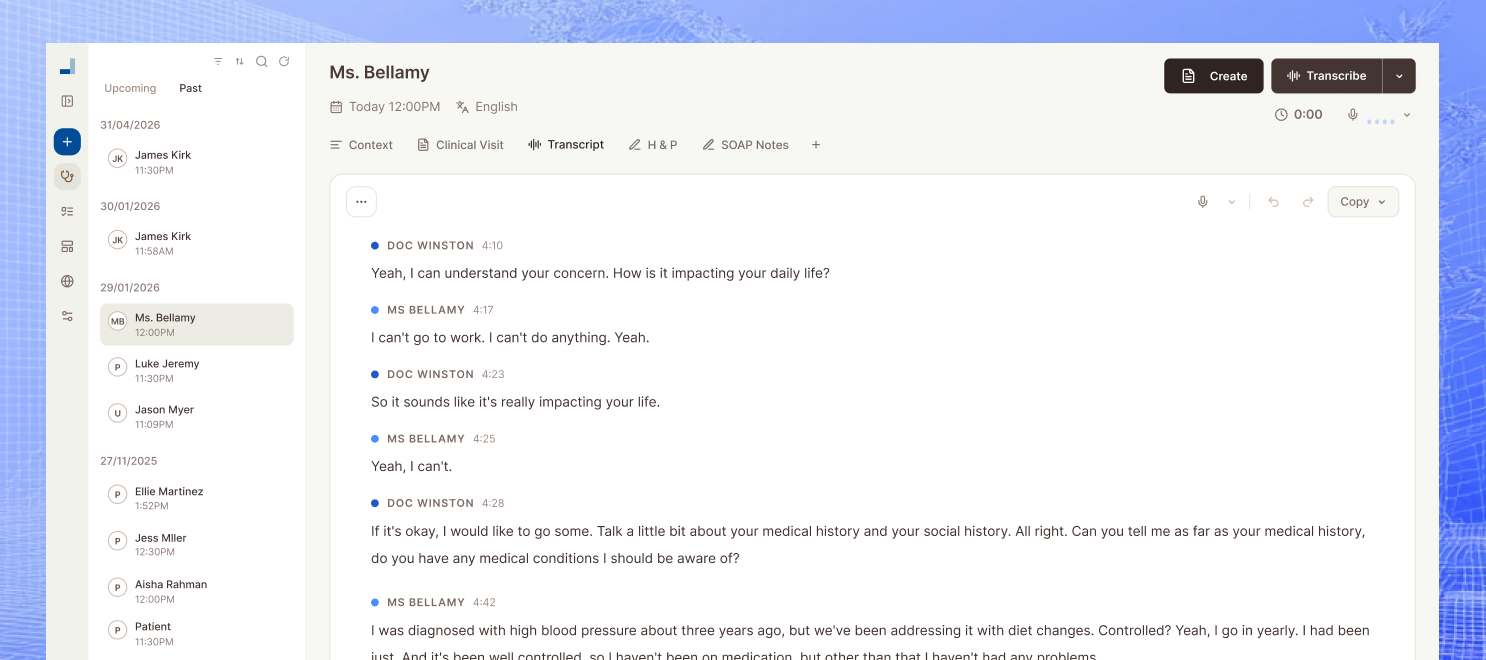
During the encounter, whether in-person or via telehealth, simply activate the capture process to record the dialogue. After the patient leaves, the system processes the audio into a structured draft within seconds. Review and edit these outputs immediately while the details are fresh. This habit transforms documentation from a looming task into a quick task-completion exercise. Finally, leverage the captured data to instantly generate secondary documents like referral letters or school excuses, maximizing the value of a single recording.
- Identify a pilot visit type to minimize initial friction and build confidence.
- Customize clinical templates to match specific specialty requirements and workflows.
- Review drafts immediately following the encounter to maintain maximum accuracy.
- Repurpose generated data for administrative tasks like forms and letters.
How to keep note quality high and reduce mistakes
Even with advanced technology, human oversight is the cornerstone of safe practice. Common failure points in documentation include incorrect medication dosages, transposed values, or the inclusion of irrelevant information—often called ‘note bloat.’ To combat this, clinicians should adopt a lightweight review habit, checking for key subjective and objective data points before finalizing the note.
Establishing team-wide standards for what constitutes a ‘good note’ helps maintain consistency across the clinic. Ensure that problem lists are updated and that the plan is clearly articulated for the next provider in the care chain. High-quality documentation is not just about length; it is about providing clear, actionable insights that facilitate better health outcomes.
- Always verify medication names, dosages, and numerical findings manually.
- Prune unnecessary filler to prevent note bloat and highlight critical findings.
- Ensure the clinical reasoning in the assessment and plan is logical and clear.
- Perform periodic peer reviews of charts to maintain institutional standards.
Privacy, consent, and patient trust (plain English)
Transparency is clinical documentation’s best friend. Patient consent is the foundation of using any recording or transcription technology. While specific regulations vary by region, the general principle is to inform the patient and obtain their verbal or written agreement. Most patients are receptive when they realize the technology allows their doctor to listen more intently rather than staring at a screen.
A simple way to explain this to a patient is: ‘I’m using an AI assistant today to record our conversation. This helps me focus entirely on you and ensures I don’t miss any details in your chart. Is that okay with you?’ This approach frames the technology as a benefit to the patient. Security-wise, ensure that your chosen platform adheres to strict data retention and encryption standards to protect sensitive health information.
- Always obtain informed consent before starting a recorded session.
- Frame the technology as a tool to improve the quality of the doctor-patient interaction.
- Follow local and regional data protection laws regarding medical recordings.
- Communicate regularly with patients about how their data is stored and protected.
Rolling it out across a clinic without disruption
A successful rollout involves more than just software; it requires a cultural shift. Start with a two-week pilot involving a small group of ‘super-users’ who can troubleshoot and provide feedback. Use this time to align templates across the team so that everyone is speaking the same clinical language. This phased approach prevents the technical friction that often kills new initiatives.
Track metrics to measure success, such as the number of hours saved per week or the reduction in charting completed after 6:00 PM. Sharing these ‘wins’ with the broader clinic staff helps build momentum. Training sessions should focus on practical application—how to handle the device, how to prompt the AI, and how to effectively edit the output—ensure every clinician feels empowered and supported through the transition.
- Launch with a small pilot team to identify and solve workflow bottlenecks.
- Track time-save metrics and note completion speeds as key KPIs.
- Standardize template libraries to ensure uniform documentation across the clinic.
- Provide hands-on training tailored to different technical ability levels.
Mcoy AI is an AI medical scribe that records and transcribes patient encounters, then generates multiple clinical note types (H&P, progress notes, consult notes, follow-up notes, procedure notes, discharge summaries, referral letters, and more). With over 200+ customizable templates and an interactive AI chat, clinicians can quickly create letters, forms, and complex documents from their talk with patients, ensuring every detail is captured without the manual typing burden.
Conclusion
Transforming your clinic’s documentation workflow is one of the most impactful changes you can make for provider well-being and patient care quality. By moving beyond the limitations of manual typing and generic SOAP notes, you create a more responsive and accurate clinical environment. Implementing an AI medical scribe as a core part of your systems will eventually turn a stress-inducing task into a seamless part of your day. Start your journey today by piloting a new workflow and experience the freedom of focused, human-centered medicine.
What a serious review table should cover
| Decision area | Common mistake | Better clinic-ready approach | Metric to watch |
|---|---|---|---|
| Workflow design | Treat build an ai documentation workflow for clinics | mcoy health as a one-off documentation task | Build a repeatable process with clear ownership and review points |
| Team adoption | Assume every clinician will naturally use the same process | Train for consistency and define exception handling early | Active user adoption |
| Quality review | Only check notes when a problem is reported | Audit a sample of notes weekly and review edge cases | Edit rate per note |
| Operational follow-through | Leave admin actions outside the documentation workflow | Use the same encounter data for referrals, letters, and follow-up tasks | Completion rate for next-step tasks |
Related reading
If you are working through build an ai documentation workflow for clinics | mcoy health, it helps to read this alongside Specialty Guides: How to Run a More Efficient Medical Practice in 2026, Specialty Guides: How to Improve Patient Encounters, and AI & Medicine: How to Turn Transcripts Into SOAP Notes With Mcoy AI. Those guides cover adjacent workflow, implementation, and evaluation questions so the decision does not sit in isolation.
FAQ
How accurate are AI medical scribes in real clinics?
AI medical scribes are remarkably accurate at capturing the narrative and technical details of a clinical encounter. They utilize advanced natural language processing to distinguish between medical terminology and conversational small talk. However, they are assistive tools, meaning they require a clinician’s final review to ensure that all clinical facts and interpretations are 100% correct before being entered into the official record.
Do I still need to review every note?
Yes, reviewing every note is a professional and legal requirement for clinicians. The AI serves to generate the draft and organize the information, but the licensed provider must verify the accuracy of the assessment, the plan, and any recorded values. This review process usually takes only a minute or two, which is significantly faster than writing a note from scratch.
What note types can an AI scribe generate besides SOAP?
Modern AI scribes are capable of generating a wide variety of documentation beyond standard SOAP notes. This includes comprehensive History and Physical (H&P) notes, detailed consult letters, procedure notes, discharge summaries, and even referral letters. Most systems allow you to choose from hundreds of templates to fit the specific needs of your specialty or appointment type.
Will this work for telehealth and in-person consults?
Yes, the technology is designed to work across both settings. For in-person visits, the device (like a smartphone or tablet) captures the room’s audio. For telehealth, the system can capture the audio stream from the virtual meeting. The result is consistent, high-quality documentation regardless of how the patient is being seen.
How do I explain recording/transcription to patients?
The best approach is complete transparency. Clinicians often tell patients that they are using a digital scribe to help them stay focused on the conversation instead of the computer screen. Most patients respond positively when they realize they have their doctor’s full attention. Always ask for verbal consent and follow your clinic’s written consent policy.
How do clinics prevent note bloat?
Note bloat is prevented by using smart templates and concise AI prompting. By setting specific guidelines for what the AI should include, you can ensure that the generated notes are pithy and relevant. Clinicians should also make it a habit to delete any redundant information during their brief review phase to keep the record clean and useful.
How long does template setup take?
Initial template setup is usually very quick. Most providers can start with pre-built industry-standard templates and then make minor adjustments as they go. Fine-tuning a template to perfectly match your personal writing style or specialty requirements often takes only a few minutes per template using built-in customization tools.
What’s the safest way to start if I’m skeptical?
The safest and most effective way to start is with a ‘shadow’ pilot. Use the AI scribe for 3–5 non-complex cases per day for one week without immediately replacing your existing system. This allows you to compare the AI-generated note against your manual note in a low-pressure environment so you can build trust in the tool’s capabilities.