AI & Medicine: How to Turn Transcripts Into SOAP Notes With Mcoy AI
Learn how to efficiently turn transcripts into SOAP notes using Mcoy AI. Streamline your clinic workflow and eliminate manual charting today.
The Heavy Burden of Manual Documentation
For many clinicians, the end of the patient day doesn’t mark the end of work. Instead, it signals the beginning of ‘Pajama Time’—hours spent hunched over a keyboard trying to turn transcripts into SOAP notes. This administrative burden is a leading cause of burnout among GPs and specialists alike. Whether it is the anxiety over potential medico-legal gaps or the sheer exhaustion of rushed notes, the traditional charting process is breaking the modern healthcare workflow.
This comprehensive guide will teach you how to master the transition from raw patient dialogue to structured clinical documentation. We will explore more than just the standard SOAP format, diving into diverse note types, quality control strategies, and privacy protocols. Whether you manage a private practice or a fast-paced university clinic, this guide provides a clear roadmap to reclaiming your time while improving the accuracy of your medical records.
What a medical scribe solves in modern practice
The real cost of documentation isn’t just time; it is the cognitive load it places on the provider. When you are focused on typing, you aren’t fully focused on the patient. This distraction often leads to delayed notes and missed clinical details that can impact the quality of care. Manual entry is inherently prone to ‘note bloat,’ where irrelevant information is copied forward, masking the actual clinical narrative.
An AI medical scribe acts as an assistive layer, capturing the nuances of the encounter in real-time. It is important to understand that these tools are not autonomous practitioners; the clinician remains the final authority and must review all outputs. By handling the heavy lifting of organization and transcription, the scribe allows doctors to maintain eye contact and build rapport with their patients.
- Reduces administrative ‘after-hours’ work significantly.
- Enhouses patient engagement by removing the screen barrier.
- Provides a reliable safety net for capturing specific patient quotes.
- Maintains consistency in formatting across the entire clinic.
Note types you can generate beyond SOAP (H&P and more)
While the SOAP format is a staple of outpatient care, modern medicine requires a wider variety of documentation styles. History and Physicals (H&P) are essential for new admissions, requiring a more comprehensive deep dive into the patient’s background. Similarly, procedure notes and discharge summaries require specific structural elements that a standard progress note might lack.
Context is everything in clinical documentation. A referral letter needs to highlight different data points than a follow-up note for a chronic condition. By utilizing diverse templates, clinicians ensure that the most relevant metrics are front and center. This specialization is vital for audit readiness and seamless handovers between departments or outside facilities.
Using the right structure for the right encounter ensures that your charts remain readable and useful. When a consultant receives a well-structured consult note, the continuity of care is drastically improved. Moving beyond a ‘one-size-fits-all’ approach to charting is the first step in creating a high-performance clinical environment.
- H&P and Consult notes for complex new-patient assessments.
- Specialized Procedure notes for billing and compliance accuracy.
- Follow-up notes focusing on interval changes and medication titration.
- Referral letters and discharge summaries for clear care transitions.
How to implement turn transcripts into SOAP notes step-by-step in a real clinic
Starting with a new digital workflow can feel daunting, so the best approach is to begin with one specific visit type. Choose your most common encounter, such as a routine follow-up, to get a feel for how the transcription captures your natural speaking style. This allows you to calibrate the system without the pressure of a highly complex case. Once you are comfortable, you can begin setting up custom templates tailored to your specialty, whether that is cardiology, pediatrics, or general practice.
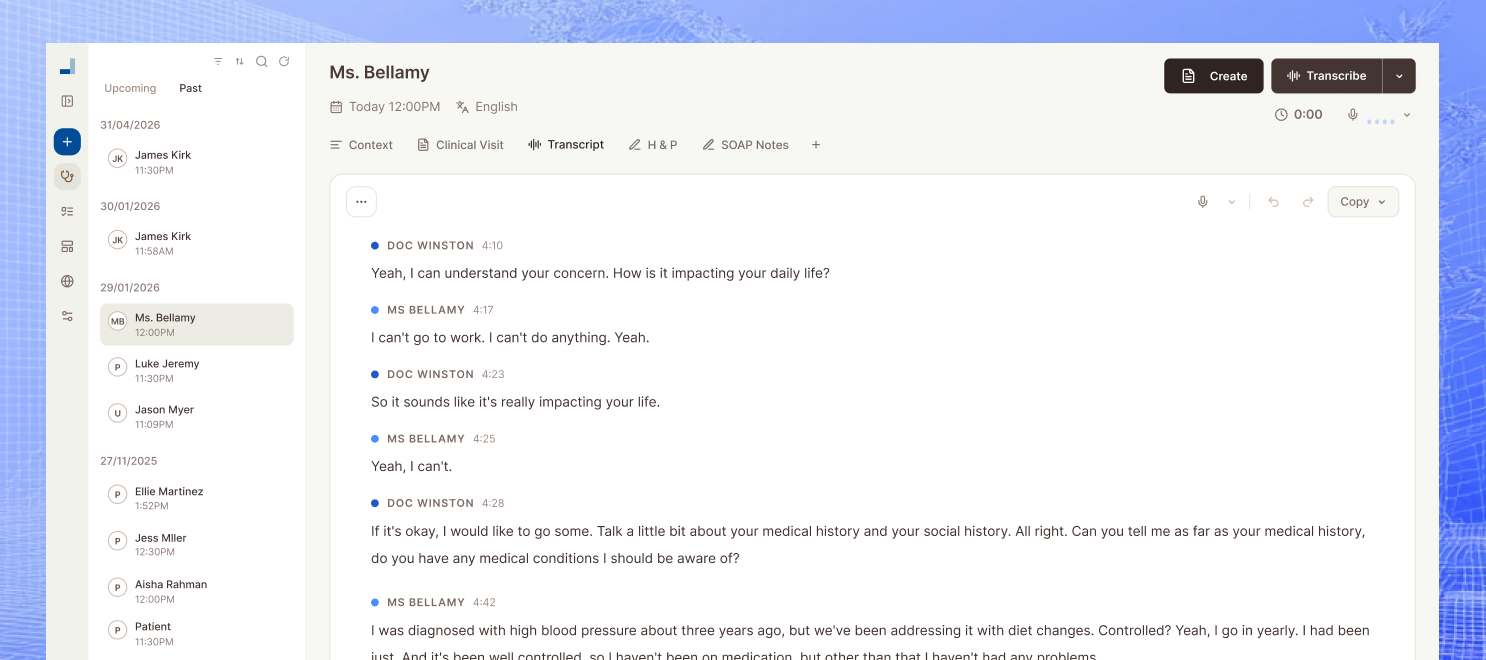
During the encounter, whether it is in-person or via telehealth, simply let the conversation flow naturally. There is no need to change how you speak to the patient; the goal is to capture the authentic clinical interaction. After the visit concludes, the system processes the audio into a structured draft within seconds. You should then perform a quick review and edit to ensure medical accuracy and personal preference in the narrative.
The final step is to leverage the structured data for multiple purposes. A single transcript can be used to generate a SOAP note for the EMR, a patient summary for the portal, and a referral letter for a specialist. This ‘capture once, use many’ philosophy is the key to massive time savings. Consistency becomes easy when the primary source of truth—the actual conversation—is the foundation for all documents.
- Select a pilot visit type to build workflow confidence.
- Use specialty-specific templates for precise data organization.
- Capture natural dialogue without robotic dictation commands.
- Review, refine, and reuse data for letters and forms.
How to keep note quality high and reduce mistakes
Accuracy in medical documentation is non-negotiable. Typical failure points in automated systems include missing medication dosages or incorrectly attributing values to the wrong problem list. To mitigate this, clinicians should adopt a lightweight review habit. Reviewing the generated note immediately after the encounter while the details are fresh is the most effective way to ensure 100% accuracy.
Setting team standards for note review also helps maintain a high bar across the clinic. Discussing common preferences for how certain phrases are documented ensures that the outputs remain professional and clinically sound. Remember, the AI is a powerful assistant, but the clinician’s signature is the ultimate verification of the note’s truthfulness.
- Verify all medication names, dosages, and frequencies manually.
- Cross-check lab values and physical exam findings for accuracy.
- Standardize clinical terminology across the practice team.
- Perform immediate post-encounter reviews for the best recall.
Privacy, consent, and patient trust (plain English)
Patient privacy is the cornerstone of the therapeutic relationship. When introducing transcription technology, it is essential to follow local regulations and your specific clinic policies regarding consent. While laws vary by region, transparency is always the best policy. Patients generally appreciate knowing that their doctor is using a tool to focus more on them and less on the computer.
You might explain it to a patient by saying: ‘I am using a digital assistant today to help me capture our conversation so I can focus entirely on you rather than typing on my screen. Is that okay with you?’ Most patients are very supportive when they realize the technology facilitates better eye contact and a more personal connection during their visit.
- Always obtain verbal or written consent based on local requirements.
- Explain the benefits of the technology to the patient clearly.
- Ensure the system adheres to modern security and data retention standards.
- Maintain a clear record of consent within the patient’s file.
Rolling it out across a clinic without disruption
A successful rollout starts with a two-week pilot program involving a small group of ‘champion’ providers. This allows the clinic to identify any workflow bottlenecks before a full-scale launch. During this time, the team should track metrics such as time saved per note and the reduction in after-hours charting to quantify the impact of the new tool.
Training should focus on template alignment and the specific mechanics of starting and stopping recordings. By the end of the pilot, you will have a clear set of best practices to share with the rest of the staff. This phased approach minimizes disruption and ensures that everyone feels supported as they transition to a more efficient way of working.
- Start with a 14-day small-scale pilot to gather feedback.
- Track time-savings metrics to demonstrate ROI to leadership.
- Align templates across the clinic for unified documentation.
- Provide brief, hands-on training sessions for all staff members.
Mcoy AI is an AI medical scribe that records and transcribes patient encounters, then generates multiple clinical note types (H&P, progress notes, consult notes, follow-up notes, procedure notes, discharge summaries, referral letters, and more). With access to over 200+ customizable templates and an AI chat feature to create secondary letters, forms, and documents, it allows clinicians to focus on care rather than paperwork.
Conclusion
Transforming clinical workflows doesn’t happen overnight, but the move toward automated documentation is a vital step in modern medicine. By following the steps in this guide, you can successfully turn transcripts into SOAP notes and other vital documents with minimal friction. This shift not only rescues your personal time but also improves the overall quality and consistency of patient records. If you’re ready to leave the ‘Pajama Time’ charting behind, starting a pilot with a tool designed to turn transcripts into SOAP notes is the best clinical decision you’ll make this year.
What a serious review table should cover
| Decision area | Common mistake | Better clinic-ready approach | Metric to watch |
|---|---|---|---|
| Workflow design | Treat how to turn transcripts into soap notes with mcoy ai as a one-off documentation task | Build a repeatable process with clear ownership and review points | Time to complete documentation |
| Team adoption | Assume every clinician will naturally use the same process | Train for consistency and define exception handling early | Active user adoption |
| Quality review | Only check notes when a problem is reported | Audit a sample of notes weekly and review edge cases | Edit rate per note |
| Operational follow-through | Leave admin actions outside the documentation workflow | Use the same encounter data for referrals, letters, and follow-up tasks | Completion rate for next-step tasks |
Related reading
If you are working through how to turn transcripts into soap notes with mcoy ai, it helps to read this alongside AI & Medicine: How to Simplify Clinical Notes for Busy Doctors, AI & Medicine: How Doctors Can Improve SOAP Notes, and Specialty Guides: How to Use an AI Medical Scribe: 5-Step Documentation Guide. Those guides cover adjacent workflow, implementation, and evaluation questions so the decision does not sit in isolation.
FAQ
How accurate are AI medical scribes in real clinics?
In most clinical settings, AI medical scribes are exceptionally accurate at capturing the core narrative and medical facts of an encounter. They excel at transcribing dialogue and categorizing it into the correct sections of a SOAP note. However, because medical terminology can be complex, the clinician must always perform a final review to ensure every nuance is correct. Consistency improves over time as the system learns your specific speaking patterns and common diagnoses.
Do I still need to review every note?
Yes, reviewing every note is a fundamental requirement for both clinical accuracy and legal compliance. While the AI does the heavy lifting of drafting the note, the clinician is the one responsible for the medical decisions and the final record. Most providers find that reviewing a pre-drafted note takes only a fraction of the time it would take to type it from scratch. This review ensures that any minor misinterpretations are corrected before the note is finalized in the EMR.
What note types can an AI scribe generate besides SOAP?
Modern AI scribes are capable of generating a wide array of clinical documents beyond the standard SOAP format. This includes comprehensive History and Physicals (H&P), detailed procedure notes, consult letters for specialists, and even discharge summaries. Because the AI captures the entire conversation, it can re-format that information into whatever template is most appropriate for the specific patient encounter. This versatility is one of the biggest advantages over traditional dictation.
Will this work for telehealth and in-person consults?
Yes, the technology is designed to work seamlessly in both environments. For in-person consults, a mobile device or tablet can record the interaction directly. For telehealth, the audio from the video call can be captured and processed in the same manner. The AI is capable of distinguishing between the provider and the patient voices in most settings, ensuring the note reflects who said what regardless of the medium of care.
How do I explain recording/transcription to patients?
The best approach is to be brief and transparent, focusing on how it helps the patient. You might say, ‘I’m using a secure digital tool to help me document our visit so I can spend more time talking with you and less time typing.’ Most patients are very understanding and even appreciative that you are prioritizing eye contact and engagement over a computer screen. Always follow your clinic’s specific protocol for documenting patient consent.
How do clinics prevent note bloat?
Note bloat is prevented by using templates that prioritize relevance over volume. Unlike ‘copy and paste’ methods in EMRs, an AI scribe generates a fresh note based on the actual conversation from that specific day. Clinicians can further reduce bloat by selecting concise templates and performing a quick edit to remove any superfluous information. This ensures that the most important clinical data remains visible and accessible to anyone reading the chart.
How long does template setup take?
Setting up your initial templates can take as little as 10 to 15 minutes. Most systems come with a wide library of pre-built templates for various specialties that you can use immediately. If you want to customize them to match your specific style or EMR requirements, the process is usually a simple ‘drag and drop’ or a text-based edit. Once your templates are set, they can be used across all your encounters without further adjustment.
What’s the safest way to start if I’m skeptical?
The safest way to start is with a limited pilot program. Choose five to ten routine patients whom you have a long-standing relationship with and use the scribe for those visits only. This low-pressure environment allows you to see the quality of the outputs and understand the workflow without feeling overwhelmed. Once you see the time savings and the accuracy of the notes, you can gradually expand the tool’s use to more complex cases and more patients.