Specialty Guides: Create a Documentation SOP for Your Clinic | Mcoy Health
Learn how to build a robust documentation SOP to reduce burnout and improve note quality. Master clinical workflows for modern healthcare practices.
The Hidden Burden of Clinical Administrative Work
Every clinician knows the feeling of finishing a long day of patient care only to face a mountain of unfinished charts. This after-hours charting is one of the leading drivers of physician burnout, creating a cycle of rushed notes and medico-legal anxiety. When documentation lacks a clear standard operating procedure (SOP), the quality of patient records becomes inconsistent, increasing the risk of missed details and audit failures.
This guide provides a comprehensive framework for establishing a documentation SOP that works. Whether you are running a private practice, a busy GP clinic, or a large university healthcare center, having a clear roadmap ensures every note is accurate, timely, and compliant. We will cover workflow optimization, diverse note formats beyond the standard SOAP note, quality control measures, and a practical rollout plan for your team.
What a medical scribe solves in modern practice
The real cost of documentation isn’t just time; it is the cognitive load it places on the provider. When a doctor is focused on typing during a consultation, the patient-provider connection suffers. Traditional documentation methods often lead to delayed notes, which can compromise the accuracy of the record as details fade from memory. Implementing a medical scribe solution addresses these pain points by shifting the burden of transcription away from the clinician.
It is important to understand that an AI medical scribe is an assistive tool, not a replacement for medical judgment. While the scribe handles the heavy lifting of capturing the dialogue and organizing it into a clinical structure, the clinician remains the final authority. The physician must still review, edit, and sign off on every document to ensure medical accuracy and clinical relevance.
- Reduces the cognitive burden on clinicians during patient encounters.
- Eliminates the need for late-night charting and administrative overtime.
- Improves the depth and accuracy of captured patient data.
- Ensures clinicians remain the primary gatekeepers of medical records.
Note types you can generate beyond SOAP (H&P and more)
While the SOAP note is the industry standard for daily progress, modern clinical practice requires a much broader range of documentation. Comprehensive care involves capturing initial History and Physicals (H&P), detailed consult notes for specialist referrals, and intricate procedure notes. Each of these formats serves a specific purpose in the continuity of care and ensures that the next provider in the chain has a clear understanding of the patient’s status.
Structure matters significantly for audit readiness and clinical handovers. For example, a discharge summary requires a different focus than a follow-up note; the former needs to summarize a whole episode of care, while the latter focuses on interval changes. Moving beyond a ‘one-size-fits-all’ approach to documentation allows clinics to capture the specific nuances of different encounter types across various specialties.
Standardizing these formats within your documentation SOP creates a predictable environment for both the medical and billing teams. It reduces the back-and-forth between clinicians and coders, as the necessary information is always in the expected place. This level of organization is essential for maintaining high standards in university clinics and specialized private practices.
- H&P and Progress Notes: Essential for tracking the primary clinical narrative.
- Consultation and Referral Letters: Vital for professional communication and handovers.
- Procedure and Discharge Summaries: Crucial for legal compliance and patient safety.
- Customized Templates: Ensure consistency across different medical specialties.
How to implement documentation SOP step-by-step in a real clinic
To begin implementing a documentation SOP, start by focusing on a single visit type, such as routine follow-ups. This allows the team to master the workflow in a controlled environment before scaling to more complex encounters. Analyze the current path of a patient through the clinic and identify exactly where documentation fits into that timeline.
Next, set up specific templates tailored to your specialty. A cardiologist will need a different data structure than a psychiatrist or a pediatrician. Having these templates ready within your digital workflow ensures that the captured information aligns with clinical expectations from the very first day. Prepare these templates to handle both in-person and telehealth consultations.
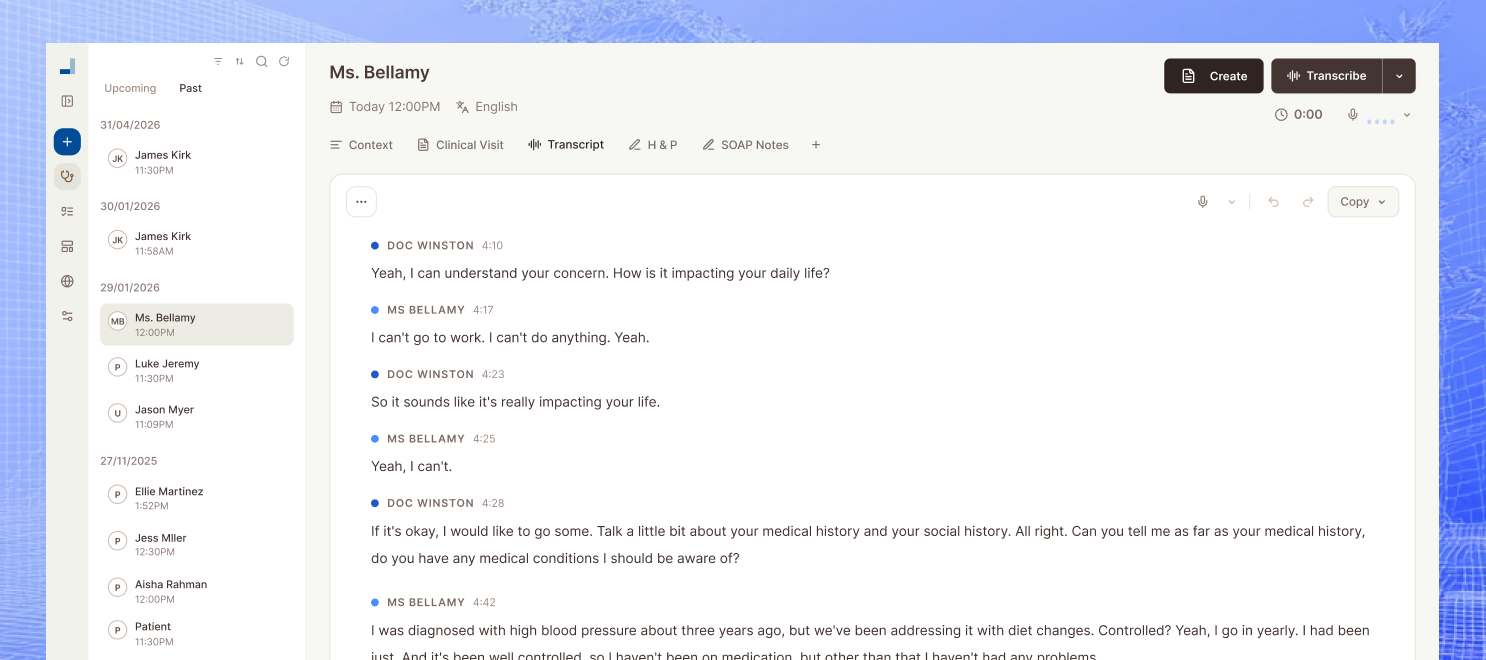
During the encounter, focus entirely on the patient while the scribe captures the dialogue. Whether it is an in-person physical or a remote video call, the goal is to have the encounter recorded and transcribed in real-time. This eliminates the ‘memory gap’ that occurs when clinicians wait until the end of the day to write their notes.
Once the encounter is over, the review and edit process should take only a minute or two. The clinician reviews the generated output, makes necessary adjustments, and finalizes the document. These outputs can then be immediately repurposed for referral letters or patient instruction forms, significantly reducing the time spent on secondary administrative tasks.
- Phase implementation by starting with one specific encounter type.
- Develop specialty-specific templates to ensure data relevance.
- Capture encounters in real-time to avoid information loss.
- Establish a rapid review habit to finalize notes immediately after the visit.
How to keep note quality high and reduce mistakes
Consistent quality is the cornerstone of any documentation SOP. Common failure points often include the omission of current medications, incorrect laboratory values, or the phenomenon of ‘note bloat.’ Note bloat happens when irrelevant information is carried over from previous visits, making the current note difficult to navigate. A strong SOP includes guidelines on what to include and what to exclude.
Developing a lightweight review habit is the most effective way to prevent errors. Clinicians should spend sixty seconds scanning the generated note for accuracy in the problem list and medication dosages. Setting team-wide standards for what constitutes a ‘high-quality note’ ensures that everyone in the clinic is operating on the same level of excellence.
- Prevent note bloat by focusing on interval changes and relevant data.
- Implement a ‘double-check’ protocol for medications and dosages.
- Set clear clinic-wide standards for documentation completeness.
- Regularly audit a small sample of notes for quality assurance.
Privacy, consent, and patient trust (plain English)
Patient trust is built on transparency. While consent requirements vary by region, the best practice is always to inform the patient when a recording or transcription tool is being used. This should be explained in a way that emphasizes the benefit to the patient: better eye contact, more focused care, and more accurate records.
Clinicians can use a simple script: ‘To ensure I can focus entirely on you today, I use a digital assistant to help me with my notes. It records our conversation so I don’t have to type while we talk. Is that alright with you?’ Most patients appreciate the extra attention they receive when the doctor isn’t staring at a computer screen.
- Follow local and regional guidelines for patient consent and data privacy.
- Use a patient-centric script to explain documentation tools.
- Ensure all data storage and retention practices are secure and compliant.
Rolling it out across a clinic without disruption
A successful rollout requires a pilot phase rather than a sudden shift. Start with a two-week pilot involving a small group of ‘early adopter’ clinicians. During this period, track key metrics like time saved per day, the reduction in after-hours charting, and the speed of note completion. This data will be essential for gaining buy-in from the rest of the staff.
Training sessions should focus on template alignment and the technical aspects of capturing the encounter. By the end of the second week, the pilot team should be able to demonstrate a significant improvement in their work-life balance, sparking interest across the entire facility. This gradual approach minimizes disruption to patient care during the transition.
- Launch a 14-day pilot with a small group of clinicians.
- Measure time savings and improvements in note quality.
- Align templates across the team to ensure clinical consistency.
Streamline Documentation with Mcoy AI
Mcoy AI is an AI medical scribe that records and transcribes patient encounters, then generates multiple clinical note types (H&P, progress notes, consult notes, follow-up notes, procedure notes, discharge summaries, referral letters, and more). With access to over 200+ customizable templates and an AI chat feature to create custom letters, forms, and administrative documents, it helps clinicians reclaim their time and focus on patient care. Whether you are managing a private practice or a large university clinic, Mcoy AI integrates into your existing workflow to eliminate the burden of manual charting.
Conclusion
Building a documentation SOP is the most effective way to protect your clinic from burnout and administrative errors. By standardizing your workflow, utilizing modern scribe technology, and maintaining high quality-control standards, you can transform your practice into a more efficient and patient-focused environment. Transitioning to a structured documentation SOP today will pay dividends in time saved and improved care for years to come. Start your pilot program this month and experience the difference in clinical documentation.
What a serious review table should cover
| Decision area | Common mistake | Better clinic-ready approach | Metric to watch |
|---|---|---|---|
| Workflow design | Treat create a documentation sop for your clinic | mcoy health as a one-off documentation task | Build a repeatable process with clear ownership and review points |
| Team adoption | Assume every clinician will naturally use the same process | Train for consistency and define exception handling early | Active user adoption |
| Quality review | Only check notes when a problem is reported | Audit a sample of notes weekly and review edge cases | Edit rate per note |
| Operational follow-through | Leave admin actions outside the documentation workflow | Use the same encounter data for referrals, letters, and follow-up tasks | Completion rate for next-step tasks |
Related reading
If you are working through create a documentation sop for your clinic | mcoy health, it helps to read this alongside Specialty Guides: How to Run a More Efficient Medical Practice in 2026, Specialty Guides: How to Improve Patient Encounters, and Compare & Choose: Best Tools Doctors Use to Save Time on Clinical Notes. Those guides cover adjacent workflow, implementation, and evaluation questions so the decision does not sit in isolation.
FAQ
How accurate are AI medical scribes in real clinics?
AI medical scribes are highly accurate in capturing the clinical narrative and medical terminology used during an encounter. However, they rely on the quality of the audio and the clarity of the conversation between the provider and the patient. While they significantly reduce documentation time, they are intended to be assistive, meaning the clinician remains responsible for the final medical accuracy. Periodic reviews confirm that these systems maintain a very high level of reliability for standard clinical documentation.
Do I still need to review every note?
Yes, reviewing every note is a fundamental requirement for both clinical safety and legal compliance. While the technology handles the transcription and formatting, the clinician must ensure that the clinical reasoning, diagnoses, and treatment plans are accurately represented. A brief review, usually taking less than two minutes, is sufficient to finalize a high-quality note. This step ensures that the physician maintains full control over the medical record.
What note types can an AI scribe generate besides SOAP?
Modern AI scribes are capable of generating a wide variety of clinical documents beyond the standard SOAP note. This includes detailed History and Physicals (H&P), specialist consultation notes, procedure summaries, and discharge transitions. Additionally, they can create referral letters and follow-up summaries based on the encounter data. This versatility ensures that every aspect of the patient’s journey is documented in the appropriate format.
Will this work for telehealth and in-person consults?
Yes, AI medical scribes are designed to be flexible and work across various consultation environments. For in-person visits, a mobile device or tablet is used to capture the audio, while for telehealth, the system can integrate with virtual meeting platforms or record the audio from the computer. In both scenarios, the result is a structured clinical note that follows your chosen template. This makes it an ideal solution for hybrid practices.
How do I explain recording/transcription to patients?
The best approach is to be brief and transparent, focusing on the benefits to the patient experience. Inform the patient that instead of typing on a computer, you use a tool to record the conversation so you can focus entirely on them. Most patients react positively because they value the eye contact and undivided attention. Providing a simple verbal notice and, if required, a written consent form is standard practice.
How do clinics prevent note bloat?
Note bloat is prevented by setting specific parameters within the templates used by the scribe. By instructing the system to focus on ‘interval changes’ and the ‘current assessment’ rather than pulling in all past medical history, the notes remain concise and readable. Training clinicians to verbalize key findings clearly during the visit also helps the AI filter out irrelevant conversation and focus on clinical data. Regular template audits further ensure notes stay focused.
How long does template setup take?
Basic template setup can often be done in just a few minutes by selecting from pre-built medical specialty libraries. Customizing those templates to fit a specific clinic’s unique workflow might take an hour or two of adjustment. Once the templates are established, they can be shared across the entire team instantly. The goal is to create a ‘set it and forget it’ system that supports the clinic long-term.
What’s the safest way to start if I’m skeptical?
The safest way to start is by running a small-scale pilot with just one or two clinicians and a single type of patient visit. This allowed the team to see the time-saving benefits firsthand without disrupting the entire clinic’s operations. Starting with lower-complexity follow-up visits allows you to gain confidence in the technology’s accuracy before expanding to comprehensive new-patient assessments. This gradual approach allows for adjustments based on actual performance data.