Specialty Guides: Document WorkCover Visits with AI Scribes: Full Guide
Learn how to use an AI medical scribe for WorkCover documentation. Streamline clinical notes, H&Ps, and specialist reports while reducing administrative burnout.
The Documentation Burden of Workers’ Compensation
Clinicians managing WorkCover or workers’ compensation cases often face a unique brand of administrative exhaustion. Between detailing the mechanism of injury, assessing functional capacity, and justifying treatment plans, the after-hours charting piles up quickly. For many private practitioners and clinic owners, these visits feel twice as long because the paperwork is twice as complex. A rushed note doesn’t just lead to burnout; it creates medico-legal anxiety and potential delays in patient benefits.
This guide provides a comprehensive roadmap for integrating an AI medical scribe into your WorkCover workflow. We will explore how to move beyond basic SOAP notes to generate high-quality H&Ps, progress notes, and complex referral letters. Whether you are a GP in a busy metro practice, a specialist, or managing a university clinic, these strategies will help you regain control of your schedule while ensuring absolute documentation accuracy and compliance.
What a medical scribe solves in modern practice
The real cost of clinical documentation isn’t just measured in minutes; it is measured in cognitive load. Every moment a doctor spends typing is a moment they aren’t looking at the patient or thinking critically about the diagnosis. In WorkCover cases, missed details regarding the date of injury or specific workplace triggers can lead to claim rejections. An AI medical scribe captures the nuances of the conversation, ensuring that the patient’s narrative is preserved without the doctor needing to be a stenographer.
It is important to understand that an AI medical scribe is an assistive tool, not a replacement for clinical judgment. The AI listens to the ambient conversation and drafts a structured note, but the clinician remains the final authority. By automating the heavy lifting of data entry, practitioners can focus on the physical examination and the patient’s recovery trajectory, knowing the bulk of the administrative work is being handled in real-time.
- Reduces the ‘pajama time’ spent on finishing charts after hours.
- Captures specific mechanisms of injury often missed in hurried manual notes.
- Standardizes documentation across multi-provider university clinics.
- Ensures all required legal elements for compensation claims are present.
Note types you can generate beyond SOAP (H&P and more)
While the SOAP format is a staple in general medicine, WorkCover visits often require a more robust set of documents. An AI scribe can easily transition between different formats depending on the stage of the claim. For initial assessments, a comprehensive History and Physical (H&P) is essential to establish a baseline. This document needs to be exhaustive, covering pre-existing conditions and the exact moment the injury occurred to satisfy insurance requirements.
As the case progresses, the documentation needs change. You may need detailed procedure notes for injections or surgeries, or follow-up notes that specifically track functional improvements rather than just symptom management. For complex cases, a consult note or a formal referral letter to a physiotherapist or surgeon becomes necessary. Using an AI tool allows you to generate these varied outputs from a single recorded encounter, ensuring that the same set of facts is shared across all documents.
The structure of these notes is vital for audit readiness and continuity of care. When an insurance auditor or a legal representative reviews a file, they look for consistency. AI-generated notes provide a chronological and logically structured history that is far more reliable than fragmented manual entries. This level of detail protects the practitioner and ensures the patient receives the support they are entitled to without unnecessary delays.
- H&P and initial assessment notes to establish claim validity.
- Detailed procedure notes and progress tracking for ongoing care.
- Professional referral letters and discharge summaries for multi-disciplinary teams.
- Enhanced audit trails and medico-legal protection through detailed narratives.
How to implement an AI medical scribe step-by-step in a real clinic
To begin implementing an AI medical scribe for your WorkCover visits, start by selecting one specific visit type to pilot, such as initial consultations. This allows your team to get comfortable with the recording process without feeling overwhelmed. Before the patient enters, ensure your software is set to the correct template—specialty-specific templates for orthopedics or occupational medicine work best here. This ensures the AI looks for key phrases relevant to workers’ compensation, like ‘return to work’ or ‘modified duties’.
During the encounter, whether it is in-person or via telehealth, simply let the AI capture the dialogue. You don’t need to change how you speak; in fact, being descriptive while talking to the patient helps the AI gather more context. For example, saying “Your grip strength is at 50% compared to the unaffected side” provides the AI with a concrete data point for the physical exam section. Once the consult is finished, the AI will present a draft within seconds.
Review the draft immediately while the conversation is fresh in your mind. Modern AI tools are remarkably accurate, but a quick check ensures that any specific legal phrasing required by your local WorkCover authority is emphasized. After the note is finalized, you can reuse the captured data to instantly generate auxiliary documents like certificates of capacity or referral letters. This streamlined flow turns a 20-minute administrative task into a 2-minute review process.
- Start with one visit type to build confidence with the technology.
- Use specialty-specific templates to capture WorkCover-sensitive data.
- Speak naturally but descriptively to provide the AI with clear clinical context.
- Review drafts immediately to ensure perfect accuracy before saving to the EMR.
How to keep note quality high and reduce mistakes
Quality control in AI documentation is about managing ‘note bloat’ and ensuring accuracy in medication dosages or specific injury dates. One of the most common failure points in clinical notes is the omission of negative findings, which are crucial in WorkCover cases to rule out non-work-related issues. Practitioners should develop a lightweight review habit: skim the history, verify the physical exam findings, and double-check the plan. This ensures the AI hasn’t included irrelevant conversational filler.
Establishing team standards for documentation is also helpful, especially in clinics with multiple providers. Agree on a standard structure for how functional limitations should be described. When everyone uses a similar framework, the AI learns to produce more consistent results. Most mistakes are avoidable if the clinician spends sixty seconds reviewing the AI’s output against the actual encounter, focusing specifically on the problem list and medication changes.
- Focus reviews on injury dates, dosages, and functional capacity findings.
- Implement clinical standards for documenting ‘return to work’ plans.
- Avoid note bloat by using concise, specialty-focused templates.
- Cross-check the AI summary against the patient’s stated mechanism of injury.
Privacy, consent, and patient trust (plain English)
Patient privacy is paramount, particularly in workers’ compensation cases where third-party insurers are involved. Always follow your local regional policies regarding recording and data storage. Generally, patients are quite receptive to the use of AI scribes when they realize it means their doctor will be looking at them instead of a computer screen. Transparency is the key to maintaining the therapeutic relationship.
You can explain the process to the patient simply: “In this clinic, we use an AI assistant to help me record our conversation so I can focus entirely on your care. It transcribes our talk into a medical note, which I then review and approve. This ensures your record is 100% accurate for your claim.” Most patients appreciate the extra level of detail this provides for their case. Ensure your security and retention principles align with HIPAA or your local equivalent to keep data protected and encrypted.
- Always obtain verbal or written consent based on local regulatory requirements.
- Explain the benefit to the patient: better eye contact and more accurate records.
- Ensure all data is encrypted and handled according to healthcare-grade security standards.
- Maintain a clear policy on how long recordings are kept before deletion.
Rolling it out across a clinic without disruption
A successful rollout starts with a two-week pilot involving a single ‘champion’ doctor who is tech-savvy. This allows the clinic to iron out any workflow kinks—like where to place the tablet or phone for best audio capture—before a full deployment. During this phase, track metrics such as time saved per day and the speed of note completion. You’ll often find that the reduction in ‘after-hours’ work is the most significant indicator of success.
Once the pilot is complete, provide a brief training session for the rest of the staff. Align your templates across the clinic so that every WorkCover note looks professional and standardized, regardless of which doctor saw the patient. This consistency is highly valued by university clinics and large private groups because it makes the billing and auditing process much smoother. With a structured roll-out, the transition from typing to AI-assisted documentation can be seamless.
- Conduct a 2-week pilot with a lead clinician to refine the workflow.
- Measure time savings and the reduction in unfinalized notes.
- Standardize templates so clinical documentation is consistent across the team.
- Focus on the ergonomic benefits to staff to encourage rapid adoption.
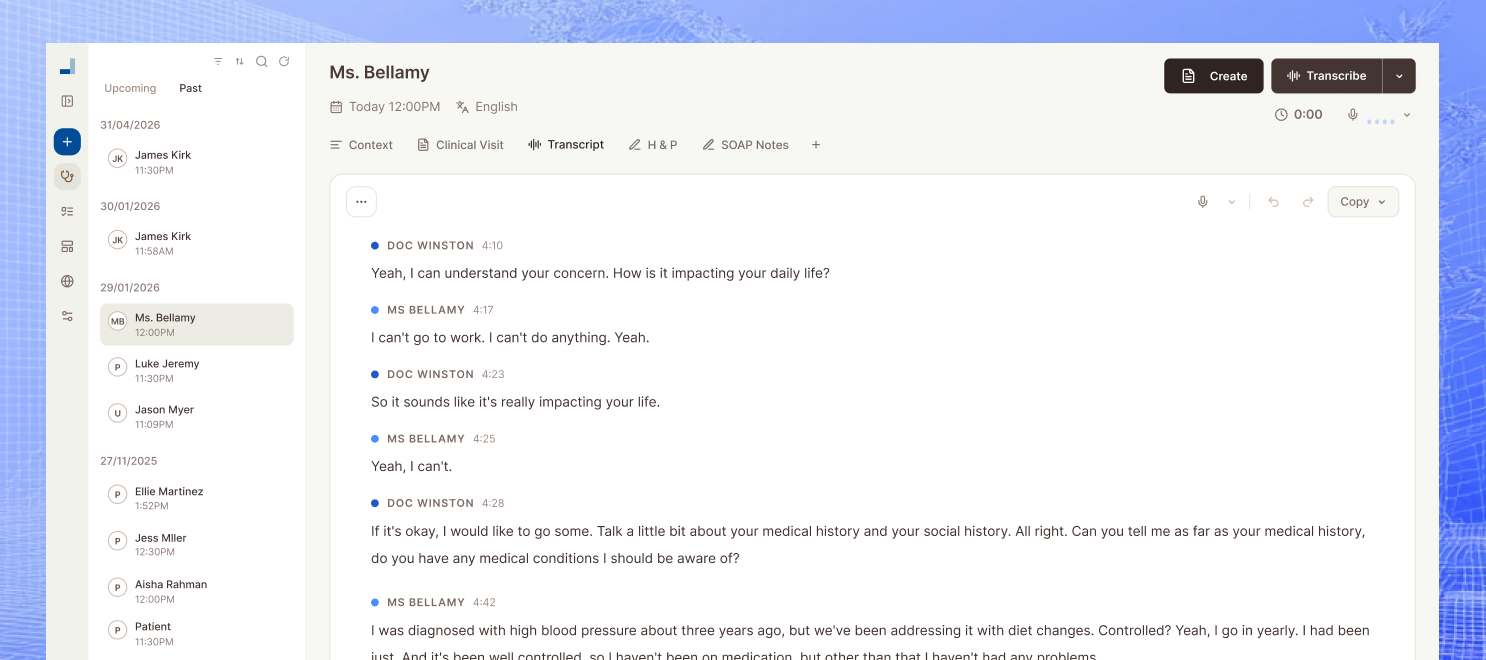
Mcoy AI is an AI medical scribe that records and transcribes patient encounters, then generates multiple clinical note types (H&P, progress notes, consult notes, follow-up notes, procedure notes, discharge summaries, referral letters, and more). With over 200 customizable templates and an integrated AI chat to create letters, forms, and documents, it helps clinicians focus more on patient care and less on the complexities of medical administration. This tool is designed to adapt to the specific needs of different specialties, ensuring that every note is as unique as the patient encounter itself.
Conclusion
Mastering WorkCover documentation doesn’t have to be a source of daily stress. By implementing an AI medical scribe, clinicians can ensure their clinical notes are comprehensive, accurate, and produced in a fraction of the time. This workflow not only improves the quality of patient care but also protects the practice from medico-legal risks. Start a pilot today and see how an AI medical scribe can transform your clinic’s administrative burden into a streamlined, automated process.
What a serious review table should cover
| Decision area | Common mistake | Better clinic-ready approach | Metric to watch |
|---|---|---|---|
| Workflow design | Treat document workcover visits with ai scribes: full guide as a one-off documentation task | Build a repeatable process with clear ownership and review points | Time to complete documentation |
| Team adoption | Assume every clinician will naturally use the same process | Train for consistency and define exception handling early | Active user adoption |
| Quality review | Only check notes when a problem is reported | Audit a sample of notes weekly and review edge cases | Edit rate per note |
| Operational follow-through | Leave admin actions outside the documentation workflow | Use the same encounter data for referrals, letters, and follow-up tasks | Completion rate for next-step tasks |
Related reading
If you are working through document workcover visits with ai scribes: full guide, it helps to read this alongside Specialty Guides: How to Run a More Efficient Medical Practice in 2026, Specialty Guides: How to Improve Patient Encounters, and Admin Management: How to Use an AI Scribe for Work Notes and Fit Notes. Those guides cover adjacent workflow, implementation, and evaluation questions so the decision does not sit in isolation.
FAQ
How accurate are AI medical scribes in real clinics?
AI medical scribes are exceptionally accurate, often capturing over 95% of the relevant clinical dialogue correctly. They are designed to understand medical terminology, acronyms, and various accents. However, because they are assistive technology, they may occasionally misinterpret nuance, which is why a brief clinician review is always the final step in the process.
Do I still need to review every note?
Yes, as the licensed clinician, you are legally responsible for the accuracy of your medical records. The AI generates a draft based on the encounter, but you must review and sign off on it. Usually, this review takes less than 60 seconds because the AI provides a highly structured and coherent starting point that requires only minor adjustments.
What note types can an AI scribe generate besides SOAP?
AI scribes are incredibly versatile and can generate a wide range of documents including History and Physicals (H&P), detailed progress notes, consultation reports, procedure notes, and discharge summaries. They can also be used to draft referral letters and even fill out specific sections of complex medical forms based on the conversation during the visit.
Will this work for telehealth and in-person consults?
Absolutely. Most AI medical scribes are designed to work across various platforms, capturing audio through a tablet, smartphone, or computer. Whether you are seeing a patient in a physical exam room or conducting a video call for a remote WorkCover assessment, the AI can listen to the audio stream and generate accurate documentation regardless of the setting.
How do I explain recording/transcription to patients?
The best approach is to be direct and positive. Tell the patient that you are using a digital assistant to help you take better notes so you can focus 100% of your attention on them during the visit. Most patients appreciate the fact that you aren’t hiding behind a screen typing while they are talking to you about their injury.
How do clinics prevent note bloat?
Preventing note bloat involves choosing the right templates. Instead of using a ‘one-size-fits-all’ approach, clinics should use concise, specialty-specific templates that prioritize relevant information over conversational filler. Standardizing what is required in each section helps the AI focus its output on high-value clinical data that is necessary for the WorkCover claim.
How long does template setup take?
Initial setup can take as little as 15 to 30 minutes. Most systems come with pre-built templates for major specialties, so you only need to make small tweaks to align them with your specific practice style. Once these templates are set, the AI uses them automatically for every subsequent visit, saving you time from day one.
What’s the safest way to start if I’m skeptical?
The safest approach is to run a small pilot for one week with just one or two patients per day. This low-pressure environment allows you to see how the AI handles your specific workflow and vocabulary. Once you see the quality of the notes and the time saved, you can gradually increase the usage across your entire patient load.