Specialty Guides: Document Medication Reviews with AI Scribe: Full Guide
Master medication review documentation using an AI scribe. Learn workflows for H&P, follow-ups, and clinic rollout to save time and reduce burnout.
What a medical scribe solves in modern practice
Documenting a comprehensive medication review is one of the most cognitively demanding tasks in clinical practice. It requires capturing current dosages, identifying side effects, evaluating adherence, and noting therapeutic changes—all while maintaining eye contact with the patient. When clinicians are forced to type during these reviews, the quality of both the note and the patient interaction suffers. This often leads to ‘pajama time,’ where doctors spend hours after clinic finishing charts to avoid medico-legal risks.
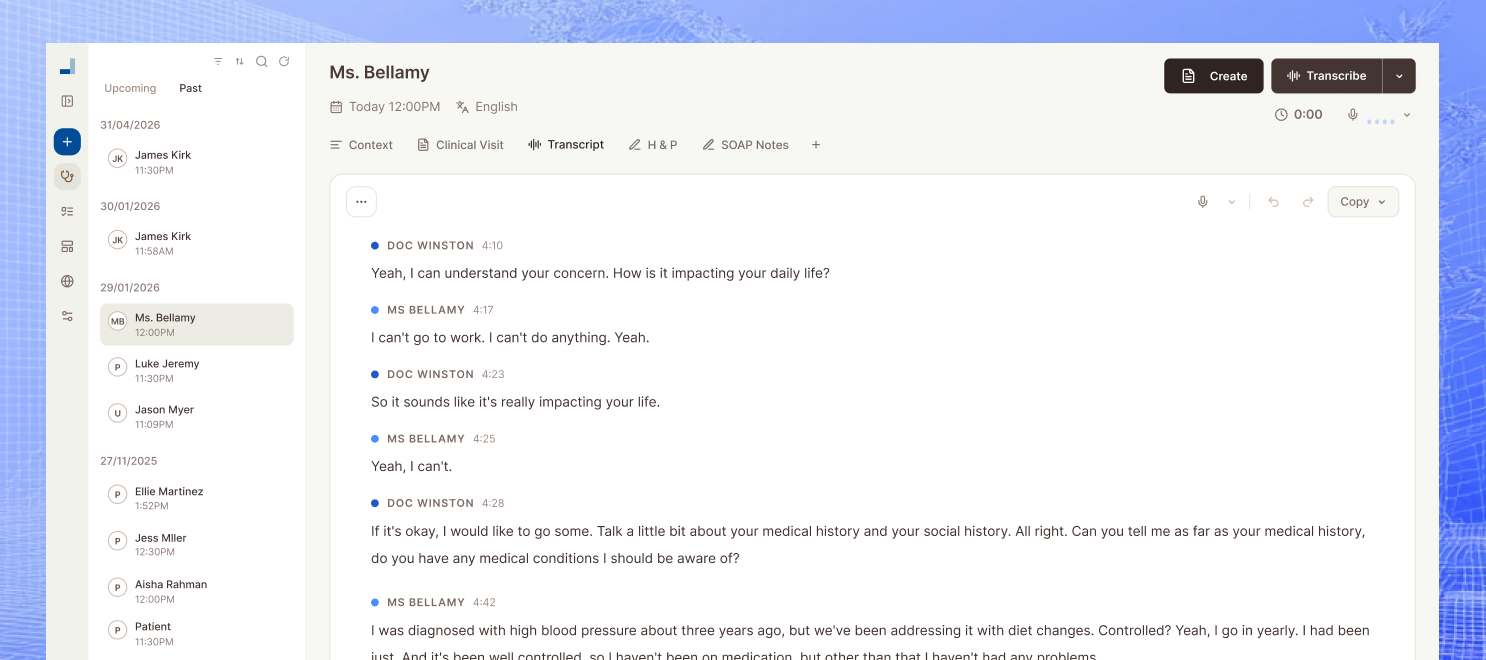
An AI medical scribe serves as a digital assistant that captures the nuances of these conversations in real time. It relieves the practitioner of the burden of manual data entry, ensuring that every drug mentioned and every dosage change discussed is accurately captured. However, it is important to remember that the AI is an assistive tool; the clinician remains the final authority, responsible for reviewing and signing off on the clinical accuracy of the generated documentation.
- Eliminates after-hours charting and clinician burnout.
- Improves patient engagement by removing the screen barrier.
- Captures granular details often missed in manual note-taking.
- Strengthens medico-legal protection with highly detailed records.
Note types you can generate beyond SOAP (H&P and more)
While the SOAP format is the most common, complex medication reviews often require more specialized structures to ensure continuity of care. History & Physical (H&P) notes are essential for new patients with extensive medication histories, providing a comprehensive baseline. In contrast, progress notes focus on the interval changes since the last review, specifically tracking how a patient is responding to a new titration or a recently added pharmaceutical agent.
Specialized documentation like procedure notes, discharge summaries, and consult notes are equally vital for specialized practices. For example, a discharge summary after a medication adjustment during hospitalization must clearly communicate changes to the primary care provider. Similarly, referral letters must concisely summarize the current regimen and the rationale for the specialist consultation to ensure patient safety and avoid drug-drug interactions.
Using a variety of note formats ensures that the documentation is fit for purpose, whether it is for internal tracking or external communication. Comprehensive templates allow clinicians to maintain audit readiness and provide a high standard of care transitions. This versatility is what transforms a simple transcript into a professional clinical document that meets all regulatory and professional standards.
- H&P and Progress notes for long-term management tracking.
- Consult notes and Referral letters for seamless care transitions.
- Procedure notes for documenting injections or medication administrations.
- Discharge summaries to prevent errors during handovers.
How to implement medication review documentation step-by-step in a real clinic
To begin implementing a digital workflow for medication reviews, start by selecting one specific visit type, such as your chronic disease management follow-ups. This allows your team to get comfortable with the technology in a controlled environment before expanding. Ensure that you have selected or customized templates that match your specialty, focusing on fields like ‘Current Medications,’ ‘Allergies,’ and ‘Plan Changes.’
During the encounter, whether it is an in-person visit or a telehealth session, focus entirely on the patient. Let the AI capture the dialogue naturally as you discuss each medication. You do not need to speak in ‘code’ or dictate; simply have a normal clinical conversation. The system will distinguish between the various components of the medication reconciliation process automatically.
Once the encounter is finished, take two to three minutes to review and edit the generated note. This is the moment to confirm that dosages are correct and that any nuanced clinical decisions are reflected accurately. Finally, reuse these outputs to generate necessary documents like referral letters or school forms, ensuring that the updated medication list is consistent across all paperwork without manual re-typing.
- Pilot the system with one visit type to build staff confidence.
- Use specialty-specific templates for precise documentation.
- Focus on the patient while the AI captures the complex dialogue.
- Review, edit, and repurpose the data for letters and forms.
How to keep note quality high and reduce mistakes
Maintenance of high-quality notes involves a proactive approach to common failure points like medication name similarities or misheard numerical values. While AI is highly capable, ‘note bloat’ can occur if the system includes irrelevant conversational filler. Establishing a standard for what constitutes a ‘clean’ note within your clinic helps keep the documentation focused and useful for future reviews.
Developing a lightweight review habit is essential for every practitioner. Spend the first few weeks closely auditing the outputs to ensure the AI understands your specific phrasing and clinical logic. Over time, as you refine your templates and the AI learns your style, the need for extensive editing will decrease, but the final sign-off remains the clinician’s most important quality control step.
- Audit notes for ‘note bloat’ to keep records concise.
- Double-check medication dosages and frequency for accuracy.
- Establish team-wide documentation standards and templates.
Privacy, consent, and patient trust (plain English)
Patient trust is the foundation of any clinical encounter, and introducing recording technology requires transparency. Always follow your local and regional regulations regarding patient consent for audio recording or transcription. Most patients are supportive of this technology when they understand it allows their doctor to listen more closely to their concerns rather than staring at a computer screen.
A simple way to explain this to a patient is: ‘With your permission, I’d like to use an AI assistant today to help me take notes. This allows me to focus entirely on our conversation and ensures your medical records are as accurate as possible. The recording is encrypted and handled according to strict privacy laws.’ This short explanation usually alleviates any anxiety and reinforces the doctor-patient bond.
- Always obtain and document patient consent per local policy.
- Explain the benefits of better eye contact and accuracy.
- Ensure data is encrypted and handled with strict security protocols.
Rolling it out across a clinic without disruption
A successful rollout requires a structured 2-week pilot plan. During the first week, let a few ‘super-users’ test the system and identify the best templates for your clinic’s unique needs. In the second week, begin training the rest of the staff, emphasizing how the tool reduces administrative burden and improves the quality of life for everyone involved.
Measure the success of the rollout by tracking specific metrics like time saved per day, reduction in after-hours charting, and the completeness of the medication lists. If you find that notes are still taking too long to finalize, revisit your templates to ensure they align with your clinical workflow. Alignment between the software and your staff’s daily habits is the key to long-term adoption.
- Launch with a 2-week pilot program to troubleshoot workflows.
- Track time savings and note completeness to measure ROI.
- Align templates with existing clinic standards to ensure consistency.
Mcoy AI is an AI medical scribe that records and transcribes patient encounters, then generates multiple clinical note types (H&P, progress notes, consult notes, follow-up notes, procedure notes, discharge summaries, referral letters, and more). With over 200+ customizable templates and an AI chat to create letters, forms, and secondary documents, it allows clinicians to spend more time on care and less on administration.
FAQ
The following frequently asked questions provide practical insights into using automated tools for clinical documentation.
How accurate are AI medical scribes in real clinics?
AI scribes are remarkably accurate, often capturing details that a human might forget or miss during a busy shift. They are particularly good at recognizing medical terminology and pharmacology names. However, they are sensitive to audio quality, so using a high-quality microphone or a quiet room is helpful. Always remember that the clinician is the final filter for accuracy.
Do I still need to review every note?
Yes, clinical responsibility dictates that you must review and verify every note before it becomes a part of the permanent medical record. While the AI does the heavy lifting, you are responsible for ensuring the medical logic and dosages are correct. Most clinicians find that this review process takes only a fraction of the time it would take to write the note from scratch.
What note types can an AI scribe generate besides SOAP?
Modern AI scribes go far beyond the standard SOAP format. They can produce History & Physical (H&P) summaries, complex consult notes, follow-up notes, and detailed procedure descriptions. They can also transform a transcript into a formal referral letter or a discharge summary, making them versatile tools for all aspects of clinical communication.
Will this work for telehealth and in-person consults?
Absolutely. Most systems are designed to capture audio from a variety of sources, including direct microphone input for in-person visits or internal system audio for telehealth platforms. This flexibility ensures that your documentation remains consistent and high-quality regardless of how you interact with your patients.
How do I explain recording/transcription to patients?
The best approach is honesty and transparency. Simply tell the patient that the tool helps you take more accurate notes so you can focus on them instead of the computer. Most patients appreciate the extra attention they receive when the doctor isn’t constantly typing, and they are usually happy to consent once they understand the benefits.
How do clinics prevent note bloat?
Note bloat is prevented by using well-structured templates that instruct the AI to focus on specific clinical findings rather than transcribing every word of the conversation. By setting parameters for brevity and importance, you ensure that the final note is concise, relevant, and easy for other healthcare providers to read.
How long does template setup take?
Initial template setup can take as little as a few minutes if you use pre-built specialty templates. Fine-tuning those templates to match your personal style or a specific clinic workflow might take an hour or two of experimentation. Once set, these templates automate the documentation process for every subsequent visit.
What’s the safest way to start if I’m skeptical?
The safest way to start is to use the AI scribe alongside your current documentation method for a few days. Don’t rely on it for your primary record immediately; instead, compare the AI’s output to your manual notes. Once you see the accuracy and the time saved, you can gradually transition to a full AI-first workflow.
Conclusion
Adopting an automated workflow is the most effective way to manage the complexities of modern clinical documentation. By following a structured implementation plan, focusing on note quality, and ensuring patient transparency, you can reclaim your time and improve your practice’s efficiency. Learning how to document medication reviews with an AI scribe is not just about technology—it is about returning the focus of medicine to the patient-provider relationship. Start your pilot today and experience the relief of a streamlined, digital clinical workflow.
What a serious review table should cover
| Decision area | Common mistake | Better clinic-ready approach | Metric to watch |
|---|---|---|---|
| Workflow design | Treat document medication reviews with ai scribe: full guide as a one-off documentation task | Build a repeatable process with clear ownership and review points | Time to complete documentation |
| Team adoption | Assume every clinician will naturally use the same process | Train for consistency and define exception handling early | Active user adoption |
| Quality review | Only check notes when a problem is reported | Audit a sample of notes weekly and review edge cases | Edit rate per note |
| Operational follow-through | Leave admin actions outside the documentation workflow | Use the same encounter data for referrals, letters, and follow-up tasks | Completion rate for next-step tasks |
Related reading
If you are working through document medication reviews with ai scribe: full guide, it helps to read this alongside Specialty Guides: How to Run a More Efficient Medical Practice in 2026, Specialty Guides: How to Improve Patient Encounters, and Specialty Guides: How to Use an AI Scribe for Patient Instructions Guide. Those guides cover adjacent workflow, implementation, and evaluation questions so the decision does not sit in isolation.
FAQ
How accurate are AI medical scribes in real clinics?
AI scribes are remarkably accurate, often capturing details that a human might forget or miss during a busy shift. They are particularly good at recognizing medical terminology and pharmacology names. However, they are sensitive to audio quality, so using a high-quality microphone or a quiet room is helpful. Always remember that the clinician is the final filter for accuracy.
Do I still need to review every note?
Yes, clinical responsibility dictates that you must review and verify every note before it becomes a part of the permanent medical record. While the AI does the heavy lifting, you are responsible for ensuring the medical logic and dosages are correct. Most clinicians find that this review process takes only a fraction of the time it would take to write the note from scratch.
What note types can an AI scribe generate besides SOAP?
Modern AI scribes go far beyond the standard SOAP format. They can produce History & Physical (H&P) summaries, complex consult notes, follow-up notes, and detailed procedure descriptions. They can also transform a transcript into a formal referral letter or a discharge summary, making them versatile tools for all aspects of clinical communication.
Will this work for telehealth and in-person consults?
Absolutely. Most systems are designed to capture audio from a variety of sources, including direct microphone input for in-person visits or internal system audio for telehealth platforms. This flexibility ensures that your documentation remains consistent and high-quality regardless of how you interact with your patients.
How do I explain recording/transcription to patients?
The best approach is honesty and transparency. Simply tell the patient that the tool helps you take more accurate notes so you can focus on them instead of the computer. Most patients appreciate the extra attention they receive when the doctor isn’t constantly typing, and they are usually happy to consent once they understand the benefits.
How do clinics prevent note bloat?
Note bloat is prevented by using well-structured templates that instruct the AI to focus on specific clinical findings rather than transcribing every word of the conversation. By setting parameters for brevity and importance, you ensure that the final note is concise, relevant, and easy for other healthcare providers to read.
How long does template setup take?
Initial template setup can take as little as a few minutes if you use pre-built specialty templates. Fine-tuning those templates to match your personal style or a specific clinic workflow might take an hour or two of experimentation. Once set, these templates automate the documentation process for every subsequent visit.
What’s the safest way to start if I’m skeptical?
The safest way to start is to use the AI scribe alongside your current documentation method for a few days. Don’t rely on it for your primary record immediately; instead, compare the AI’s output to your manual notes. Once you see the accuracy and the time saved, you can gradually transition to a full AI-first workflow.