Specialty Guides: Document Insurance Reports with AI Scribe: Full Guide
Learn how to use an AI scribe to document insurance reports and clinical notes efficiently. Master workflows for H&P, consults, and faster reimbursements.
The Burden of Insurance Documentation in Modern Medicine
For many practitioners, the most taxing part of the workday isn’t the complex diagnosis or the patient interaction; it’s the hours spent staring at a screen completing insurance reports and clinical documentation. After-hours charting has become a leading cause of burnout among private practitioners and university clinic staff alike. The anxiety of potentially missing a specific medical necessity keyword or failing to provide enough detail for an insurance claim can lead to delayed reimbursements and significant administrative stress.
This guide provides a comprehensive roadmap for clinicians—from general practitioners to specialists—on how to optimize their workflow using an AI scribe. We will explore how to document insurance reports beyond the basic SOAP format, quality control measures for high-stakes audits, and a seamless rollout plan for your clinic. Whether you are managing a busy telehealth schedule or a high-volume physical clinic, mastering these digital tools is the key to reclaiming your personal time.
What a medical scribe solves in modern practice
The real cost of manual documentation is often hidden in the form of ‘cognitive load.’ When a doctor is struggling to remember every detail for an insurance report while simultaneously listening to a patient, the quality of both the note and the care can suffer. Delayed notes are often less accurate, as the nuances of the encounter fade within hours. An AI medical scribe acts as a cognitive assistant, allowing the physician to remain fully present with the patient while the heavy lifting of data capture happens in the background.
It is important to understand that an AI scribe is an assistive tool, not a replacement for clinical judgment. The clinician remains the ultimate authority and is responsible for the accuracy of every report. However, by automating the transcription and initial drafting of complex insurance reports, the software ensures that no detail—such as specific symptoms or functional limitations required by payers—is left on the cutting room floor.
- Eliminates the ‘pajama time’ spent on finishing charts after hours.
- Reduces cognitive fatigue by allowing clinicians to focus on the patient voice.
- Provides a highly detailed first draft that ensures consistency across encounters.
- Captures specific clinical nuances that are often forgotten during manual entry.
Note types you can generate beyond SOAP (H&P and more)
While the SOAP note is the industry standard for daily progress, insurance reports and complex specialty care often require much more. A comprehensive History and Physical (H&P) is essential for new admissions or major insurance authorizations. Consult notes and referral letters must distill complex information into a format that another provider (and an insurance adjuster) can quickly understand. For surgical or specialty clinics, procedure notes and discharge summaries are the primary documents that prove the necessity of care.
Structure matters immensely for audit readiness and continuity of care. Using standardized templates for follow-up notes ensures that the progression of a chronic condition is clearly tracked over time, which is a frequent requirement for ongoing insurance coverage. By diversifying the types of documents you generate with an AI assistant, you create a robust medical record that stands up to the scrutiny of both peers and payers.
- H&P and Progress Notes: Essential for baseline documentation and daily updates.
- Consultation and Referral Letters: Vital for inter-provider communication and authorizations.
- Procedure Notes: Detailed logs of specific interventions for billing accuracy.
- Discharge Summaries: High-level overviews for handovers and long-term insurance tracking.
How to implement AI scribe documentation step-by-step in a real clinic
To begin implementing this technology, start by selecting one specific visit type—such as initial consultations or specific insurance-heavy assessments. This allows the team to get comfortable with the interface without overwhelming the entire schedule. Before the first session, take ten minutes to select or customize templates that match your specialty’s specific billing requirements, ensuring the AI knows which data points to prioritize.
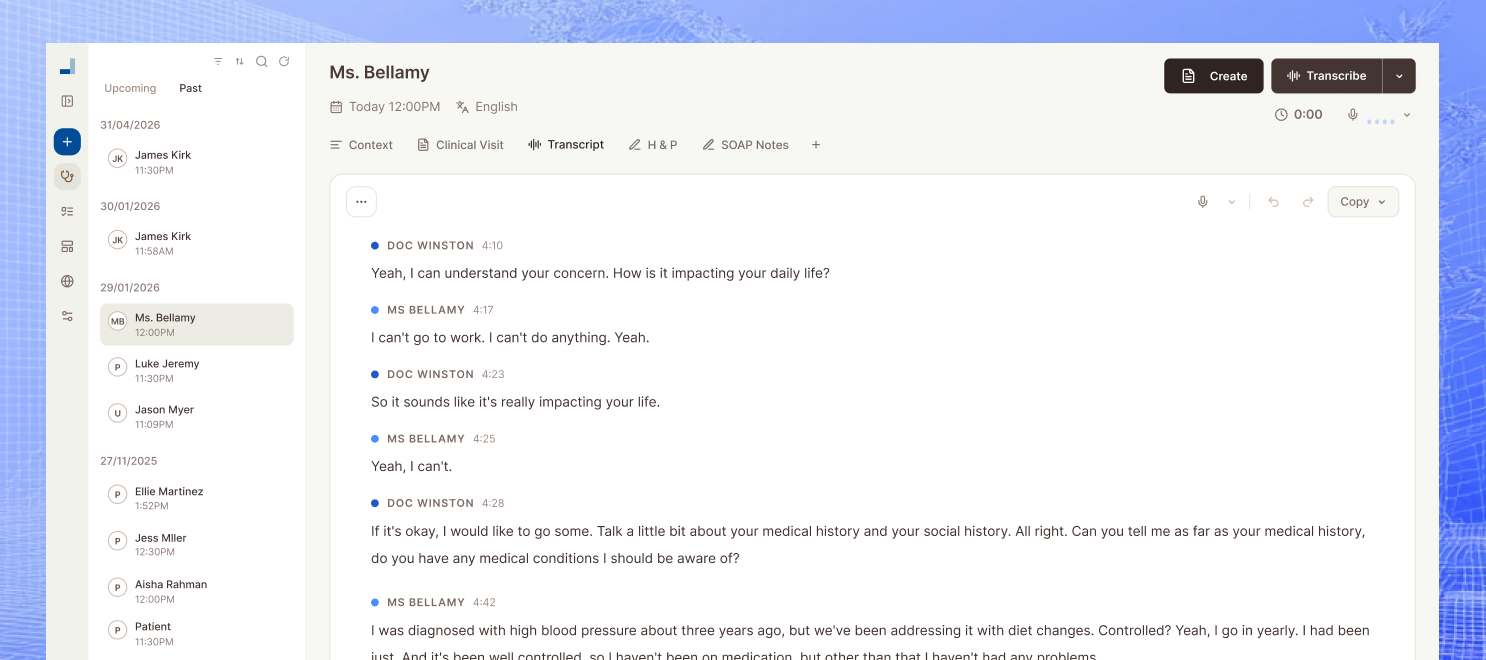
During the encounter, whether it is an in-person visit or a telehealth session, simply initiate the recording. Speak naturally to the patient as you normally would. You do not need to ‘dictate’ to the AI; the most effective way to document insurance reports is to have a high-quality clinical conversation. After the visit is over, the AI generates a draft within seconds. Review the output immediately while the session is fresh in your mind, making any necessary clinical adjustments.
Once the note is finalized, you can reuse the captured data for multiple purposes. For instance, the information used in an H&P can instantly be adapted into a referral letter or an insurance pre-authorization form. This ‘write once, use many’ approach significantly reduces the time spent on administrative busywork. Over time, the system learns your preferences, making the editing phase faster and more intuitive.
- Start with one visit type to minimize disruption to the clinic flow.
- Select specialty-specific templates that mirror insurance reporting needs.
- Review drafts immediately to ensure 100% clinical accuracy.
- Repurpose encounter data for letters, forms, and discharge summaries.
How to keep note quality high and reduce mistakes
Documentation failure points often involve missing medications, incorrect dosage values, or ‘note bloat’—where irrelevant information obscures the clinical narrative. To prevent this when you document insurance reports, establish a lightweight review habit. Spend two minutes checking the ‘Plan’ and ‘Assessment’ sections specifically, as these are the most scrutinized by insurance auditors. Encouraging a standard team protocol for reviewing AI-generated drafts ensures that everyone in the clinic maintains the same level of medical-legal safety.
- Focus on checking the assessment and plan for insurance keywords.
- Prune unnecessary text to prevent ‘note bloat’ and improve readability.
- Establish a consistent peer-review standard within the practice.
Privacy, consent, and patient trust
Trust is the foundation of the patient-provider relationship. When using an AI scribe, transparency is key. Most patients are supportive of the technology when they realize it means their doctor will be looking at them instead of a computer screen. Consent requirements vary by region, so always ensure you are following your local health authority’s policies. A simple script like, ‘To help me focus on you rather than my keyboard, I use an AI assistant to help me summarize our visit. Is that okay with you?’ is usually all it takes to put a patient at ease.
- Always follow local regulations regarding audio recording and data storage.
- Use a patient-centered script to introduce the technology.
- Ensure the scribe service adheres to high-level security and retention standards.
Rolling it out across a clinic without disruption
A successful rollout starts with a two-week pilot program involving one or two ‘tech-forward’ clinicians. During this period, track metrics such as time saved per day and the reduction in ‘after-hours’ charting. Once the pilot proves the value, roll it out to the rest of the clinic with a clear training session on template alignment. This ensures that every report generated—whether for a minor check-up or a complex insurance report—meets the clinic’s high standards.
- Run a 14-day pilot to identify workflow bottlenecks.
- Track time-saving metrics and clinician satisfaction scores.
- Align templates across the clinic for uniform documentation.
Mcoy AI is an AI medical scribe that records and transcribes patient encounters, then generates multiple clinical note types including H&P, progress notes, consult notes, follow-up notes, procedure notes, discharge summaries, referral letters, and more. It features over 200 customizable templates and an AI chat function to help create letters, forms, and specific documents effortlessly, allowing clinicians to focus more on patient care and less on administration.
Conclusion
The transition to digital documentation doesn’t have to be a source of stress. By integrating an AI scribe into your daily workflow, you can handle the most complex clinical notes and insurance reports with ease. This technology allows you to maintain high standards of care while significantly reducing the administrative burden that leads to burnout. If you are ready to reclaim your time, the best next step is to initiate a pilot program and see how effectively you can document insurance reports with the help of AI documentation. Start your journey toward a more efficient practice today.
What a serious review table should cover
| Decision area | Common mistake | Better clinic-ready approach | Metric to watch |
|---|---|---|---|
| Workflow design | Treat document insurance reports with ai scribe: full guide as a one-off documentation task | Build a repeatable process with clear ownership and review points | Time to complete documentation |
| Team adoption | Assume every clinician will naturally use the same process | Train for consistency and define exception handling early | Active user adoption |
| Quality review | Only check notes when a problem is reported | Audit a sample of notes weekly and review edge cases | Edit rate per note |
| Operational follow-through | Leave admin actions outside the documentation workflow | Use the same encounter data for referrals, letters, and follow-up tasks | Completion rate for next-step tasks |
Related reading
If you are working through document insurance reports with ai scribe: full guide, it helps to read this alongside Specialty Guides: How to Run a More Efficient Medical Practice in 2026, Specialty Guides: How to Improve Patient Encounters, and Admin Management: How to Use AI Scribe for Care Plans: A Complete Guide. Those guides cover adjacent workflow, implementation, and evaluation questions so the decision does not sit in isolation.
FAQ
How accurate are AI medical scribes in real clinics?
In modern clinical settings, AI medical scribes are remarkably accurate, often capturing nuances that even a human scribe might miss during a fast-paced encounter. However, their accuracy depends on the quality of the audio and the clarity of the conversation. Currently, they provide a 90-95% accurate draft that serves as an excellent foundation for a final clinical note. Most clinicians find they only need to make minor tweaks to the assessment or plan.
Do I still need to review every note?
Yes, reviewing every note is a fundamental requirement for medical-legal safety and professional responsibility. An AI scribe is an assistive tool designed to create a draft, but the clinician remains the person responsible for the medical record. Fortunately, reviewing an AI-generated note usually takes only a fraction of the time it would take to write one from scratch. A quick 60-second review is usually sufficient to ensure all clinical facts are correct.
What note types can an AI scribe generate besides SOAP?
Advanced AI scribes can generate a wide variety of documentation beyond standard SOAP notes, including History and Physicals (H&P), consultation letters, and referral notes. They are also highly effective at creating procedure notes, discharge summaries, and follow-up progress notes. By utilizing different templates, the AI can structure the captured information to fit the specific needs of any medical specialty or insurance report. This versatility helps clinics maintain a comprehensive and audit-ready medical record.
Will this work for telehealth and in-person consults?
Yes, most AI scribe solutions are designed to work seamlessly with both telehealth platforms and in-person patient encounters. For telehealth, the scribe can often capture audio directly from the computer output, while in-person visits use a mobile device or room microphone. The AI’s ability to distinguish between the voices of the doctor and the patient ensures that the resulting insurance reports and clinical summaries are accurate regardless of the setting.
How do I explain recording/transcription to patients?
The best approach is to be direct and highlight the benefit to the patient. You might say, ‘I’m using a secure AI tool to capture our conversation so I can focus 100% on you rather than typing on my computer.’ Most patients appreciate the increased eye contact and personal attention. It is also important to mention that the recording is processed securely to maintain their privacy.
How do clinics prevent note bloat?
Note bloat occurs when too much irrelevant information is included in the record. To prevent this, clinics should select concise templates and use the AI’s ‘summarization’ settings rather than full transcript copies. Clinicians should also get in the habit of deleting tangential information during the review phase. Setting clinic-wide standards for note length and detail level for specific insurance reports also helps keep the documentation lean and professional.
How long does template setup take?
Setting up your initial templates usually takes less than an hour. Most AI scribe platforms come with a library of pre-built, specialty-specific templates that you can use immediately. Customizing these to include your specific ‘must-have’ phrases for insurance reports or particular patient instructions can be done incrementally over your first few days of use. Once set, these templates automate the formatting for all future sessions.
What’s the safest way to start if I’m skeptical?
The safest way to start is with a limited pilot involving just one or two non-complex patients per day. This allows you to test the accuracy of the technology without any pressure on your clinical schedule. You can record the session while still taking your usual brief notes as a backup. Once you see the quality of the AI-generated insurance reports and clinical summaries, you can gradually increase its use until it becomes your primary documentation method.