Specialty Guides: Document Follow-Up Visits Faster With an AI Scribe Guide
Learn how to optimize your clinic workflow and document follow-up visits faster using an AI scribe. Professional guide for doctors & private practices.
Introduction
For many clinicians, the primary source of burnout isn’t the patient care itself, but the mountain of administrative work that follows every encounter. Follow-up visits, which should be efficient check-ins, often result in after-hours charting, rushed notes, and a nagging sense of medico-legal anxiety. When documentation becomes a bottleneck, the quality of both the clinician’s life and the patient’s experience suffers.
This guide provides a comprehensive roadmap for integrating an AI medical scribe into your daily routine. We will explore how to move beyond basic SOAP formats, maintain high-quality clinical standards, and manage privacy concerns. Whether you are a general practitioner, a specialist in a private practice, or managing a high-volume university clinic, these strategies are designed to streamline your workflow and restore your focus to the patient.
What a medical scribe solves in modern practice
The real cost of documentation extends far beyond the time spent typing. It includes a heavy cognitive load that leads to ‘pajama time’—those hours spent finishing charts at home instead of resting. Delayed documentation often results in missed nuances from the encounter, as details fade from memory between the visit and the final sign-off. This delay creates a ripple effect of inefficiency throughout the entire clinic.
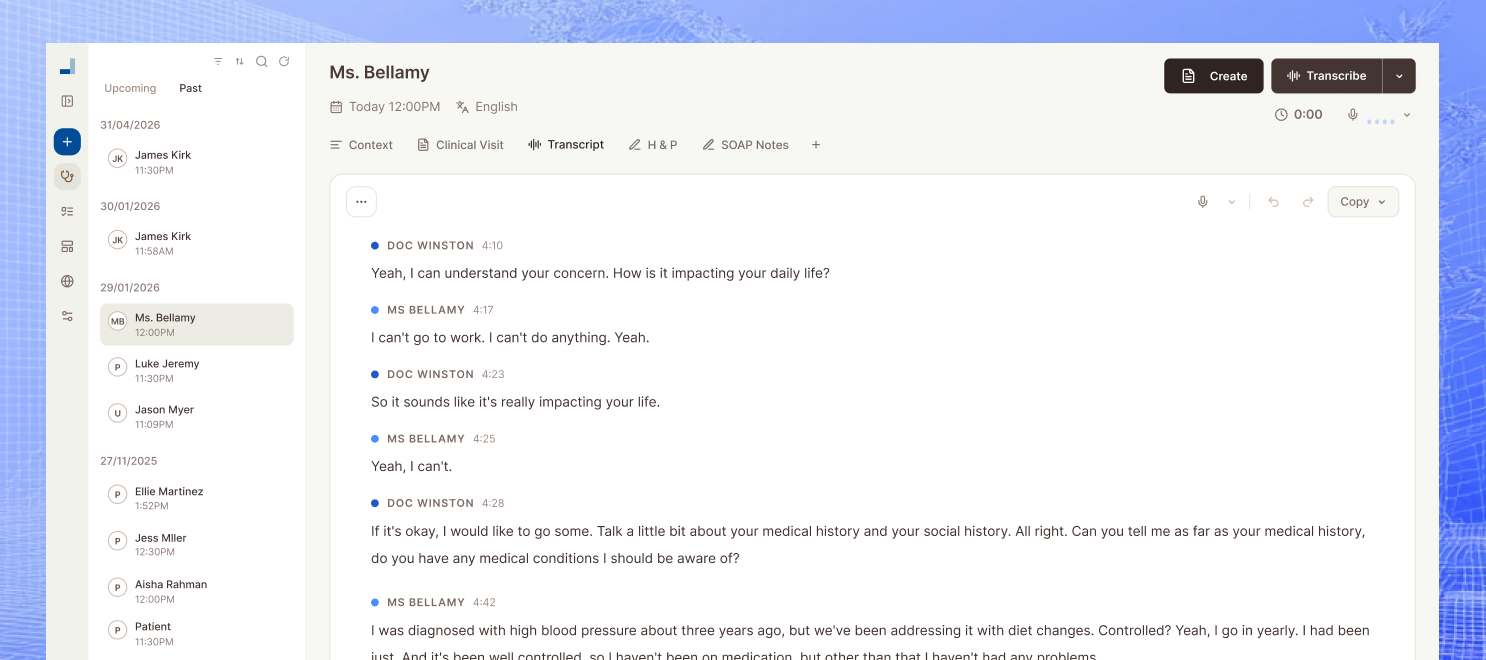
An AI medical scribe acts as an assistive partner, capturing the natural dialogue between doctor and patient in real-time. It is important to understand that these tools are not autonomous practitioners; the clinician remains the final authority and responsible party for every note. The AI does the heavy lifting of transcription and initial formatting, allowing the doctor to engage in active listening without the distraction of a computer screen.
- Eliminates late-night charting by providing near-instant drafts.
- Reduces cognitive load by capturing details during the visit.
- Enhances patient engagement by removing the screen barrier.
- Provides a structured foundation for more accurate clinical records.
Note types you can generate beyond SOAP (H&P and more)
While the SOAP note is a staple of medical training, it isn’t always the most efficient or appropriate format for every encounter. Different clinical scenarios require different documentation structures to ensure continuity of care and audit readiness. For example, a complex initial evaluation requires a full History and Physical (H&P), while a routine check-in may only need a concise follow-up note or progress report.
Utilizing a variety of formats allows for better handover quality and professional communication. Consult notes need to highlight specific recommendations for the referring physician, while procedure notes must focus on the technical details and patient tolerance. Having the ability to switch between these formats seamlessly ensures that the documentation fits the clinical context perfectly every time.
A well-structured note is not just about compliance; it is about creating a reliable medical history that any member of the care team can understand. By moving beyond a ‘one-size-fits-all’ approach, clinics can improve their internal communication and make external referrals much smoother for everyone involved.
- H&P and Progress Notes for inpatient and complex outpatient care.
- Consultation and Referral Letters for professional specialty communication.
- Procedure Notes and Discharge Summaries for surgical or acute transitions.
- Follow-up Notes tailored specifically to chronic disease management.
How to implement an AI scribe step-by-step in a real clinic
The best way to start using an AI scribe is to focus on one specific visit type first, such as routine follow-ups. By narrowing your focus, you can get used to the technology without feeling overwhelmed by your entire schedule. This allows you to witness the immediate benefit of faster turnarounds on simple cases before moving to more complex presentations.
Next, you should set up or select templates that align with your specialty. Most providers find that having a pre-defined structure helps the AI organize the captured conversation more effectively. Once your templates are ready, you can begin capturing encounters, whether they are in-person or conducted via telehealth. The AI listens to the natural flow of the conversation, so there is no need to dictate commands or use stilted language.
After the encounter, the generated draft appears almost immediately. Take a moment to review and edit the output. This review process typically takes less than a minute for a follow-up visit. Finally, you can reuse the data from these outputs to auto-populate other necessary documents, such as work slips, referral letters, or patient instructions, creating a truly unified administrative workflow.
- Start with one visit type to build confidence and habit.
- Select specialty-specific templates for better structural accuracy.
- Review drafts immediately while the encounter is fresh in your mind.
- Leverage AI outputs to generate secondary documents like referral letters.
How to keep note quality high and reduce mistakes
Maintaining high quality in AI-generated notes requires a proactive approach. Typical failure points include missing specific medication dosages mentioned only briefly or ‘note bloat,’ where the AI includes irrelevant social chatter. Developing a lightweight review habit is essential; you are effectively the editor-in-chief of your own clinical records.
Establishing team standards for documentation also helps. When every provider in a clinic uses similar templates and review criteria, the consistency of the medical records improves significantly. This makes peer reviews and audits much simpler and ensures that the clinic’s ‘voice’ remains professional and concise across all patient charts.
- Check specific values like dosages and dates for absolute accuracy.
- Trim irrelevant conversational filler to keep notes concise.
- Standardize templates across the clinic for consistent documentation.
- Adopt a ‘review-before-sign’ protocol to ensure professional accountability.
Privacy, consent, and patient trust (plain English)
Privacy is a cornerstone of the patient-provider relationship. While consent requirements vary by region, it is best practice to follow your local healthcare regulations and institutional policies. Most patients are receptive to the technology when they understand it allows their doctor to focus entirely on them rather than a keyboard.
A simple way to explain this to a patient is: ‘I’m using an AI assistant today to help me take accurate notes so I can focus on our conversation. It records our talk and helps me write the medical record later. Is that alright with you?’ This transparency builds trust and usually leads to a more relaxed and open dialogue during the visit.
- Always check local and state regulations regarding recording consent.
- Explain the benefit to the patient (more eye contact, better focus).
- Ensure the tool you use follows standard healthcare security protocols.
- Allow patients to opt-out if they feel uncomfortable with the technology.
Rolling it out across a clinic without disruption
A successful rollout starts with a two-week pilot plan involving one or two ‘champion’ clinicians. Use this period to identify any friction points in the workflow. Tracking metrics like hours saved per week and the reduction in after-hours charting provides clear evidence of the tool’s value, which helps in gaining buy-in from the rest of the staff.
Training should focus on template alignment and the best practices for capturing clear audio. Once the pilot clinicians are comfortable, the rollout can expand to the rest of the team. This gradual approach minimizes disruption and ensures that everyone feels supported as they transition to a more efficient way of working.
- Launch with a two-week pilot to iron out workflow kinks.
- Track time saved and note completion speed to measure ROI.
- Provide brief, hands-on training sessions for the entire clinical team.
- Align templates across the practice for a unified clinical record.
Mcoy AI is an AI medical scribe that records and transcribes patient encounters, then generates multiple clinical note types (H&P, progress notes, consult notes, follow-up notes, procedure notes, discharge summaries, referral letters, and more). With over 200 customizable templates and an AI chat feature to help create letters, forms, and documents, it allows clinicians to spend more time with patients and less time on burdensome administrative tasks.
Conclusion
Transitioning to an AI-assisted workflow is one of the most effective ways to reclaim your time and improve practice efficiency. By following a structured implementation plan, focusing on quality control, and choosing the right formats for each encounter, you can document follow-up visits faster and more accurately. The future of clinical practice is about leveraging tools that allow doctors to be doctors again. Take the first step by starting a pilot with an AI scribe today and experience the difference in your daily workflow.
What a serious review table should cover
| Decision area | Common mistake | Better clinic-ready approach | Metric to watch |
|---|---|---|---|
| Workflow design | Treat document follow-up visits faster with an ai scribe guide as a one-off documentation task | Build a repeatable process with clear ownership and review points | Time to complete documentation |
| Team adoption | Assume every clinician will naturally use the same process | Train for consistency and define exception handling early | Active user adoption |
| Quality review | Only check notes when a problem is reported | Audit a sample of notes weekly and review edge cases | Edit rate per note |
| Operational follow-through | Leave admin actions outside the documentation workflow | Use the same encounter data for referrals, letters, and follow-up tasks | Completion rate for next-step tasks |
Related reading
If you are working through document follow-up visits faster with an ai scribe guide, it helps to read this alongside Specialty Guides: How to Run a More Efficient Medical Practice in 2026, Specialty Guides: How to Improve Patient Encounters, and AI & Medicine: How to Use an AI Medical Scribe in a Noisy Clinic. Those guides cover adjacent workflow, implementation, and evaluation questions so the decision does not sit in isolation.
FAQ
How accurate are AI medical scribes in real clinics?
AI medical scribes are remarkably accurate in capturing clinical dialogue and translating it into medical terminology. However, they are assistive tools, not replacements for clinical judgment. Accuracy is highest when there is clear audio and when the clinician reviews the draft for specific numbers or medication names.
Do I still need to review every note?
Yes, reviewing every note is essential for medical-legal reasons and patient safety. The AI provides a highly accurate draft, but the clinician must verify that the details are correct and that the plan reflects their final intentions. Usually, this review takes only a fraction of the time it would take to type the note manually.
What note types can an AI scribe generate besides SOAP?
Beyond the standard SOAP note, modern AI scribes can generate History and Physicals (H&P), detailed procedure notes, consult letters, and discharge summaries. They can also create follow-up visit summaries and referral letters to other specialists, ensuring that all aspects of patient care are documented.
Will this work for telehealth and in-person consults?
Most AI scribes are designed to work seamlessly in both environments. For in-person visits, a smartphone or tablet can capture the audio. For telehealth, the scribe can often integrate with the video platform or capture the audio from the computer’s output, providing the same level of documentation quality regardless of the setting.
How do I explain recording/transcription to patients?
The best approach is to be direct and highlight the benefits. Simply tell the patient that the tool allows you to look at them instead of a screen and ensures their medical record is as accurate as possible. Most patients appreciate the extra attention they receive when the doctor isn’t focused on typing.
How do clinics prevent note bloat?
Clinics prevent note bloat by using concise templates and setting specific instructions for the AI on what to prioritize. During the review phase, clinicians should remove any excessive conversational details that do not add clinical value. Training the AI on specific preferences also helps keep the outputs focused.
How long does template setup take?
Initial template setup is usually very quick, often taking only a few minutes per type. Most platforms offer pre-built library templates for various specialties that can be used immediately or tweaked slightly to fit a specific clinician’s style. It is an investment that pays off in long-term efficiency.
What’s the safest way to start if I’m skeptical?
The safest way to start is with a small pilot program. Choose your least complex follow-up visits for the first week and use the scribe alongside your traditional method if necessary. As you gain confidence in the AI’s ability to capture the encounter accurately, you can gradually phase out the manual charting.