Specialty Guides: Document Diabetes Reviews with AI Scribe: Complete Guide
Learn how to use an AI medical scribe for diabetes reviews. Save time on H&P, SOAP notes, and referrals while improving clinical accuracy and patient care.
What a medical scribe solves in modern practice
The administrative burden of managing chronic conditions like diabetes often leads to significant clinician burnout. Between tracking HbA1c trends, foot exams, and medication adjustments, the cognitive load required to maintain detailed records is immense. Doctors often find themselves finishing charts late into the evening, which degrades their quality of life and increases the risk of documentation errors.
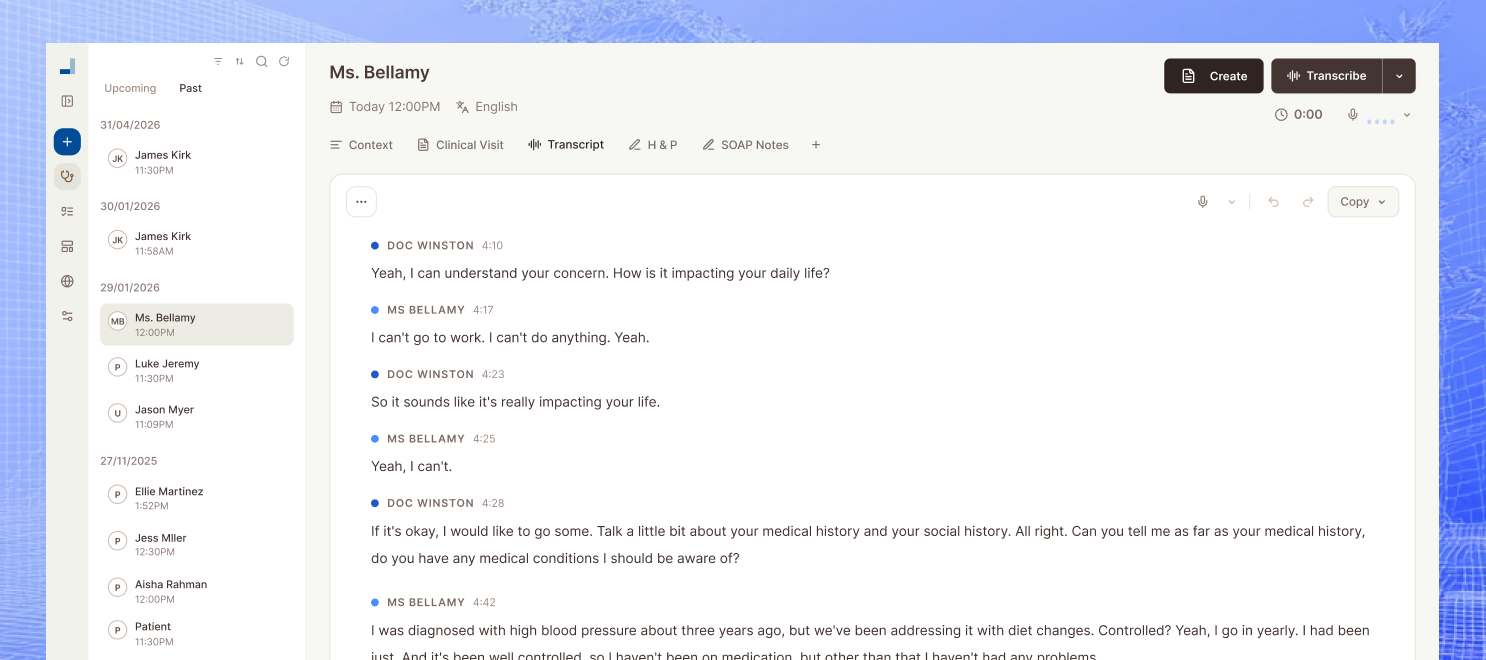
An AI medical scribe acts as a sophisticated digital assistant that captures the nuances of a patient encounter in real-time. It is important to remember that these tools are assistive; while they drastically reduce the manual typing of notes, the clinician remains the final authority and must review all outputs for clinical accuracy. By automating the heavy lifting of transcription, physicians can refocus their attention on the patient sitting in front of them.
- Eliminates hours of after-hours charting and manual data entry.
- Reduces cognitive load by capturing every detail of the conversation.
- Ensures more accurate records by documenting the encounter as it happens.
- Allows clinicians to maintain better eye contact and patient rapport.
Note types you can generate beyond SOAP (H&P and more)
While the SOAP format is a staple in medical documentation, complex diabetes management often requires more specialized note types. A comprehensive diabetes review might necessitate a detailed History and Physical (H&P) for new patients, or specific procedure notes for foot debridement or insulin pump site inspections. Relying solely on a generic format can lead to missed data points that are critical for long-term tracking.
Using specialized templates for consult notes, follow-up progress notes, and referral letters ensures that the information is structured logically for external specialists like endocrinologists or podiatrists. High-quality documentation is the backbone of continuity of care, as it provides a clear roadmap for any other provider involved in the patient’s journey. Proper structure also makes the practice audit-ready and simplifies the billing process.
- H&P and progress notes specifically tailored for chronic disease management.
- Detailed referral letters for specialty care such as ophthalmology or nephrology.
- Procedure notes for specialized assessments and diagnostic tests.
- Discharge summaries and follow-up notes that track objective clinical data.
How to implement AI medical scribe step-by-step in a real clinic
Scaling the use of an AI medical scribe begins with a narrow focus. Start by using the tool for one specific visit type, such as routine quarterly diabetes check-ups. This allows the clinical team to get comfortable with the interface and the transcription accuracy without being overwhelmed by a full patient load. By focusing on a single pathology, you can refine how you verbalize physical exam findings to ensure the AI captures them correctly.
Next, you should configure your preferred templates by specialty. For diabetes, this might include sections for glucose monitoring data, dietary compliance, and medication adherence. Once the templates are ready, you can simply begin the recording during the encounter, whether it is an in-person visit or a telehealth session. The AI will work in the background, allowing you to narrate your assessment and plan naturally as you discuss it with the patient.
After the encounter concludes, the draft Note is ready for immediate review. Clinical staff should take a moment to skim the output and make quick edits if necessary. This workflow allows you to reuse the generated content for secondary purposes, such as generating referral letters or patient instruction sheets, which are often created by feeding the captured data back into the system’s document generator.
- Start with one visit type to master the workflow.
- Select and customize templates specific to chronic disease.
- Capture encounters via mobile or desktop during the consult.
- Quickly review and edit notes before finalizing in the EMR.
How to keep note quality high and reduce mistakes
Clinical documentation quality is only as good as the input and the subsequent review process. Common failure points in AI-generated notes include missing specific dosages, misinterpreting whispered values, or creating ‘note bloat’ with redundant information. It is essential to develop a lightweight review habit where the clinician checks the ‘Assessment and Plan’ sections with particular scrutiny to ensure the intent is captured perfectly.
Establishing team standards for documentation also helps maintain consistency across the clinic. For example, if your university clinic prefers a specific way of listing comorbid conditions, ensure the AI templates reflect that formatting. Regularly auditing a small sample of notes can help identify if the AI is consistently missing specific types of data, allowing you to adjust your verbal prompts during the exam for better clarity.
- Implement a ‘Final Sign-off’ habit to catch minor transcription errors.
- Focus review efforts on medication dosages and clinical plans.
- Standardize templates across the practice for consistent reporting.
- Periodically audit notes to ensure they meet medico-legal standards.
Privacy, consent, and patient trust (plain English)
Patient privacy is paramount, and clinicians must follow local regulations and institutional policies regarding recording. In most settings, a simple verbal consent is both necessary and sufficient to begin. Being transparent with patients about why you are using the tool—to give them your full attention—usually builds trust rather than diminishing it.
A simple way to explain this to a patient is: ‘I’m using a digital assistant today to take notes for us. It records our conversation so I can focus on you instead of typing on my computer. The recording is secure and used only to create your medical record.’ This framing positions the technology as a benefit to the patient’s experience.
- Obtain clear verbal consent before starting any recording.
- Explain the technology as a way to improve the doctor-patient connection.
- Follow all local and regional data residency and security laws.
- Ensure the platform used meets high-level encryption standards.
Rolling it out across a clinic without disruption
A successful rollout requires a structured pilot phase, ideally lasting about two weeks. During this time, select a few ‘champion’ providers who are tech-savvy to lead the way. They can iron out any workflow kinks and provide internal feedback before the tool is introduced to the entire staff. This prevents the frustration that comes with a sudden, clinic-wide change.
Metrics for success should be tracked throughout the pilot. Measure the time saved on charting each day, the reduction in ‘pajama time’ spent on work at home, and the overall completeness of the notes. Once the benefits are clear, training the rest of the staff becomes a much easier task, as there is already a proven internal track record of success.
- Launch a 14-day pilot with a small group of clinicians.
- Track time-saving metrics and clinician satisfaction scores.
- Align templates across the organization to ensure data uniformity.
- Provide brief, hands-on training sessions for late adopters.
Mcoy AI is an AI medical scribe that records and transcribes patient encounters, then generates multiple clinical note types (H&P, progress notes, consult notes, follow-up notes, procedure notes, discharge summaries, referral letters, and more). It offers 200+ customizable templates and includes an AI chat feature designed to help clinicians create letters, forms, and other essential medical documents quickly and accurately.
Final Thoughts
Using an AI medical scribe is more than just a tech upgrade; it is a fundamental shift in how doctors experience their workday. By mastering the workflow of an AI medical scribe, practitioners can reclaim their time, improve their documentation quality, and provide better care for patients with complex needs like diabetes. Start your pilot today and see how digital transcription can revitalize your practice.
SEO description: Learn how an AI medical scribe can streamline diabetes reviews, reduce burnout, and improve note accuracy for private and university clinics.
What a serious review table should cover
| Decision area | Common mistake | Better clinic-ready approach | Metric to watch |
|---|---|---|---|
| Workflow design | Treat document diabetes reviews with ai scribe: complete guide as a one-off documentation task | Build a repeatable process with clear ownership and review points | Time to complete documentation |
| Team adoption | Assume every clinician will naturally use the same process | Train for consistency and define exception handling early | Active user adoption |
| Quality review | Only check notes when a problem is reported | Audit a sample of notes weekly and review edge cases | Edit rate per note |
| Operational follow-through | Leave admin actions outside the documentation workflow | Use the same encounter data for referrals, letters, and follow-up tasks | Completion rate for next-step tasks |
Related reading
If you are working through document diabetes reviews with ai scribe: complete guide, it helps to read this alongside Specialty Guides: How to Run a More Efficient Medical Practice in 2026, Specialty Guides: How to Improve Patient Encounters, and Specialty Guides: How to Implement AI Scribing: A Guide for New Practices. Those guides cover adjacent workflow, implementation, and evaluation questions so the decision does not sit in isolation.
FAQ
How accurate are AI medical scribes in real clinics?
Modern AI scribes are remarkably accurate, often exceeding 95% in capturing clinical dialogue. However, accuracy can vary based on background noise, accents, and medicine-specific terminology. This is why the clinician must always perform a final review of the generated note to ensure every clinical detail is correct before it is finalized in the patient’s record.
Do I still need to review every note?
Yes, reviewing every note is a professional and legal requirement for clinicians. While the AI scribe does the heavy lifting of drafting the content, the doctor is responsible for the clinical accuracy of the documentation. Most users find that reviewing and editing a pre-written note takes a fraction of the time it would take to type it from scratch.
What note types can an AI scribe generate besides SOAP?
Advanced AI scribes can generate a wide variety of documentation beyond standard SOAP notes. This includes History and Physical (H&P) reports, consult notes for specialists, procedure notes for minor surgeries, and comprehensive discharge summaries. They can also be used to draft referral letters and patient-facing instruction documents based on the captured encounter.
Will this work for telehealth and in-person consults?
Yes, AI medical scribes are designed to be versatile and function well in both environments. For in-person visits, the device is typically placed on a desk between the provider and patient. For telehealth, the scribe can capture audio directly from the computer, ensuring that remote consultations are documented with the same level of detail as face-to-face encounters.
How do I explain recording/transcription to patients?
The best approach is to be brief and emphasize the benefit to the patient. Tell them that the tool allows you to listen to them more closely because you don’t have to type. Most patients appreciate the extra attention and are comfortable with the technology once they understand it is a secure part of their medical record process.
How do clinics prevent note bloat?
Note bloat is prevented by using concise templates and setting specific instructions for the AI. You can customize the AI to prioritize relevant clinical findings over every single word spoken. By refining your templates and documenting only what is medically necessary for the specific visit type, the outputs remain clear and professional.
How long does template setup take?
Initial template setup usually takes only a few minutes, especially if you start with pre-built clinical templates. Most systems allow you to tweak these templates on the fly. Within an hour, a clinician can usually have 5-10 specialized templates ready for their most common visit types, such as diabetes follow-ups or initial consults.
What’s the safest way to start if I’m skeptical?
The safest way to start is to use the scribe for just one or two non-complex patients per day. This low-pressure environment allows you to see how the AI handles your speaking style and clinical workflow. Once you see the time savings and accuracy firsthand, you can gradually increase its use across more complex patient reviews.