Compare & Choose: Best Chronic Care Note Template Guide for Clinicians
Learn how to build a chronic care note template pack to save time, reduce burnout, and improve documentation quality in your private practice or clinic.
What a medical scribe solves in modern practice
Documentation is no longer just a byproduct of healthcare; for many clinicians, it has become a primary source of cognitive load and burnout. The hidden cost of manual charting isn’t just the hours spent after a shift; it’s the mental fatigue that leads to rushed notes and missed clinical nuances. When practitioners are forced to choose between eye contact with a patient and a complete electronic health record, the quality of the therapeutic relationship often suffers.
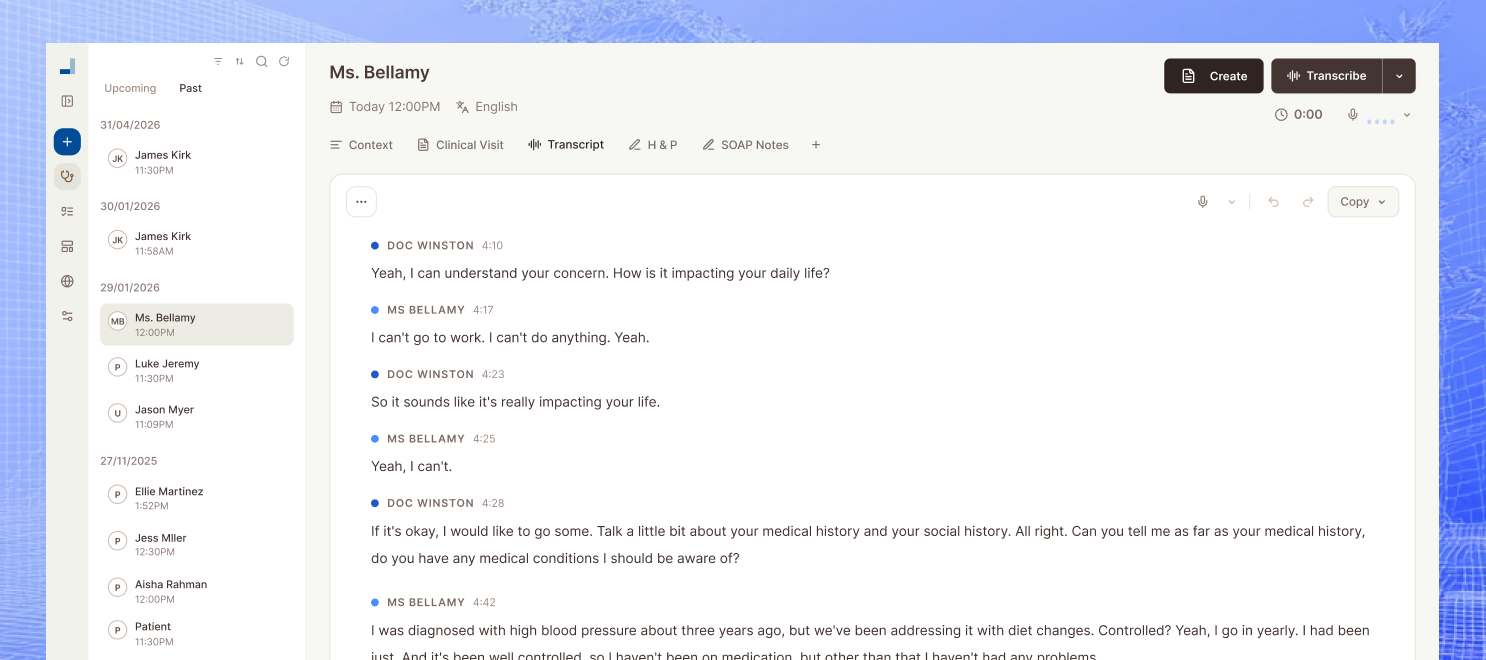
An AI medical scribe acts as an assistive layer, bridging the gap between a natural conversation and a structured clinical record. It captures the raw data of the encounter in real-time, allowing the doctor to focus entirely on the patient’s narrative. However, it’s important to remember that these tools are assistive—the clinician remains the final authority and must review all outputs for medical accuracy.
- Reclaims hours of personal time previously lost to ‘Pajama Time’ charting.
- Reduces the cognitive burden by capturing facts, numbers, and dates automatically.
- Ensures clinical notes are finished immediately following the encounter.
- Allows clinicians to focus on complex decision-making rather than transcription.
Note types you can generate beyond SOAP (H&P and more)
While the SOAP format is the industry standard, chronic disease management often requires more specialized structures to ensure continuity of care. High-quality documentation for long-term conditions demands a look back at historical trends and a look forward at preventive screenings. Relying solely on a generic format can lead to gaps in the patient’s longitudinal story, especially during handovers or audits.
A comprehensive chronic care note template pack should include varied formats such as History and Physical (H&P) reports for new admissions, detailed progress notes for established patients, and specialized consult notes for multi-disciplinary coordination. Procedure notes and discharge summaries are equally vital for documenting interventions and transitions of care safely. Using specific templates for each encounter type ensures that no critical data point—like a recent A1c or a cardiovascular risk score—is omitted.
- H&P and Progress Notes provide a holistic view of the patient’s status.
- Consult and Referral letters facilitate better communication between specialists.
- Procedure notes and Discharge summaries ensure legal and clinical compliance.
- Customized templates guarantee audit readiness and smoother billing cycles.
How to implement Chronic Care Note Template step-by-step in a real clinic
The first step in modernizing your workflow is to select one specific visit type to serve as your pilot, such as a routine diabetes follow-up or a hypertension check. By starting small, you can identify where your existing documentation falls short and how your new templates should be structured to capture specific vital signs and medication adherence. This initial focus prevents the team from feeling overwhelmed by a total system overhaul.
Next, you should configure your clinical templates according to your specialty’s unique requirements. For a university clinic, this might involve adding sections for academic research or resident supervision. Once the templates are ready, you can begin capturing encounters during the patient visit. Whether the consult is in-person or via telehealth, the key is to allow the technology to record the dialogue while you interact naturally with the patient.
After the encounter, the generated draft must be reviewed and edited quickly. Because the bulk of the drafting is already done, this usually takes only a minute or two. Once the note is finalized, the outputs can be repurposed immediately. You can use the data to auto-generate referral letters, work excuses, or patient education summaries, ensuring that the same information flows seamlessly across all necessary documents.
- Identify a high-volume visit type to test the template workflow.
- Customize templates to include condition-specific metrics and goals.
- Review the AI-generated draft immediately to maintain high accuracy.
- Reuse the finalized clinical data to produce letters and forms instantly.
How to keep note quality high and reduce mistakes
Quality control in medical documentation is primarily about preventing ‘note bloat’ and ensuring that the most relevant clinical data is prominent. A common failure point in automated documentation is the inclusion of unnecessary dialogue or the perpetuation of outdated problem lists. To maintain high standards, clinicians should establish a lightweight review habit, checking for specific gold-standard data points like current dosages and new symptoms before signing off.
It is also helpful to set team-wide standards for what constitutes a ‘good’ note. In a private practice setting, this means ensuring that every note clearly identifies the clinical reasoning behind a change in treatment. Regular, brief audits of a random selection of notes can help identify if any templates need adjusting or if certain clinicians need more support with the digital transition.
- Verify medications and dosages against the patient’s actual reported usage.
- Remove redundant information to prevent cluttered, unreadable records.
- Standardize clinical reasoning sections to improve peer-to-peer communication.
- Audit notes periodically to ensure compliance with billing and legal standards.
Privacy, consent, and patient trust (plain English)
Maintaining patient trust is the foundation of any digital implementation in a clinic. It is essential to understand that consent requirements can vary significantly by region, so practitioners must always align with local healthcare privacy policies. In most cases, patients are appreciative of technology if they understand that it allows their doctor to listen more closely to their concerns rather than staring at a computer screen.
When introducing a recording or transcription tool, a simple, transparent explanation works best. You might say: ‘I’m using a secure digital assistant today to take notes for us. This lets me focus entirely on you instead of typing, and it helps me make sure your record is perfectly accurate. Is that okay with you?’ Most patients find this reassures them that their data is being handled professionally and for their direct benefit.
- Always follow local jurisdiction rules regarding audio and data recording.
- Explain the digital assistant’s benefit to the patient’s care quality.
- Ensure data is stored in a HIPAA-compliant or locally regulated environment.
- Confirm patient consent verbally or through written intake forms.
Rolling it out across a clinic without disruption
For a successful rollout, especially in complex environments like university clinics, a two-week pilot plan is highly recommended. Start with a small group of ‘super-users’ who are comfortable with technology. This group can provide feedback on template alignment and help refine the workflow before it is introduced to the wider staff, ensuring that any technical hurdles are cleared early on.
During this period, track specific metrics such as the average time saved per note and the reduction in after-hours charting. Seeing tangible data on how much time is reclaimed can be a powerful motivator for more skeptical staff members. Training sessions should focus on practical tips, such as how to orient the microphone and how to use AI features to generate follow-up documents effectively.
- Run a 14-day pilot with tech-savvy staff to iron out workflow kinks.
- Measure ‘time-to-sign’ to prove the efficiency of the new system.
- Coordinate templates across the clinic to ensure a unified documentation style.
- Provide brief, hands-on training focusing on review and editing techniques.
Mcoy AI is an AI medical scribe that records and transcribes patient encounters, then generates multiple clinical note types including H&P, progress notes, consult notes, follow-up notes, procedure notes, discharge summaries, referral letters, and more. It features over 200 customizable templates and an interactive AI chat that allows clinicians to instantly create letters, forms, and other essential documents. By streamlining the documentation process, it helps healthcare providers focus on patient care rather than administrative tasks.
Conclusion
Transitioning to a structured workflow with a Chronic Care Note Template pack is a transformative step for any modern clinic. By automating the heavy lifting of transcription and organization, you essentially give yourself the gift of time and mental clarity. This approach not only protects you from the stresses of documentation but also elevates the standard of care your patients receive. Start by piloting a few templates this week, and you will quickly see why a Chronic Care Note Template is the key to a more sustainable and rewarding medical practice.
What a serious review table should cover
| Decision area | Common mistake | Better clinic-ready approach | Metric to watch |
|---|---|---|---|
| Workflow design | Treat best chronic care note template guide for clinicians as a one-off documentation task | Build a repeatable process with clear ownership and review points | Time to complete documentation |
| Team adoption | Assume every clinician will naturally use the same process | Train for consistency and define exception handling early | Active user adoption |
| Quality review | Only check notes when a problem is reported | Audit a sample of notes weekly and review edge cases | Edit rate per note |
| Operational follow-through | Leave admin actions outside the documentation workflow | Use the same encounter data for referrals, letters, and follow-up tasks | Completion rate for next-step tasks |
Related reading
If you are working through best chronic care note template guide for clinicians, it helps to read this alongside Compare & Choose: Best Tools Doctors Use to Save Time on Clinical Notes, Compare & Choose: Medical Scribing Services: Are They Worth It?, and AI & Medicine: How to Use AI Medical Scribe to Reduce Note Errors | Mcoy. Those guides cover adjacent workflow, implementation, and evaluation questions so the decision does not sit in isolation.
FAQ
How accurate are AI medical scribes in real clinics?
AI medical scribes have reached high levels of accuracy, often capturing nuances that manual typing might miss. However, the technology is meant to assist, not replace, the clinician. It is highly effective at transcribing dialogue into medical terminology, but because accents and background noise can occasionally interfere, a quick final review is always necessary to ensure the clinical intent is perfectly captured.
Do I still need to review every note?
Yes, reviewing every note is a fundamental requirement for clinical safety and legal responsibility. While the AI does the heavy lifting of drafting the Chronic Care Note Template, the clinician must verify that the facts, assessments, and plans are accurate. A typical review usually takes less than 60 seconds, which is still a massive time saving compared to manual entry.
What note types can an AI scribe generate besides SOAP?
Beyond the standard SOAP format, modern AI scribes can generate a wide range of documents including History and Physicals (H&P), detailed procedure notes, and discharge summaries. They are also capable of drafting referral letters and specialized consult notes. This variety ensures that every stage of the patient journey is documented in the most appropriate and professional format possible.
Will this work for telehealth and in-person consults?
Absolutely, the technology is designed to work seamlessly across different consultation formats. Whether you are using a smartphone in an exam room or a computer for a telehealth session, the scribe captures the audio from the conversation. This flexibility makes it an ideal solution for modern practices that offer hybrid care models to their patients.
How do I explain recording/transcription to patients?
The best approach is to be brief and emphasize the benefit to the patient. Most clinicians say something like, ‘I’m using a secure tool to help me document our visit so I can focus on listening to you rather than my screen.’ Most patients are very supportive when they see it results in a more engaged and attentive doctor during their appointment.
How do clinics prevent note bloat?
Clinics prevent note bloat by using concise, specialized templates rather than one-size-fits-all forms. By setting instructions for the AI to focus on ‘pertinent positives and negatives’ and specific clinical goals, the resulting notes are more focused and readable. Regularly refining these templates based on doctor feedback helps keep the documentation sharp and meaningful.
How long does template setup take?
Initial setup for a standard Chronic Care Note Template often takes only a few minutes if you are using pre-built specialized templates. Customizing them to fit the specific nuances of your private practice or university clinic might take a little longer, but once they are set, they can be used indefinitely. The long-term time savings far outweigh the few minutes spent on initial configuration.
What’s the safest way to start if I’m skeptical?
The safest way to start is by running a small pilot with non-complex cases or ‘shadow-charting’ a few sessions. This allows you to see the quality of the outputs without the pressure of a full clinical schedule. Once you see the accuracy and the amount of time you save on even a single Chronic Care Note Template, you will likely feel much more confident rolling it out further.