AI & Medicine: Capture Safety-Netting Advice in Notes With AI | Mcoy Health
Discover how to use an AI medical scribe to document safety-netting advice and high-quality clinical notes. Reduce burnout and improve patient safety today.
Capturing Safety-Netting Advice in the Digital Age
For many clinicians, particularly those in busy university clinics or private practices, the most stressful part of the day isn’t the patient interaction—it’s the documentation that follows. The fear of leaving out critical safety-netting advice from a note can lead to significant medico-legal anxiety. When you are rushing between back-to-back appointments, capturing the exact nuances of what you told a patient to watch out for often falls through the cracks, leading to incomplete records and after-hours charting burnout.
This guide provides a comprehensive roadmap for transforming your documentation workflow. We will explore how to reliably capture safety-netting advice in notes with AI, moving beyond the limitations of standard SOAP notes to create a robust clinical record. Whether you are a GP, a specialist, or managing a high-volume telehealth service, implementing these strategies will ensure your quality control remains high while your administrative burden drops.
By the end of this article, you will understand how to transition from manual, hurried typing to a streamlined system. We will cover specific note formats, privacy considerations, and a step-by-step rollout plan for your clinic to ensure that every crucial detail—from red-flag warnings to follow-up instructions—is documented accurately and efficiently.
What a medical scribe solves in modern practice
The modern healthcare environment is plagued by the high cognitive load of dual-tasking: trying to listen to a patient while simultaneously typing. The real cost of manual documentation isn’t just the hours lost; it’s the quality of the patient-provider relationship and the risk of missing subtle clinical details. When clinicians are distracted by a screen, patient trust can erode, leading to a poorer overall experience and potential gaps in the medical history.
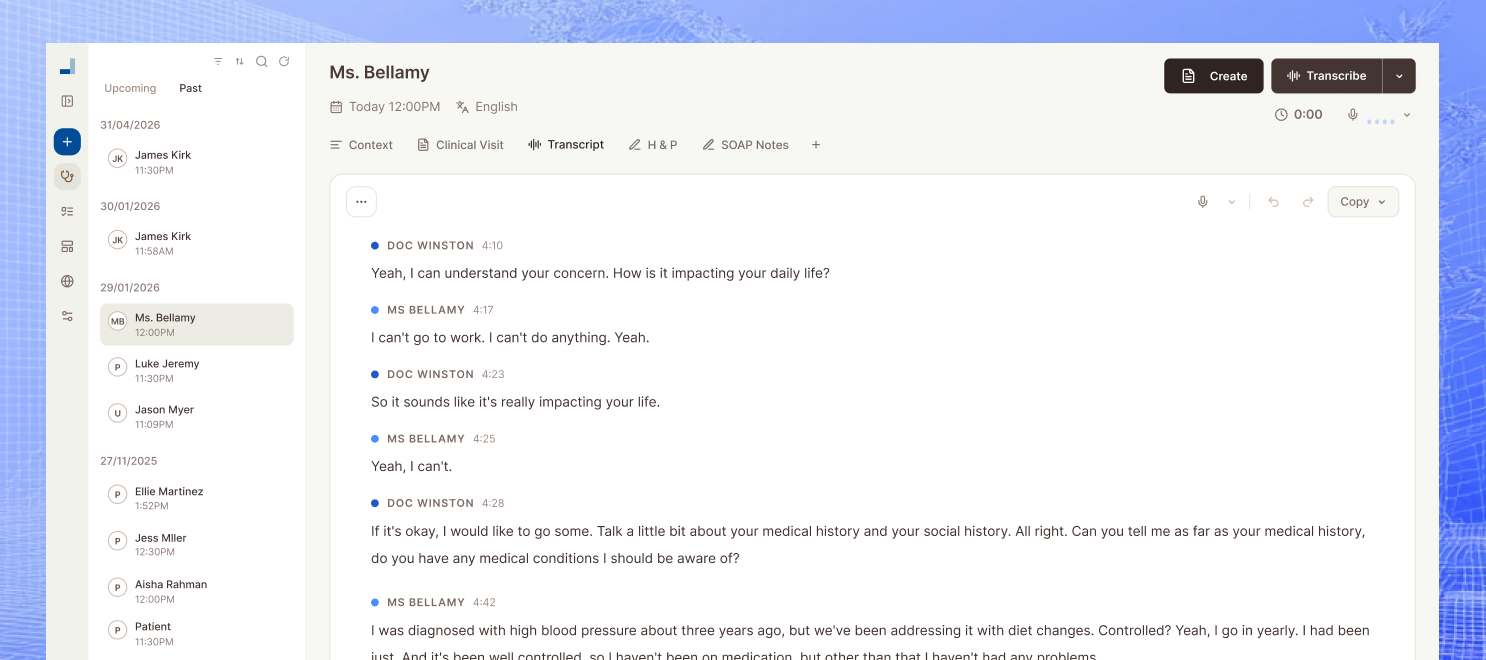
An AI medical scribe acts as a sophisticated assistant that listens to the natural conversation and extracts relevant clinical data. It is important to remember that these tools are assistive technologies; the clinician remains the final authority and holds the responsibility for the accuracy of the record. The scribe significantly reduces the time spent on administrative tasks, allowing doctors to focus entirely on the person sitting in front of them.
- Reduces the immense cognitive load of simultaneous charting.
- Eliminates the need for significant after-hours documentation.
- Captures natural dialogue that manual typing often misses.
- Enhances patient engagement by removing the laptop barrier.
Note types you can generate beyond SOAP (H&P and more)
While the SOAP note is a staple of medical education, it often fails to capture the complexity of specialized care or specific procedural outcomes. Relying solely on one format can lead to “note bloat” or, conversely, a lack of necessary detail for complex cases. Using an AI-driven approach allows for a more diverse range of documentation, including History and Physicals (H&P), detailed consult notes, and clear discharge summaries that are easy for both staff and patients to understand.
The structure of your documentation is vital for continuity of care. High-quality follow-up notes and referral letters ensure that the next provider in the chain of care has a clear picture of the patient’s trajectory. This level of detail is essential for audit readiness and provides a superior legal defense should a case ever be reviewed. Specialized templates for procedure notes also ensure that technical steps and safety-netting instructions are never omitted.
- H&P and Progress Notes: Detailed tracking of patient status over time.
- Consult and Referral Letters: Professional communication with other specialists.
- Procedure Notes: Step-by-step documentation of clinical interventions.
- Discharge Summaries: Clear instructions for the patient’s transition home.
How to implement capture safety-netting advice in notes with AI step-by-step
Transitioning your clinic to an AI-assisted workflow should be done carefully to avoid disrupting patient flow. Start by selecting one specific visit type—perhaps routine follow-ups or standard assessments—to pilot the technology. This allows you to get comfortable with the interface without the pressure of a complex emergency or a high-stakes surgical consult. Choose a quiet room with a stable internet connection to ensure the highest quality of audio transcription during these initial stages.
Before you begin the encounter, ensure your templates are set up by specialty. Customizing your headers and preferred phrasing beforehand ensures that the output feels natural to your specific style of practice. When you enter the room, simply start the recording and conduct the visit as you normally would. Focus on vocalizing your safety-netting advice clearly, such as, “If you develop a fever over 101 degrees or notice increased redness, you must call our office or go to the ER.”
Once the encounter is finished, the AI will process the audio and generate a draft. Take a few moments immediately after the patient leaves to review and edit the note while the details are still fresh in your mind. This rapid review cycle is the best way to maintain high data integrity. After finalizing the clinical note, you can reuse those same outputs to quickly generate patient-friendly letters or specific forms without having to re-type the same information.
- Identify one visit type to test the workflow initially.
- Configure specialized templates to match your practice style.
- Vocalize red flags clearly during the patient encounter.
- Review and finalize drafts immediately after the session.
How to keep note quality high and reduce mistakes
Even with advanced technology, clinical documentation requires a watchful eye. Common failure points in any medical record include missing or outdated medication lists, wrong numerical values, and the inclusion of irrelevant “filler” text. To maintain high standards, it is helpful to establish a team-wide standard for note formatting and review. This ensures that every practitioner in a clinic is producing consistent, high-quality data.
Developing a lightweight review habit is the most effective way to prevent errors. Rather than waiting until the end of the shift, spend 60 seconds at the end of each consult checking the key sections: the physical exam findings, the assessment, and the safety-netting instructions. If the tool ever produces “note bloat,” refine your templates to be more concise. Consistent feedback improves the system’s performance and your own speed over time.
- Verify medication dosages and specific numerical values manually.
- Adopt a “review as you go” habit to ensure immediate accuracy.
- Refine templates periodically to eliminate irrelevant information.
- Standardize clinical language across the entire practice group.
Privacy, consent, and patient trust (plain English)
Patient privacy is the cornerstone of the medical profession. Rules surrounding recording and data retention vary significantly by region and jurisdiction, so it is essential to follow your local healthcare policies. Most clinics find that being transparent and upfront about the technology is the best way to maintain trust. Patients generally appreciate that their doctor is looking at them rather than at a computer screen.
A simple script can help normalize the process: “I’m using a secure AI assistant today to record our conversation so I can focus 100% on you instead of typing on my computer. This helps me make sure I capture all your concerns and our plan for your care accurately. Is that okay with you?” This approach frames the technology as a benefit to the patient’s care quality and safety.
- Always verify local regulations regarding recording consent.
- Frame the technology as a way to improve face-to-face attention.
- Ensure data is stored on secure, healthcare-compliant servers.
- Provide patients with a clear way to opt-out if they feel uncomfortable.
Rolling it out across a clinic without disruption
A phased rollout is much more successful than a sudden, clinic-wide mandate. We recommend a 2-week pilot program involving one or two “tech-forward” clinicians. During this period, track specific metrics like time saved per day, the reduction in after-hours charting, and the perceived completeness of the notes. These data points will be invaluable when presenting the tool to the rest of the staff.
Training should focus on template alignment and the nuances of “speaking for the scribe.” Once the pilot group has ironed out the workflow, they can act as mentors for the rest of the team. This peer-to-peer training model is often more effective than formal seminars and helps build collective confidence in the new system.
- Start with a 2-week pilot featuring a small group of doctors.
- Track time savings and note quality as primary success metrics.
- Hold brief weekly syncs to align on template customizations.
- Designate internal “champions” to help train more skeptical staff.
Mcoy AI is an AI medical scribe that records and transcribes patient encounters, then generates multiple clinical note types (H&P, progress notes, consult notes, follow-up notes, procedure notes, discharge summaries, referral letters, and more). With over 200+ customizable templates and an AI chat feature, it allows clinicians to quickly create letters, forms, and specific documents tailored to their needs. It is designed to be a helpful partner in the exam room, ensuring that every detail of the patient encounter is captured without the burden of manual typing.
Summary and Conclusion
Mastering the modern clinical workflow means finding a balance between thorough documentation and personal well-being. By learning how to capture safety-netting advice in notes with AI, you are not just saving time; you are creating a safer environment for your patients and a more sustainable career for yourself. The transition from manual entry to AI-assisted transcription is a journey that starts with a single step—piloting the tool in your next follow-up visit. Embrace the change, refine your templates, and reclaim your time for what matters most: patient care.
SEO description: Learn how to capture safety-netting advice in notes with AI to improve patient safety, reduce charting time, and prevent physician burnout effectively.
What a serious review table should cover
| Decision area | Common mistake | Better clinic-ready approach | Metric to watch |
|---|---|---|---|
| Workflow design | Treat capture safety-netting advice in notes with ai | mcoy health as a one-off documentation task | Build a repeatable process with clear ownership and review points |
| Team adoption | Assume every clinician will naturally use the same process | Train for consistency and define exception handling early | Active user adoption |
| Quality review | Only check notes when a problem is reported | Audit a sample of notes weekly and review edge cases | Edit rate per note |
| Operational follow-through | Leave admin actions outside the documentation workflow | Use the same encounter data for referrals, letters, and follow-up tasks | Completion rate for next-step tasks |
Related reading
If you are working through capture safety-netting advice in notes with ai | mcoy health, it helps to read this alongside AI & Medicine: How to Simplify Clinical Notes for Busy Doctors, AI & Medicine: How Doctors Can Improve SOAP Notes, and Practice Operations: How to Set Up a Clinician Sign-Off Workflow for AI Notes. Those guides cover adjacent workflow, implementation, and evaluation questions so the decision does not sit in isolation.
FAQ
How accurate are AI medical scribes in real clinics?
Modern AI scribes are highly accurate when it comes to capturing the nuances of clinical dialogue, often exceeding the speed and detail of manual typing. However, the quality of the output depends on the clarity of the audio and the specific templates used. Clinicians should expect a brief learning curve as they adapt to vocalizing specific findings. Most users find that the drafts require only minor adjustments before they are ready for signing. Reliability in complex medical terminology has improved drastically with recent advancements in natural language processing.
Do I still need to review every note?
Yes, ethical and legal standards dictate that the clinician is ultimately responsible for the accuracy of the medical record. While the AI does the heavy lifting of transcribing and formatting, it cannot replace professional clinical judgment. A quick review ensures that all red flags, safety-netting advice, and medication updates are precisely recorded. This step is essential for maintaining high-quality care and protecting the clinician from potential errors. Thinking of the AI as a draft generator rather than a final author is the safest approach.
What note types can an AI scribe generate besides SOAP?
AI scribes are incredibly versatile and can generate a wide array of documentation formats beyond the standard SOAP note. This includes comprehensive History and Physicals (H&P), detailed procedure notes, consult letters for specialists, and discharge summaries for patients. Some systems also support referral letters, follow-up notes, and progress reports tailored to specific departments. The use of customizable templates allows these tools to adapt to almost any medical specialty. This variety ensures that every piece of documentation serves its intended clinical purpose.
Will this work for telehealth and in-person consults?
Yes, most AI medical scribing solutions are designed to be platform-agnostic, working effectively for both in-person and telehealth encounters. For in-person visits, a smartphone or tablet is usually sufficient to capture the audio clearly. For telehealth, the software can often integrate or run alongside video conferencing tools to process the digital audio feed directly. This flexibility is vital for modern clinics that offer a hybrid model of care. The core benefit of capturing natural conversation remains consistent regardless of the medium.
How do I explain recording/transcription to patients?
The best approach is to be brief, transparent, and focused on the benefits to the patient. You can explain that the tool allows you to look them in the eye and listen fully rather than typing on a computer. Most patients are comfortable with the technology when they understand it leads to a more accurate medical record and a more personal interaction. Having a short, standardized script helps you feel more confident and professional when introducing the device. Always offer the patient the option to opt-out to maintain their comfort and trust.
How do clinics prevent note bloat?
Note bloat is prevented by using well-designed, concise templates that prioritize high-value clinical information over verbatim transcripts. Clinicians should set their AI tools to focus on summarization rather than documenting every “um” and “ah” in the conversation. Regularly reviewing and refining your templates will help the AI learn which elements are essential for your specific practice style. By focusing the output on the assessment, plan, and safety-netting, the notes remain professional and readable. Less is often more when it comes to high-quality medical documentation.
How long does template setup take?
Basic template setup can often be completed in just a few minutes, especially if the system comes pre-loaded with standard medical formats. However, fine-tuning those templates to match your specific specialty and personal “voice” might take a few hours over the course of the first week of use. Many clinicians find it helpful to adjust their templates incrementally as they review their first few dozen notes. This iterative process ensures that the tool becomes more efficient the more you use it. It is a small time investment that pays off in hours saved later.
What’s the safest way to start if I’m skeptical?
The safest way to start is with a small pilot program focused on your least complex cases, such as routine check-ups or low-risk follow-ups. This allows you to verify the accuracy and security of the system without high stakes. You can continue to take minimal manual notes as a backup during this phase until you feel confident in the AI’s performance. Many skeptical clinicians find that their concerns vanish once they see the quality of the first few drafts. Starting slow ensures that you maintain full control of your workflow throughout the transition.