AI & Medicine: How to Capture Medications and Allergies with AI Scribes
Learn how to use an AI medical scribe to accurately document medications and allergies. Improve patient safety and reduce charting time today.
What a medical scribe solves in modern practice
For many clinicians, the most stressful part of a patient encounter isn’t the diagnosis; it’s the meticulous documentation of medication lists and allergy sensitivities. When after-hours charting becomes the norm, the risk of missing a drug-to-drug interaction or a critical allergy increases. Traditional manual entry is not only time-consuming but prone to human error, especially during hurried handovers or complex university clinic sessions.
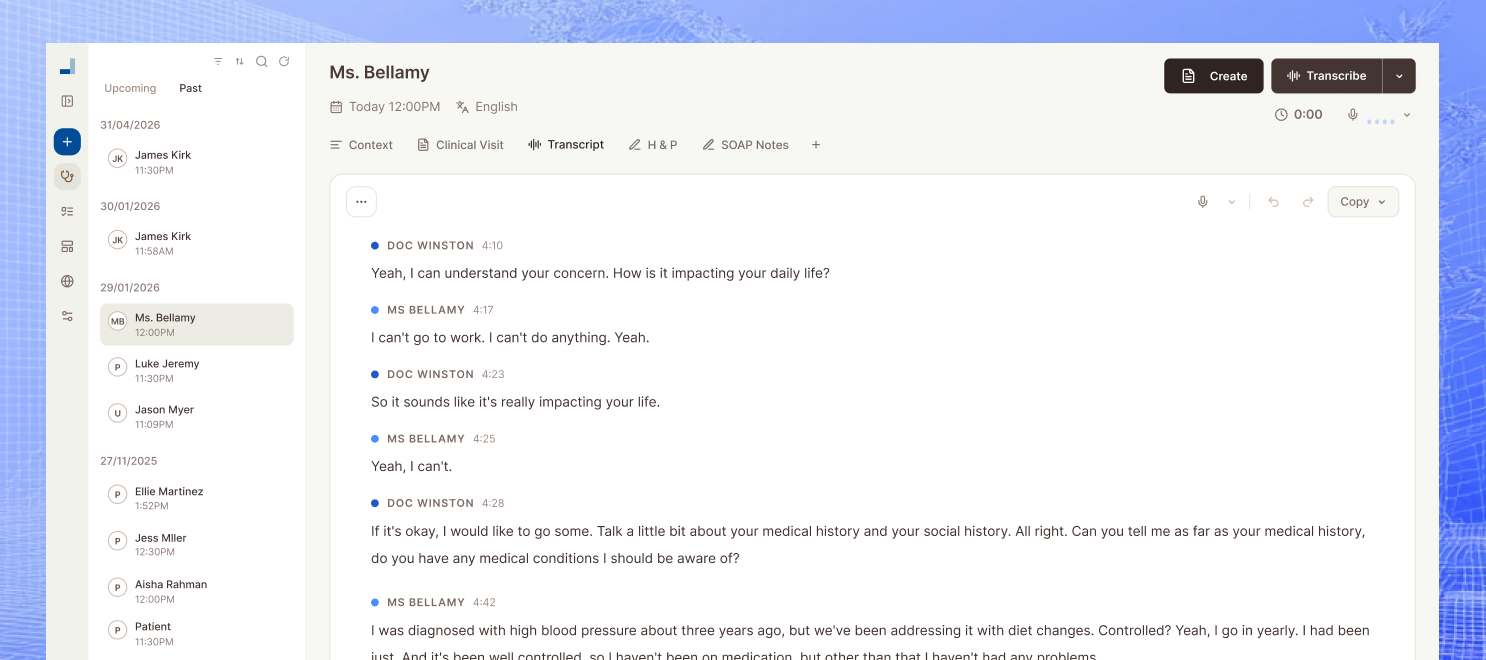
An AI medical scribe serves as a sophisticated digital assistant that listens to the natural conversation between the doctor and patient. It captures the nuance of dosage changes, discontinued meds, and specific allergic reactions in real-time. Crucially, the AI does not replace the physician’s judgment; it acts as a high-fidelity capture tool that ensures the raw data is ready for clinical review without the need for manual typing.
- Eliminates the cognitive load of memorizing lists during the exam.
- Reduces the ‘pajama time’ spent on administrative data entry.
- Captures exact patient phrasing regarding symptoms and side effects.
- Ensures clinical notes are finalized shortly after the encounter.
Note types you can generate beyond SOAP (H&P and more)
While the SOAP note is a standard in medicine, complex patients often require more specific documentation styles to ensure safety. Accurate capturing of medications and allergies is central to History and Physical (H&P) reports, where a comprehensive baseline is established. Consult notes also rely heavily on this data to provide specialists with a clear picture of the patient’s current regimen and previous adverse reactions.
Modern AI tools allow for the generation of varied formats including follow-up notes, procedure notes, and discharge summaries. For surgeons, a procedure note must clearly state which medications were administered or withheld, while a referral letter needs to highlight allergies to ensure the receiving physician doesn’t prescribe a contraindicated substance. Having these different outputs populated from a single recorded encounter improves continuity of care.
Using structured templates for these varied note types ensures that nothing is overlooked during an audit. When a scribe can instantly pivot from a progress note to a discharge summary, the administrative burden on the practitioner drops significantly. This structural consistency is particularly valuable in teaching hospitals and multi-disciplinary clinics where multiple providers access the same record.
- H&P and Consult notes for comprehensive baseline data.
- Discharge summaries that clearly list medication changes.
- Referral letters that prioritize allergy alerts for specialists.
- Procedure notes documenting perioperative medication management.
How to implement AI medical scribing step-by-step in a real clinic
The first step in a successful rollout is to choose a specific visit type to pilot, such as new patient intakes or chronic disease management reviews. These encounters are typically heavy on medication reconciliation and allergy updates. Begin by confirming your specialty-specific templates are configured to highlight these sections, ensuring the AI knows where to categorize pharmacological data.
During the encounter, whether in-person or via telehealth, simply conduct the interview as you normally would. Ensure you verbalize the specific names, dosages, and frequencies of medications as you discuss them with the patient. This vocalization serves the dual purpose of patient education and providing the AI with clear data points to transcribe into the medical record.
Once the encounter ends, immediately review the generated output. The AI will have organized the spoken dialogue into a formatted note. This is the time to verify that any complex drug names or specific allergy triggers were captured correctly. Once verified, you can use the AI’s tools to instantly generate secondary documents like referral letters or school forms based on the captured data.
- Start with one high-volume visit type to build confidence.
- Verbalize dosages and frequencies clearly during the exam.
- Review the AI-generated draft for clinical accuracy immediately.
- Repurpose the captured data for letters and administrative forms.
How to keep note quality high and reduce mistakes
To maintain high standards, clinicians should be mindful of ‘note bloat’—the inclusion of unnecessary or repetitive data. While an AI captures everything, the clinician’s role is to ensure the final note reflects the most relevant clinical information. Common failure points like misspelling a similar-sounding drug name can be mitigated by a quick scan of the medication list before signing off.
Establishing a lightweight review habit is essential. Instead of re-typing, focus on confirming that any new allergies or medication changes are prominently featured. Setting team standards for how medications are listed (e.g., generic vs. brand name) ensures that everyone in the clinic is on the same page, resulting in a cleaner, more professional legal record.
- Focus on reviewing drug names and allergy triggers for accuracy.
- Avoid note bloat by removing redundant or irrelevant dialogue.
- Standardize naming conventions across the entire clinical team.
- Perform a final ‘safety check’ on the problem list before saving.
Privacy, consent, and patient trust (plain English)
Privacy is the cornerstone of the patient-provider relationship. Most patients are comfortable with AI scribing once they understand it allows their doctor to look at them rather than a screen. It is important to follow your local regional guidelines regarding recording consent and data retention, as these laws vary significantly by jurisdiction.
A simple way to explain this to a patient is: ‘I’m using a digital assistant today to record our conversation so I can focus entirely on you instead of my computer. It helps me make sure I get your medication list and history exactly right. Is that okay with you?’ Most patients appreciate the transparency and the increased eye contact it provides.
- Always obtain verbal or written consent based on local policy.
- Explain the technology as a tool for accuracy and attention.
- Ensure the scribe software meets high-level data security standards.
- Maintain transparency about how and where data is stored.
Rolling it out across a clinic without disruption
A smooth rollout requires a phased approach, typically starting with a two-week pilot involving one or two ‘tech-forward’ providers. During this phase, track metrics such as time saved on charting and the reduction in after-hours work. These tangible results help gain buy-in from more skeptical staff members or administrators.
Weekly check-ins during the rollout can help align templates across different specialties. For example, a pediatrician might need a different allergy layout than a gerontologist. By sharing best practices and refined templates, the entire clinic can transition to AI-assisted documentation without interrupting patient flow or reducing the daily appointment volume.
- Conduct a 2-week pilot with a small group of clinicians.
- Monitor time-saving metrics and note completeness regularly.
- Hold brief meetings to align and share custom templates.
- Provide clear training on how to handle recording in various zones.
Mcoy AI is an AI medical scribe that records and transcribes patient encounters, then generates multiple clinical note types including H&P, progress notes, consult notes, follow-up notes, procedure notes, discharge summaries, referral letters, and more. With over 200+ customizable templates and an interactive AI chat, clinicians can easily create letters, forms, and specialized documents from their recorded sessions, ensuring every medication and allergy is documented with precision.
Conclusion
Successfully integrating an AI scribe into your workflow transforms the way you handle complex clinical data. By focusing on a structured rollout and clear communication, you ensure that every medication change and allergy alert is captured with the highest degree of accuracy. Using an AI medical scribe allows you to return your focus to the patient, confident that your documentation is complete and your medical-legal risks are minimized. Start your pilot today and reclaim your time for what matters most: patient care.
What a serious review table should cover
| Decision area | Common mistake | Better clinic-ready approach | Metric to watch |
|---|---|---|---|
| Workflow design | Treat how to capture medications and allergies with ai scribes as a one-off documentation task | Build a repeatable process with clear ownership and review points | Time to complete documentation |
| Team adoption | Assume every clinician will naturally use the same process | Train for consistency and define exception handling early | Active user adoption |
| Quality review | Only check notes when a problem is reported | Audit a sample of notes weekly and review edge cases | Edit rate per note |
| Operational follow-through | Leave admin actions outside the documentation workflow | Use the same encounter data for referrals, letters, and follow-up tasks | Completion rate for next-step tasks |
Related reading
If you are working through how to capture medications and allergies with ai scribes, it helps to read this alongside AI & Medicine: How to Simplify Clinical Notes for Busy Doctors, AI & Medicine: How Doctors Can Improve SOAP Notes, and AI & Medicine: Reduce AI Clinical Note Errors: A Guide for Clinicians. Those guides cover adjacent workflow, implementation, and evaluation questions so the decision does not sit in isolation.
FAQ
How accurate are AI medical scribes in real clinics?
AI medical scribes are highly accurate in capturing the dialogue between a clinician and a patient, often exceeding the detail found in manual notes. However, accuracy depends on clear verbalization of clinical details like drug names and dosages. While the AI is excellent at transcription, it is an assistive tool that requires a final review by the licensed professional.
Do I still need to review every note?
Yes, the clinician remains the legally responsible party for the accuracy of the medical record. The AI generates a draft based on the encounter, but the doctor must review and sign off to ensure clinical correctness. This review process is significantly faster than writing a note from scratch, often taking only a minute or two.
What note types can an AI scribe generate besides SOAP?
Modern AI scribes are capable of generating a wide variety of formats beyond the standard SOAP note. These include History and Physical (H&P) reports, consult notes, procedure notes, discharge summaries, and referral letters. The AI uses the recorded data to populate the specific fields required for each unique document type.
Will this work for telehealth and in-person consults?
AI medical scribes are versatile and work across both in-person and telehealth environments. For telehealth, the AI can often integrate with the video platform or record the audio from the computer. In person, a simple mobile device or tablet is used to capture the conversation, allowing for seamless documentation regardless of the setting.
How do I explain recording/transcription to patients?
The best approach is to be brief and emphasize the benefit to the patient. You can explain that the tool allows you to focus on the conversation rather than a keyboard. Most patients are supportive once they realize it leads to more attentive care and more accurate medical records.
How do clinics prevent note bloat?
Note bloat is prevented by using structured templates that instruct the AI to capture only relevant clinical information. Clinicians can also refine their templates to ensure that only necessary sections—like Assessment and Plan—are detailed, while avoiding the inclusion of every filler word from the transcript.
How long does template setup take?
Initial template setup is typically very fast, especially when using pre-built libraries. Most clinicians can select and customize their core templates in under an hour. As you use the system, you can make minor adjustments in real-time to perfect the output for your specific workflow.
What’s the safest way to start if I’m skeptical?
The safest way to start is with a small pilot program using non-complex cases or routine follow-ups. This allows you to see the quality of the output and become comfortable with the consent process. As you see the time savings and accuracy, you can gradually expand the use of the AI scribe to more complex encounters.