Specialty Guides: Build a Telehealth Notes Template Pack | Free Guide
Learn how to build a professional telehealth notes template pack. Improve clinic efficiency and reduce charting time with our free guide for doctors.
What a medical scribe solves in modern practice
The transition to virtual care has introduced unique burdens on the modern clinician. While telehealth offers accessibility, the documentation requirements often lead to significant cognitive load and after-hours charting. Doctors frequently find themselves typing throughout the entire video call, which degrades the patient-clinician connection and leads to rushed, incomplete notes that may miss subtle verbal cues.
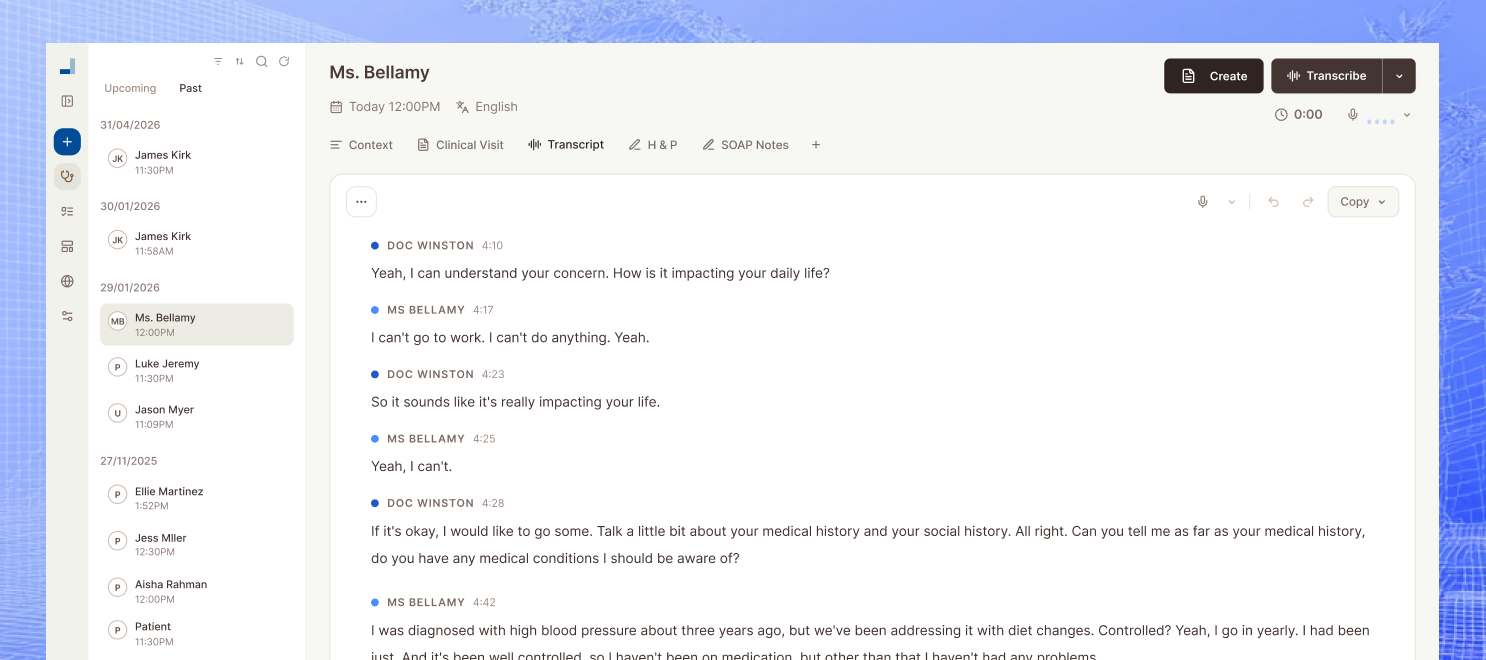
An AI medical scribe serves as an assistive partner in this digital environment. It captures the nuances of the conversation automatically, allowing the practitioner to maintain eye contact with the screen rather than a keyboard. It is important to remember that these tools are assistive; the clinician remains the final authority and is responsible for verifying the accuracy of every entry before it enters the legal health record.
- Reduces administrative burnout by automating real-time documentation.
- Enhances patient engagement by allowing clinicians to focus on the conversation.
- Ensures clinical details are captured accurately without manual shorthand.
- Supports better work-life balance by eliminating late-night charting sessions.
Note types you can generate beyond SOAP (H&P and more)
While the SOAP format is a staple in medicine, telehealth often requires a broader range of documentation to support continuity of care. A comprehensive template pack should include History and Physical (H&P) summaries, specialized consult notes, and follow-up assessments. These formats ensure that the virtual encounter meets the same rigorous standards as an in-person visit, particularly for complex cases or new patient intakes.
Beyond standard visits, clinicians frequently need to generate procedure notes, discharge summaries, and detailed referral letters based on virtual findings. Having a structured approach to these diverse note types ensures audit readiness and high-quality handovers between multidisciplinary teams. This structural consistency is vital for university clinics and large practices where multiple providers may interact with the same patient record.
- H&P and Consult notes for comprehensive initial virtual assessments.
- Progress and Follow-up notes to track chronic disease management.
- Referral letters and Discharge summaries for seamless care transitions.
- Procedure notes for documenting guided self-exams or virtual instructions.
How to implement telehealth notes template pack step-by-step in a real clinic
Starting the journey to a more efficient workflow begins with selecting a single, common visit type, such as a routine follow-up or a specific chronic condition review. This narrow focus allows the team to refine the template without being overwhelmed by the entire scope of practice. Once the initial template feels right, clinicians can expand the library to include specialty-specific formats that reflect the unique data points required for their field.
During the encounter, the clinician should focus entirely on the patient, whether via a dedicated telehealth platform or a standard video interface. The AI captures the dialogue in the background. After the call ends, the generated draft is reviewed and edited for precision. This process takes a fraction of the time compared to traditional typing. Finally, the outputs can be instantly repurposed to create referral letters or patient instruction forms, ensuring every piece of documentation is derived from the same accurate source.
- Identify one frequent visit type to pilot the new template structure.
- Build a library of specialty-specific templates for consistent data capture.
- Capture the encounter naturally and review the generated draft immediately.
- Convert drafted notes into secondary documents like referrals or school notes.
How to keep note quality high and reduce mistakes
Maintaining high-quality documentation in a digital-first environment requires vigilance against common failure points such as missing medications, incorrect lab values, or “note bloat.” Note bloat occurs when irrelevant information is pulled into the record, making it difficult for other providers to find the most pertinent clinical data. Establishing a standard for what constitutes a “clean” note is essential for team-wide consistency.
A lightweight review habit—spending 60 to 90 seconds per note immediately after the encounter—is the most effective way to catch errors while the conversation is still fresh. Setting clinic-wide standards for problem lists and medication reconciliation ensures that every provider is working from the same high-quality foundation, which drastically reduces medico-legal risks and improves patient safety.
- Implement a quick post-visit review habit to verify medication and dosages.
- Define clear standards for note length to prevent unnecessary documentation bloat.
- Regularly audit a small sample of notes for clinical accuracy and coding compliance.
- Ensure the problem list is updated and succinct in every virtual encounter.
Privacy, consent, and patient trust (plain English)
Patient trust is the cornerstone of any successful telehealth program. It is essential to understand that consent requirements for recording and transcription vary significantly by region and local jurisdiction. Clinicians must always follow their specific local policies and institutional guidelines to remain compliant. Transparency about the tools being used is usually the best approach to maintaining the therapeutic alliance.
Explaining the technology to a patient can be done simply. You might say, “To help me focus entirely on our conversation today, I’m using a digital assistant that helps me write my medical notes. It records what we say so I don’t have to type while we talk. Is that okay with you?” This approach frames the technology as a tool for better care rather than a privacy intrusion. Most patients appreciate the extra attention they receive when the doctor isn’t staring at a keyboard.
- Always adhere to local and regional privacy regulations regarding recording.
- Use a simple, transparent script to obtain verbal patient consent.
- Explain the benefits of the technology, such as one-on-one focus and accuracy.
- Ensure that all data retention practices align with your clinic’s security policy.
Rolling it out across a clinic without disruption
A successful rollout starts with a two-week pilot involving a small group of “super-users” who can test the templates and workflows. During this phase, the clinic should track key metrics such as time saved per note, the reduction in after-hours charting, and the overall completeness of the clinical record. This data helps build a case for wider adoption among more skeptical staff members.
Training should focus on template alignment so that all practitioners are using the same language and structure. This uniformity makes it easier for staff to cover for one another and improves the quality of the data available for research or quality improvement projects. Once the pilot is successful, the workflow can be scaled across the entire facility with minimal friction, leading to a more focused and less stressed clinical team.
- Launch a 14-day pilot with a small group of clinicians to iron out kinks.
- Monitor time-savings and note quality to demonstrate clear value.
- Standardize templates across the clinic for better internal communication.
- Provide brief, hands-on training sessions to ensure all staff feel confident.
Mcoy AI is an AI medical scribe that records and transcribes patient encounters, then generates multiple clinical note types (H&P, progress notes, consult notes, follow-up notes, procedure notes, discharge summaries, referral letters, and more). It features 200+ customizable templates and an AI chat interface to create letters, forms, and other essential documents directly from the encounter data, helping clinicians focus more on patient care and less on administrative tasks.
Conclusion
Building a robust telehealth notes template pack is a transformative step for any modern practice. By moving beyond basic SOAP notes and implementing a structured, automated workflow, you can reclaim hours of your day while improving the clinical accuracy of your records. The key is to start small, prioritize patient consent, and consistently review your documentation for quality. Using a telehealth notes template pack effectively ensures that your practice remains efficient, compliant, and—most importantly—focused on delivering exceptional patient care.
What a serious review table should cover
| Decision area | Common mistake | Better clinic-ready approach | Metric to watch |
|---|---|---|---|
| Workflow design | Treat build a telehealth notes template pack | free guide as a one-off documentation task | Build a repeatable process with clear ownership and review points |
| Team adoption | Assume every clinician will naturally use the same process | Train for consistency and define exception handling early | Active user adoption |
| Quality review | Only check notes when a problem is reported | Audit a sample of notes weekly and review edge cases | Edit rate per note |
| Operational follow-through | Leave admin actions outside the documentation workflow | Use the same encounter data for referrals, letters, and follow-up tasks | Completion rate for next-step tasks |
Related reading
If you are working through build a telehealth notes template pack | free guide, it helps to read this alongside Specialty Guides: How to Run a More Efficient Medical Practice in 2026, Specialty Guides: How to Improve Patient Encounters, and AI & Medicine: Capture Safety-Netting Advice in Notes With AI | Mcoy Health. Those guides cover adjacent workflow, implementation, and evaluation questions so the decision does not sit in isolation.
FAQ
How accurate are AI medical scribes in real clinics?
In real-world clinical settings, AI medical scribes are remarkably accurate at capturing the dialogue between a doctor and patient. They excel at clinical terminology and can distinguish between different speakers effectively. However, they are not a replacement for medical judgment, and clinicians should always perform a quick review to ensure specific details like dosages or complex diagnoses are captured precisely. Most users find that the drafts require only minor adjustments before they are ready for the EHR.
Do I still need to review every note?
Yes, reviewing every note is a critical step in the clinical workflow. As the licensed provider, you are legally responsible for the documentation in the patient’s record. While the AI does the heavy lifting of transcribing and formatting, your role is to verify that the clinical reasoning is sound and the facts are correct. This review process is typically very fast, often taking less than a minute per encounter.
What note types can an AI scribe generate besides SOAP?
Modern AI scribes are highly versatile and can generate a wide array of documentation beyond the standard SOAP note. This includes History and Physical (H&P) summaries, specialized consultation notes, follow-up reports, and even complex procedure notes. Additionally, they can help draft referral letters and discharge summaries by extracting the most relevant information from the recorded encounter, ensuring consistency across all forms of documentation.
Will this work for telehealth and in-person consults?
Absolutely, the technology is designed to be flexible for both environments. For telehealth, the scribe can capture audio directly from the computer system or a secondary device during the video call. For in-person visits, it functions similarly to a traditional scribe by listening to the room’s audio. This allows for a seamless documentation experience regardless of how the patient is being seen.
How do I explain recording/transcription to patients?
Transparency is key to maintaining patient trust. A simple way to explain it is to tell the patient that you are using a digital assistant to help with note-taking so that you can focus entirely on them rather than your computer. Most patients are very supportive of this because they feel they are getting more of their doctor’s undivided attention. Always ensure you are following your local legal requirements regarding patient consent for audio recording.
How do clinics prevent note bloat?
Clinics can prevent note bloat by using concise templates that emphasize quality over quantity. Instead of asking the AI to capture every single word spoken, templates should be configured to extract only the medically relevant data points and clinical reasoning. Standardizing these templates across the practice ensures that every provider produces notes that are succinct, readable, and focused on essential care details.
How long does template setup take?
Setting up a basic set of templates can take as little as 30 to 60 minutes. Most systems come with pre-built templates for common specialties that can be adjusted to fit your specific workflow. Refining them into a custom “pack” for your clinic might take a few days of testing during real encounters, but the long-term time savings far outweigh this initial investment.
What’s the safest way to start if I’m skeptical?
The safest approach is to start with a “shadow pilot” where you use the scribe alongside your traditional charting method for one or two non-complex patients per day. This allows you to compare the AI-generated notes with your own manual notes without any risk to patient care. Once you see the accuracy and the time saved, you can gradually increase its use across more of your daily schedule.