Practice Operations: How to Use AI Scribing Without Integration [Full Guide]
Learn how to use AI scribing when direct EHR integration isn't an option. Optimize your workflow, save time, and improve note quality with this manual guide.
How to Use AI Scribing When You Can’t Integrate Directly
Many clinicians find themselves in a frustrating position: they recognize the immense value of artificial intelligence in documentation, but their specific electronic health record (EHR) system is closed, outdated, or too costly to integrate via API. This often leads to after-hours charting, persistent burnout, and a mounting pile of unfinished progress notes. The anxiety of potentially missing a critical detail during a rushed encounter can weigh heavily on even the most experienced private practitioners.
This guide provides a comprehensive roadmap for implementing AI scribing as a standalone solution. We will explore how to manage complex workflows, move beyond the basic SOAP format into specialized note types, and maintain high quality control without a direct sync. Whether you are a GP in a small clinic, a specialist in a university hospital, or a provider navigating the unique demands of telehealth, these strategies will help you reclaim your time from the keyboard.
What a medical scribe solves in modern practice
Modern practitioners face a hidden tax on their productivity known as the cognitive load of documentation. When a doctor is forced to type while a patient speaks, eye contact is broken, and subtle clinical cues can be missed. The real cost isn’t just the minutes spent typing; it is the mental exhaustion that follows a day of dual-tasking. AI scribing acts as a cognitive assistant, allowing the clinician to focus entirely on the human interaction while the system captures the clinical narrative in the background.
It is important to remember that while these tools are powerful, they are assistive rather than autonomous. The clinician remains the final authority and is legally responsible for the accuracy of every note. By offloading the initial drafting process, the provider shifts from being a data entry clerk to being a medical editor. This subtle shift significantly reduces the ‘pajama time’ spent finishing notes at home, ensuring that documentation is completed shortly after the encounter while the details are still fresh.
- Reduces physician burnout by eliminating manual typing during and after visits.
- Enhances patient engagement by allowing for better eye contact and listening.
- Ensures more detailed and accurate records by capturing dialogue in real-time.
- Functions as a drafting assistant, leaving the final clinical review to the provider.
Note types you can generate beyond SOAP (H&P and more)
While the SOAP note is the industry standard for daily progress, clinical practice often demands more specialized documentation. Relying solely on one format can lead to gaps in the patient record or excessive ‘note bloat’ where irrelevant information is carried over. Using AI to generate diverse note types ensures that the documentation matches the specific clinical intent of the visit, whether it is an initial assessment or a complex surgical procedure.
Sophisticated AI tools can now produce comprehensive History and Physical (H&P) reports, detailed consult notes for specialists, and precise procedure notes that capture the nuances of an intervention. For patients transitioning out of care, discharge summaries and referral letters can be structured automatically. This variety is crucial for continuity of care, as it provides subsequent providers with a clear, structured narrative that is easy to digest during handovers or audits.
Consistency in these formats also protects the practice from a medico-legal perspective. When every follow-up note or referral letter follows a standardized, high-quality structure, the risk of miscommunication or omitted data drops significantly. By moving beyond the basic SOAP structure, clinics can ensure that their documentation is truly fit for purpose across all departments.
- H&P and Consult Notes for comprehensive initial patient evaluations.
- Procedure and Follow-up notes for tracking specific treatments and outcomes.
- Discharge summaries and referral letters to facilitate smooth care transitions.
- Standardized documentation that improves audit readiness and legal compliance.
How to implement AI scribing step-by-step in a real clinic
Starting with AI scribing when you can’t integrate directly requires a disciplined but simple workflow. Begin by selecting one specific visit type, such as routine follow-ups or wellness exams, to pilot the process. This allows your team to get comfortable with the tool without feeling overwhelmed by the entire patient load. Once you’ve selected the visit type, select or customize a template that matches your specialty’s requirements.
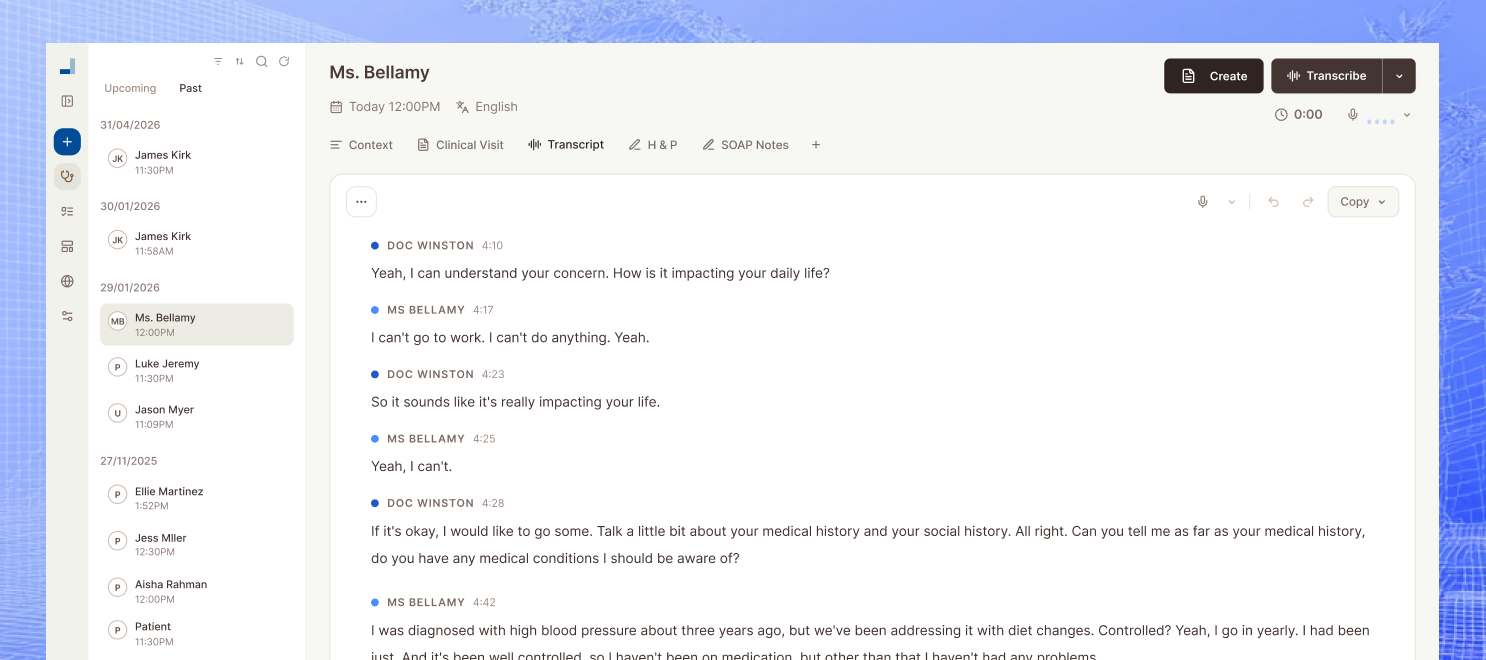
During the encounter, whether in-person or via a telehealth platform, use the AI tool to capture the audio on a secondary device or a separate browser window. Focus entirely on the patient, using your natural clinical dialogue to guide the ‘story’ of the visit. Once the encounter ends, the AI will generate a draft almost immediately. This is the moment to perform a quick review and edit for any specific clinical nuances that need adjustment.
Since the tool isn’t integrated into your EHR, the final step involves a simple copy-and-paste of the refined note into your clinical software. While this adds one manual step, the time saved in drafting the content from scratch far outweighs the few seconds spent moving the text. Finally, reuse the AI-generated outputs to quickly create any necessary referral letters or patient instructions by prompting the tool to summarize the visit findings into those specific documents.
- Start with one visit type to master the workflow before scaling.
- Use customizable templates to match your specific specialty needs.
- Review and edit the AI draft immediately after the visit for maximum accuracy.
- Copy and paste the final text into your EHR as a seamless manual workaround.
How to keep note quality high and reduce mistakes
Maintaining high-quality documentation in an AI-assisted environment requires a ‘human-in-the-loop’ approach. The most common failure points include missing specific medication dosages or the inclusion of ‘note bloat’ where the AI might include conversational filler. To prevent this, clinicians should adopt a lightweight review habit, scanning the draft for key vitals, drug names, and the final assessment and plan before finalizing the document.
Establishing team standards also helps in keeping quality consistent across a clinic. If multiple providers are using the tool, agree on how certain data points should be captured and which templates are the gold standard for your practice. Regularly reviewing a small sample of notes as a team can help identify if the AI is consistently misinterpreting specific clinical jargon used in your specific field, allowing you to adjust your templates or speaking style accordingly.
- Perform a focused review of medication dosages and objective values.
- Avoid note bloat by selecting templates that prioritize concise summaries.
- Develop clinic-wide standards for template usage and note structure.
- Periodically audit a sample of notes to ensure ongoing clinical accuracy.
Privacy, consent, and patient trust (plain English)
Patient trust is the foundation of any successful medical practice, and introducing recording technology requires transparency. Consent requirements vary by region and local jurisdiction, so it is vital to follow your local healthcare policy and board guidelines. In most cases, a simple verbal or written agreement from the patient is sufficient to begin using an AI scribe during their visit.
A simple way to explain this to a patient is: ‘To ensure I can focus entirely on you today and keep an accurate record, I use an AI assistant to help me draft my notes. It records our conversation, transcribes it, and then deletes the audio once my note is finished. Is that okay with you?’ Most patients appreciate the extra attention they receive when the doctor isn’t staring at a screen. Security-wise, ensure the tool you choose uses enterprise-grade encryption and has a clear policy on data retention and HIPAA/GDPR compliance.
- Always obtain informed consent before starting a recording.
- Use a transparent, simple script to explain the benefits to the patient.
- Verify that the technology provider adheres to strict data security standards.
- Ensure that audio files are deleted according to a strict, short-term policy.
Rolling it out across a clinic without disruption
A successful rollout starts with a two-week pilot program involving one or two ‘champion’ clinicians. These early adopters can iron out the manual workflow and develop a set of best practices for the rest of the team. During this pilot, track specific metrics such as the time spent on notes per day and the reduction in after-hours work. Seeing tangible data on time savings is the best way to gain buy-in from skeptical staff members.
Training should focus on both the technical use of the app and the ‘art’ of clinical narration—speaking your thoughts aloud so the AI can capture your clinical reasoning. By aligning templates across the clinic, you ensure that even if the software isn’t directly integrated with the EHR, the output remains uniform and professional. This structured approach prevents the chaos of everyone using the tool differently and ensures a smooth transition for administrative staff as well.
- Run a two-week pilot with a small group of clinicians to test the workflow.
- Track time saved and note completion rates to demonstrate ROI.
- Train staff on clinical narration to improve the quality of AI drafts.
- Standardize templates across the practice for a uniform professional output.
Mcoy AI is an AI medical scribe that records and transcribes patient encounters, then generates multiple clinical note types (H&P, progress notes, consult notes, follow-up notes, procedure notes, discharge summaries, referral letters, and more). It features 200+ customizable templates and an AI chat function that allows clinicians to create letters, forms, and other documents instantly. By simplifying the documentation process, it helps practitioners focus on patient care without the burden of manual charting.
FAQ
Transitioning to a new documentation workflow often raises practical questions about accuracy and efficiency. Here are the most common inquiries from clinicians looking to optimize their practice.
How accurate are AI medical scribes in real clinics?
AI scribes are remarkably accurate at capturing the narrative flow and clinical facts of an encounter. While they may occasionally struggle with very heavy accents or highly niche technical jargon, they generally produce drafts that are 80-90% complete. The clinician’s role is to provide the final 10% of refinement and clinical oversight. Regular use actually allows the AI to become more attuned to your personal speaking style and common phrases.
Do I still need to review every note?
Yes, the clinician is the person of record and must review every note for accuracy and completeness. The AI is a drafting tool, not a replacement for clinical judgment. However, reviewing and editing a pre-generated draft is significantly faster than writing a note from scratch. Most providers find that they can finalize a note in less than 60 seconds after the AI has finished its initial document generation.
What note types can an AI scribe generate besides SOAP?
Modern AI scribes are versatile and can generate a wide range of documents including History and Physicals (H&P), detailed Consult Notes, Procedure Notes, and Discharge Summaries. They can also be used to draft referral letters and patient education summaries based on the encounter. This variety ensures that every aspect of the patient’s journey is documented in the appropriate professional format beyond just the daily progress note.
Will this work for telehealth and in-person consults?
Absolutely. For in-person visits, the AI can record via a smartphone or tablet placed on the desk. For telehealth, the AI can capture audio directly from the computer speakers or through a browser extension. The process remains the same: the system listens to the conversation, identifies the key medical data, and structures it into your chosen template regardless of how the meeting is physically conducted.
How do I explain recording/transcription to patients?
The best approach is to be direct and highlight the benefit to the patient. Explain that the tool allows you to listen to them better because you don’t have to type. Emphasize that the recording is used only to create a medical note and is handled with the same privacy as any other part of their medical record. Most patients are very supportive when they realize it means their doctor will be more present during the visit.
How do clinics prevent note bloat?
Note bloat is prevented by using highly structured and concise templates. Instead of transcribing every single word spoken, the AI is programmed to extract only the medically relevant information. Clinicians can also select ‘concise’ versions of templates or use AI chat features to summarize a long encounter into a few punchy, high-impact paragraphs that satisfy billing and clinical requirements without unnecessary filler.
How long does template setup take?
Initial template setup usually takes only a few minutes. Most clinicians start with pre-built templates for their specialty and then make minor adjustments over the first few days of use. Because the templates are customizable, you can easily add or remove sections to mirror the exact flow you are used to in your EHR. Once these are set, they become the permanent foundation for all your future notes.
What’s the safest way to start if I’m skeptical?
The safest way to start is to use the tool for non-complex, ‘easy’ cases like simple follow-ups or vaccinations. This allows you to see the quality of the output in a low-risk scenario. You don’t need to change your entire practice overnight; you can simply use it as a ‘back-up’ draft for a few days until you feel confident in its ability to capture your clinical reasoning accurately and securely.
Conclusion
Implementing a new documentation workflow doesn’t have to depend on your IT department. By using the strategies outlined in this guide, you can successfully learn how to use AI scribing when you can’t integrate directly into your EHR. By focusing on template variety, clear patient communication, and a disciplined review process, you can significantly reduce your administrative burden. Take the first step by piloting this workflow in your clinic today and see how much time you can reclaim for what matters most: your patients.
What a serious review table should cover
| Decision area | Common mistake | Better clinic-ready approach | Metric to watch |
|---|---|---|---|
| Workflow design | Treat how to use ai scribing without integration [full guide] as a one-off documentation task | Build a repeatable process with clear ownership and review points | Time to complete documentation |
| Team adoption | Assume every clinician will naturally use the same process | Train for consistency and define exception handling early | Active user adoption |
| Quality review | Only check notes when a problem is reported | Audit a sample of notes weekly and review edge cases | Edit rate per note |
| Operational follow-through | Leave admin actions outside the documentation workflow | Use the same encounter data for referrals, letters, and follow-up tasks | Completion rate for next-step tasks |
Related reading
If you are working through how to use ai scribing without integration [full guide], it helps to read this alongside Practice Operations: How Clinics Can Streamline Daily Operations, Practice Operations: How Clinics Can Improve Workflow Without Changing Their EHR, and AI & Medicine: Customize Mcoy AI Templates: Specialty Guide for Doctors. Those guides cover adjacent workflow, implementation, and evaluation questions so the decision does not sit in isolation.
FAQ
How accurate are AI medical scribes in real clinics?
AI scribes are remarkably accurate at capturing the narrative flow and clinical facts of an encounter. While they may occasionally struggle with very heavy accents or highly niche technical jargon, they generally produce drafts that are 80-90% complete. The clinician’s role is to provide the final 10% of refinement and clinical oversight. Regular use actually allows the AI to become more attuned to your personal speaking style and common phrases.
Do I still need to review every note?
Yes, the clinician is the person of record and must review every note for accuracy and completeness. The AI is a drafting tool, not a replacement for clinical judgment. However, reviewing and editing a pre-generated draft is significantly faster than writing a note from scratch. Most providers find that they can finalize a note in less than 60 seconds after the AI has finished its initial document generation.
What note types can an AI scribe generate besides SOAP?
Modern AI scribes are versatile and can generate a wide range of documents including History and Physicals (H&P), detailed Consult Notes, Procedure Notes, and Discharge Summaries. They can also be used to draft referral letters and patient education summaries based on the encounter. This variety ensures that every aspect of the patient’s journey is documented in the appropriate professional format beyond just the daily progress note.
Will this work for telehealth and in-person consults?
Absolutely. For in-person visits, the AI can record via a smartphone or tablet placed on the desk. For telehealth, the AI can capture audio directly from the computer speakers or through a browser extension. The process remains the same: the system listens to the conversation, identifies the key medical data, and structures it into your chosen template regardless of how the meeting is physically conducted.
How do I explain recording/transcription to patients?
The best approach is to be direct and highlight the benefit to the patient. Explain that the tool allows you to listen to them better because you don’t have to type. Emphasize that the recording is used only to create a medical note and is handled with the same privacy as any other part of their medical record. Most patients are very supportive when they realize it means their doctor will be more present during the visit.
How do clinics prevent note bloat?
Note bloat is prevented by using highly structured and concise templates. Instead of transcribing every single word spoken, the AI is programmed to extract only the medically relevant information. Clinicians can also select ‘concise’ versions of templates or use AI chat features to summarize a long encounter into a few punchy, high-impact paragraphs that satisfy billing and clinical requirements without unnecessary filler.
How long does template setup take?
Initial template setup usually takes only a few minutes. Most clinicians start with pre-built templates for their specialty and then make minor adjustments over the first few days of use. Because the templates are customizable, you can easily add or remove sections to mirror the exact flow you are used to in your EHR. Once these are set, they become the permanent foundation for all your future notes.
What’s the safest way to start if I’m skeptical?
The safest way to start is to use the tool for non-complex, ‘easy’ cases like simple follow-ups or vaccinations. This allows you to see the quality of the output in a low-risk scenario. You don’t need to change your entire practice overnight; you can simply use it as a ‘back-up’ draft for a few days until you feel confident in its ability to capture your clinical reasoning accurately and securely.