Specialty Guides: How to Use an AI Scribe for Cardiology Clinic Notes
Master AI cardiology documentation. Learn how AI scribes streamline H&P, consults, and procedure notes for faster, more accurate cardiology clinic workflows.
The Documentation Burden in Cardiology
Cardiologists face a unique documentation challenge: the intersection of complex hemodynamics, extensive medication lists, and the need for precision in recording physical exam findings like murmurs or edema. For many specialists and clinic owners, the workday doesn’t end when the last patient leaves. Instead, it transitions into hours of ‘pajama time’ spent catching up on EHR entries, which often leads to burnout and a high risk of clerical errors. This guide explores how to reclaim your time while maintaining the highest standards of clinical accuracy.
In this guide, you will learn how to integrate an AI medical scribe into your daily cardiology workflow. We will cover moving beyond basic SOAP notes to complex formats like H&Ps and procedure summaries, ensuring data privacy, and implementing a rollout plan that doesn’t disrupt your existing patient flow. Whether you are a solo practitioner or managing a large university clinic, these strategies will help you produce high-quality notes with minimal effort.
What a medical scribe solves in modern practice
The real cost of documentation isn’t just time; it is the cognitive load required to recall specific patient details hours after the encounter. In a busy cardiology clinic, missing a single detail about a patient’s palpitations or their response to a beta-blocker titration can have significant clinical implications. These delays often lead to billing lags and incomplete records that may fail to meet medico-legal or audit requirements.
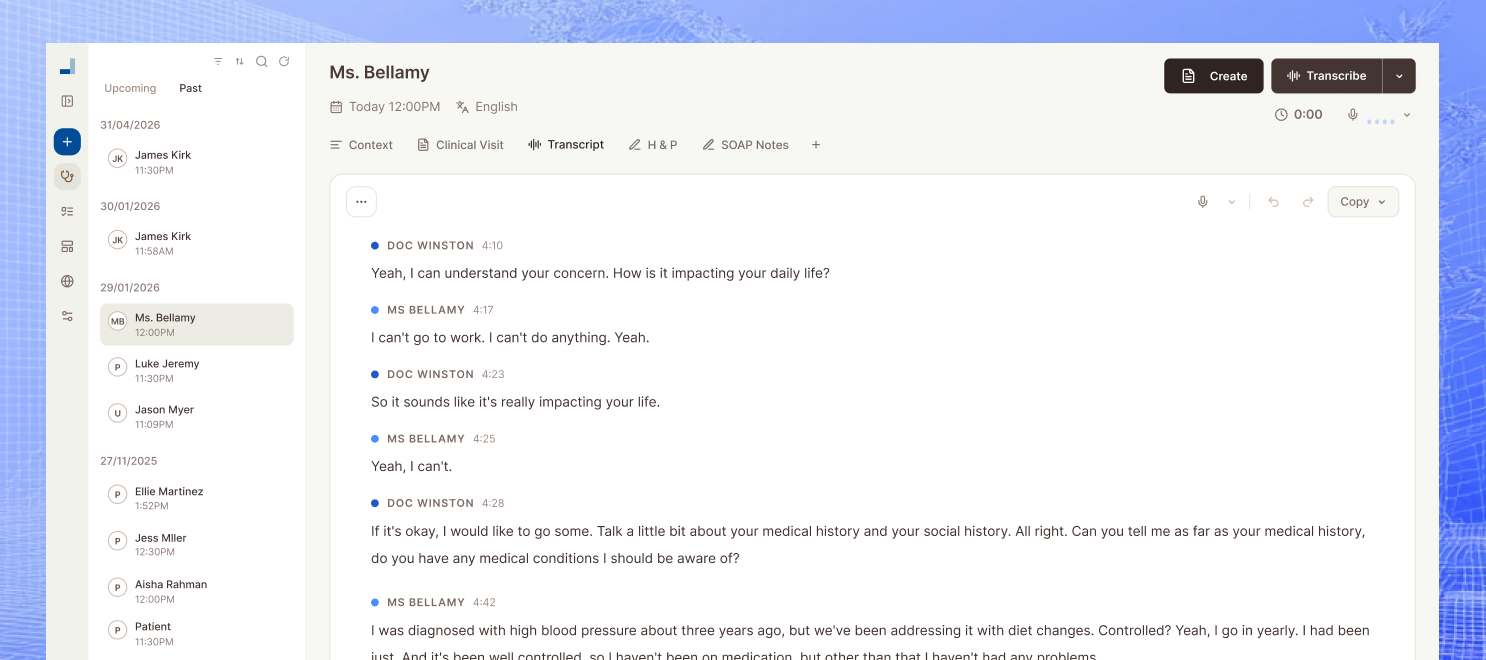
An AI medical scribe serves as an assistive tool that captures the nuances of a conversation in real-time. It allows the cardiologist to maintain eye contact and focus entirely on the patient rather than a screen. However, it is essential to remember that the AI is a supportive assistant; the clinician remains the ultimate authority, responsible for reviewing and validating every clinical entry for accuracy before finalizing the record.
- Eliminates after-hours charting by generating drafts immediately after consults.
- Reduces cognitive fatigue, allowing for more presence during complex cardiac exams.
- Captures specific patient terminology and symptoms that might be forgotten.
- Enhances record-keeping accuracy for better audit and legal protection.
Note types you can generate beyond SOAP (H&P and more)
While SOAP notes are the industry standard, cardiology requires a broader range of documentation to provide a full picture of patient health. History and Physical (H&P) notes are critical for new referrals, requiring a deep dive into family history, risk factors like hypertension or hyperlipidemia, and previous cardiac interventions. Relying on a one-size-fits-all template often results in shallow documentation that doesn’t reflect the complexity of the case.
Advanced AI tools allow for the creation of diverse document types, including consult notes for surgical clearances, follow-up notes for chronic heart failure management, and even detailed procedure notes for bedside assessments. Structured documentation ensures continuity of care, making it significantly easier for the next provider in the care chain—whether a primary care physician or a cardiothoracic surgeon—to understand the clinical reasoning and the plan of action.
Furthermore, high-quality referral letters and discharge summaries are essential for maintaining professional relationships and patient safety. When notes are structured correctly, they become searchable and audit-ready, reducing the administrative burden on the entire clinic staff. This organization is particularly vital for university clinics where multiple residents and fellows might be reviewing the same patient history.
- H&P and Consult Notes for comprehensive new patient evaluations.
- Procedure Notes for bedside EKG interpretations or stress test summaries.
- Referral Letters that effectively communicate findings to primary care teams.
- Follow-up and Progress Notes focused on titration and symptom management.
How to implement AI Scribe for Cardiology Clinic Notes step-by-step
Starting with an AI scribe doesn’t require an overnight overhaul of your entire practice. The most successful implementations begin with a single visit type, such as routine follow-ups for hypertension or stable angina. By focusing on a high-volume, predictable encounter, you can get comfortable with how the AI interprets cardiac terminology and your specific dictation style before moving on to more complex new-patient consults.
Before you start the encounter, select or customize a template that fits your specialty. For cardiology, this might include dedicated sections for cardiovascular physical exams and specific cardiac medication lists. During the encounter, simply let the device record the conversation naturally. You don’t need to change how you speak; in fact, talking through your findings out loud—such as describing a grade II systolic murmur—helps the AI capture specific clinical data for the physical exam section.
Once the patient leaves, the AI generates a draft within seconds. Your role is to perform a quick review and edit. This is the time to ensure the AI correctly captured dosages and specific anatomical details. Because the draft is ready immediately, you can complete this task while the details are fresh in your mind, usually in less than two minutes. Finally, these outputs can be instantly repurposed into referral letters or patient education summaries, streamlining your entire administrative output in one go.
- Begin with routine follow-up visits to build confidence in the tool.
- Use cardiology-specific templates to ensure all relevant data points are captured.
- Narrate your physical exam findings out loud to improve note detail.
- Review every draft immediately to maximize memory recall and accuracy.
How to keep note quality high and reduce mistakes
Technology is not infallible; note bloat and ‘hallucinations’ regarding medication dosages or lab values are common failure points in unmonitored AI systems. In cardiology, where a decimal point error in a medication dose can be critical, a lightweight review habit is non-negotiable. Establishing team standards for how AI-generated notes are reviewed ensures that the quality remains consistent across the entire clinic.
Clinicians should look specifically for ‘cloned’ text where the AI might repeat findings from previous encounters if not properly prompted. By maintaining a standard checklist—checking the problem list, verifying the plan, and confirming medication changes—you ensure that the final record is a true reflection of the visit. This process doesn’t just prevent errors; it creates a superior clinical record that stands up to insurance audits and peer reviews.
- Verify all medication dosages and frequencies for cardiac drugs.
- Check for note bloat to ensure the most relevant clinical facts stand out.
- Implement a ‘final sign-off’ protocol to maintain high professional standards.
- Report recurring AI errors to improve the system’s learning loop.
Privacy, consent, and patient trust
Patient trust is the bedrock of the doctor-patient relationship. When introducing recording technology, transparency is key. Most patients are receptive when they understand that the tool allows their doctor to focus on them rather than a computer screen. It is important to follow local and regional guidelines regarding consent, as requirements can vary significantly between jurisdictions.
A simple, patient-friendly way to explain the process is: ‘To help me stay focused on our conversation today, I’m using a secure digital assistant to help me with my notes. It records what we talk about so I don’t have to type while we speak. Is that alright with you?’ This approach emphasizes the benefit to the patient—personalized attention—while clearly explaining the tech. Security and data retention should also be prioritized, ensuring all data is encrypted and handled according to healthcare privacy standards.
- Always obtain verbal or written consent based on your local regulations.
- Explain the AI scribe as a tool for improving patient-doctor face time.
- Ensure the platform used is HIPAA/GDPR compliant and secure.
- Maintain clear policies on how long recordings are stored and when they are deleted.
Rolling it out across a clinic without disruption
A successful rollout involves a structured two-week pilot program. Start with one or two ‘champion’ physicians who are tech-savvy. During this period, track metrics such as time saved per day, the reduction in after-hours charting, and the subjective quality of the notes. This data will be crucial for convincing more skeptical staff members of the tool’s value.
Training should focus on template alignment. When every clinician uses a standardized set of cardiology templates, it creates a cohesive experience for the nursing and administrative staff who handle the outputs. By the end of the pilot, you can refine the workflow based on real-world feedback, ensuring that when the tool is launched clinic-wide, it feels like a help rather than a hindrance.
- Launch a 14-day pilot with one physician to iron out workflow kinks.
- Track ‘pajama time’ reduction to measure the ROI of the tool.
- Standardize cardiology templates across the practice for consistency.
- Conduct a short weekly briefing during the pilot to share best practices.
Mcoy AI is an AI medical scribe that records and transcribes patient encounters, then generates multiple clinical note types (H&P, progress notes, consult notes, follow-up notes, procedure notes, discharge summaries, referral letters, and more). It helps cardiology clinics stay organized with 200+ customizable templates and includes an AI chat to create letters, forms, and other documents instantly from your session data.
Frequently Asked Questions
Adopting new technology often brings up valid concerns regarding accuracy and daily operations. Below are answers to the most common questions about using AI in a cardiology setting.
How accurate are AI medical scribes in real clinics?
AI scribes are highly accurate in capturing the dialogue of a clinical encounter, often picking up details that a human might miss. However, the accuracy of the clinical synthesis depends on the quality of the conversation and the clinician’s narration. They are best viewed as a high-level drafting tool that requires a final expert review.
Do I still need to review every note?
Yes, the clinician is legally and ethically responsible for the contents of the medical record. While the AI does the heavy lifting of drafting and formatting, you must review the note to ensure all clinical findings, dosages, and plans are 100% correct before signing off.
What note types can an AI scribe generate besides SOAP?
Advanced systems can generate a wide array of documents, including H&Ps, cardiology consults, procedure notes for things like echoes or EKGs, and formal referral letters. This versatility is what makes the tool more than just a simple transcription service.
Will this work for telehealth and in-person consults?
Most AI scribes are designed to work seamlessly in both environments. For telehealth, the AI can capture audio directly from the computer, while in-person visits usually involve a smartphone or tablet app to record the conversation securely from the exam room.
How do I explain recording/transcription to patients?
Focus on the benefit to the patient. Explain that it allows you to look at them instead of a keyboard and ensures that their medical record is as detailed and accurate as possible. Most patients appreciate the extra attention and transparency.
How do clinics prevent note bloat?
By using specific, concise templates and providing feedback to the AI, clinics can ensure that the outputs are focused. It is also important for the clinician to edit out any redundant or irrelevant information during the brief review stage.
How long does template setup take?
Basic setup can take minutes, but fine-tuning cardiology-specific templates may take a few hours of use. Most platforms offer pre-built templates that can be adjusted on the fly as you discover what works best for your specific documentation style.
What’s the safest way to start if I’m skeptical?
The safest way to start is with a small pilot. Use the tool for your most straightforward follow-up appointments for a week. This allows you to evaluate the quality and security of the system without the pressure of documenting a complex new-patient case.
Conclusion
Transitioning to a digital workflow is no longer just an option; it is a necessity for modern cardiology practices. By implementing a systematic approach—selecting the right templates, establishing a review habit, and ensuring patient transparency—you can significantly reduce administrative stress. Using an AI Scribe for Cardiology Clinic Notes allows you to focus on what matters most: delivering high-quality cardiac care. Start with a small pilot this week and experience the difference in your daily workflow. Ready to reclaim your time? Explore how advanced documentation tools can transform your clinic today.
SEO description: Learn how to use an AI Scribe for Cardiology Clinic Notes to save hours of charting, improve documentation accuracy, and reduce clinician burnout.
What a serious review table should cover
| Decision area | Common mistake | Better clinic-ready approach | Metric to watch |
|---|---|---|---|
| Workflow design | Treat how to use an ai scribe for cardiology clinic notes as a one-off documentation task | Build a repeatable process with clear ownership and review points | Time to complete documentation |
| Team adoption | Assume every clinician will naturally use the same process | Train for consistency and define exception handling early | Active user adoption |
| Quality review | Only check notes when a problem is reported | Audit a sample of notes weekly and review edge cases | Edit rate per note |
| Operational follow-through | Leave admin actions outside the documentation workflow | Use the same encounter data for referrals, letters, and follow-up tasks | Completion rate for next-step tasks |
Related reading
If you are working through how to use an ai scribe for cardiology clinic notes, it helps to read this alongside Specialty Guides: How to Run a More Efficient Medical Practice in 2026, Specialty Guides: How to Improve Patient Encounters, and Specialty Guides: Master Hypertension Follow-Ups with an AI Medical Scribe. Those guides cover adjacent workflow, implementation, and evaluation questions so the decision does not sit in isolation.
FAQ
How accurate are AI medical scribes in real clinics?
AI scribes are highly accurate in capturing the dialogue of a clinical encounter, often picking up details that a human might miss. However, the accuracy of the clinical synthesis depends on the quality of the conversation and the clinician’s narration. They are best viewed as a high-level drafting tool that requires a final expert review.
Do I still need to review every note?
Yes, the clinician is legally and ethically responsible for the contents of the medical record. While the AI does the heavy lifting of drafting and formatting, you must review the note to ensure all clinical findings, dosages, and plans are 100% correct before signing off.
What note types can an AI scribe generate besides SOAP?
Advanced systems can generate a wide array of documents, including H&Ps, cardiology consults, procedure notes for things like echoes or EKGs, and formal referral letters. This versatility is what makes the tool more than just a simple transcription service.
Will this work for telehealth and in-person consults?
Most AI scribes are designed to work seamlessly in both environments. For telehealth, the AI can capture audio directly from the computer, while in-person visits usually involve a smartphone or tablet app to record the conversation securely from the exam room.
How do I explain recording/transcription to patients?
Focus on the benefit to the patient. Explain that it allows you to look at them instead of a keyboard and ensures that their medical record is as detailed and accurate as possible. Most patients appreciate the extra attention and transparency.
How do clinics prevent note bloat?
By using specific, concise templates and providing feedback to the AI, clinics can ensure that the outputs are focused. It is also important for the clinician to edit out any redundant or irrelevant information during the brief review stage.
How long does template setup take?
Basic setup can take minutes, but fine-tuning cardiology-specific templates may take a few hours of use. Most platforms offer pre-built templates that can be adjusted on the fly as you discover what works best for your specific documentation style.
What’s the safest way to start if I’m skeptical?
The safest way to start is with a small pilot. Use the tool for your most straightforward follow-up appointments for a week. This allows you to evaluate the quality and security of the system without the pressure of documenting a complex new-patient case.