Specialty Guides: How to Use AI Scribes for Teaching Clinics & Supervision
Learn how teaching clinics and university medical centers can use AI scribes to improve supervision, student documentation, and clinical workflows.
The Documentation Dilemma in Teaching Institutions
In the high-pressure environment of teaching clinics and university health centers, documentation is often the primary source of friction. For attending physicians and supervisors, the burden of reviewing student-generated notes while maintaining their own clinical volume leads to chronic after-hours charting. Residents and students, meanwhile, struggle with the steep learning curve of capturing accurate patient narratives while simultaneously learning diagnostic reasoning. This tension often results in rushed notes, a lack of consistency across departments, and significant medico-legal anxiety for the supervising clinician.
This guide provides a roadmap for integrating an AI scribe for teaching clinics and supervision into your academic workflow. We will explore how to transition beyond the basic SOAP format into specialized clinical notes, maintain high-quality control across a rotating team, and ensure patient privacy remains at the forefront. Whether you are a solo attending in a private practice with a rotating student or a director of a large university clinic, these strategies will help you reclaim time and improve the educational experience.
What a medical scribe solves in modern practice
The true cost of traditional documentation in a teaching setting isn’t just measured in minutes; it is measured in cognitive load. When an attending physician is forced to spend hours correcting or rewriting student notes, they are not teaching—they are performing administrative salvage. An AI medical scribe acts as an assistive layer, capturing the granular details of a patient encounter in real-time. This allows the resident to focus on the patient and the attending to focus on the clinical nuances rather than frantic note-taking.
It is important to remember that an AI scribe is an assistive tool, not a replacement for clinical judgment. The clinician remains the ultimate authority and responsible party for the final signature. By automating the mechanical task of transcription and structuring, the AI ensures that no detail—like a subtle medication change or a specific patient concern—is lost in the transition from the exam room to the electronic health record (EHR).
- Reduces the ‘pajama time’ spent by supervisors reviewing student documentation.
- Ensures clinical details are captured accurately even when a student is overwhelmed.
- Standardizes the narrative flow across different levels of clinical experience.
- Allows supervisors to focus on mentoring rather than administrative corrections.
Note types you can generate beyond SOAP
While the SOAP note is a staple of medical education, it is often insufficient for the diverse needs of a teaching hospital. Modern AI tools can generate complex History and Physical (H&P) reports, consult notes for specialized referrals, and detailed procedure notes. For university clinics, having a structured approach to discharge summaries and referral letters is vital for maintaining continuity of care as patients move between student teams and primary care providers.
The structure of these notes matters deeply for audit readiness and regional compliance. A well-organized progress note provides a clear audit trail of the medical decision-making process, which is essential when multiple providers are involved in a single case. By utilizing specialized templates, clinics can ensure that every encounter—from a routine follow-up to a complex surgical consult—is documented with the same level of professional rigor.
- H&Ps and progress notes provide a foundation for longitudinal patient tracking.
- Consult and referral letters improve the hand-off quality between specialties.
- Procedure notes and discharge summaries ensure compliance and safety.
- Customized formats allow for specialty-specific documentation requirements.
How to implement an AI scribe for teaching clinics and supervision step-by-step
Implementation begins with choosing a single visit type or one specific student cohort. Rather than rolling out the technology to the entire department overnight, start with routine follow-up visits or a specific specialty clinic like internal medicine. This allows the attending physician to establish a baseline for what a ‘good’ AI-generated note looks like within their specific context. Once the initial workflow is comfortable, you can move toward more complex scenarios like new patient intakes or multi-disciplinary consults.
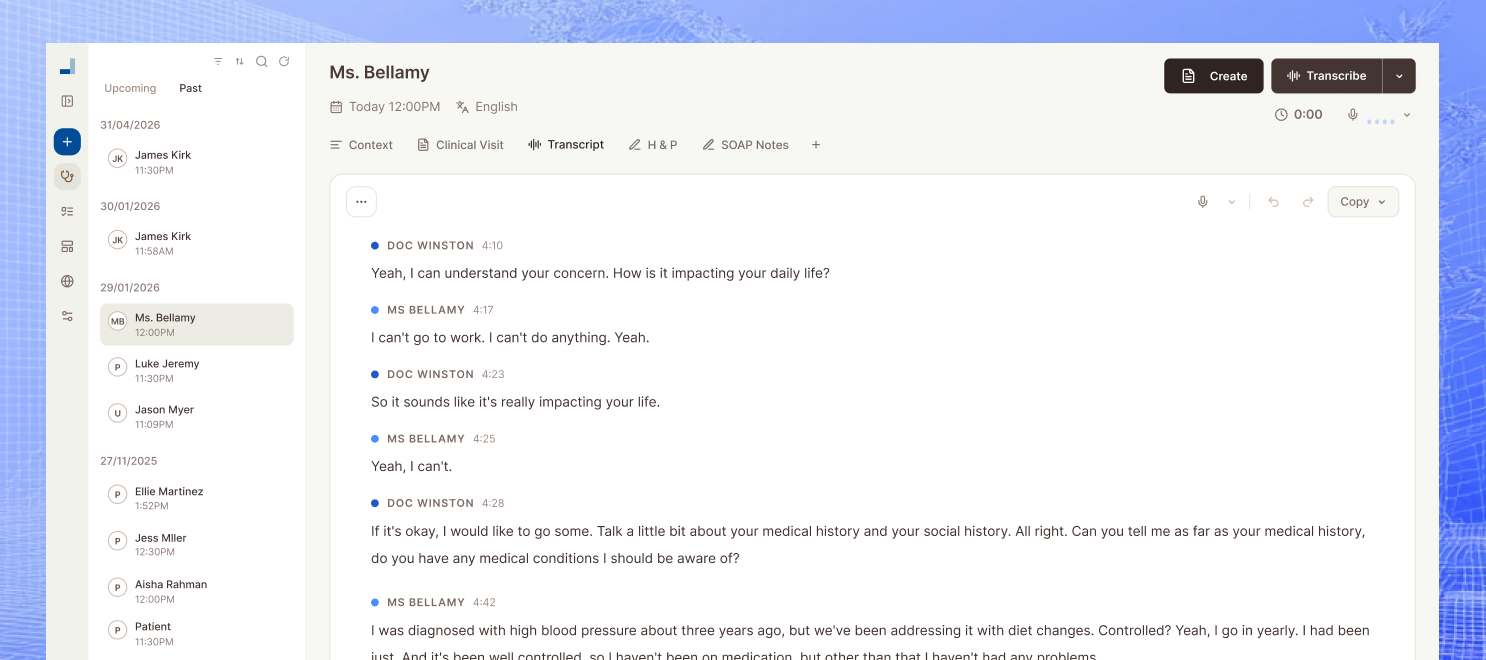
The next phase involves setting up clinical templates tailored to your specialty. In a teaching environment, consistency is key. Every student should be using the same standardized templates for their respective rotations. During the encounter, the AI captures the dialogue between the student, the patient, and often the supervising attending. This three-way interaction is automatically synthesized into a coherent draft, allowing the supervisor to see the students’ logic and the actual patient data side-by-side.
Review and editing should happen immediately after the encounter while the details are fresh. The student reviews the draft first, making any necessary corrections to the clinical reasoning or plan. The attending then performs a final review, providing feedback to the student within the platform. This creates a powerful feedback loop where the AI-generated note serves as an educational tool. Finally, those outputs can be easily converted into referral letters or patient instruction forms, maximizing the utility of a single recording.
- Start with one department or student group to refine the workflow.
- Standardize specialty-specific templates to maintain high institutional quality.
- Use the AI draft as a collaborative teaching tool between student and supervisor.
- Reuse clinical data to instantly generate letters and discharge documents.
How to keep note quality high and reduce mistakes
The primary failure points in clinical documentation often involve missing medications, incorrect numerical values, or ‘note bloat’ where unnecessary information masks the actual assessment. In a teaching clinic, these errors are often compounded by student inexperience. To combat this, supervisors should implement a lightweight review habit where they verify high-risk data points—such as dosages and specific diagnostic test results—against the raw transcript provided by the AI.
Establishing team standards is equally important. Define clear benchmarks for what constitutes a complete note and use the AI’s output to highlight where students might be missing critical subjective or objective data. By treating the AI scribe as an objective observer, you can identify patterns in a student’s history-taking skills, using those insights to improve their clinical training while simultaneously ensuring the medical record stays accurate and concise.
- Implement a cross-check system for dosages and vital signs.
- Audit notes periodically to prevent repetitive or irrelevant ‘bloat’.
- Use transcripts as an objective reference to resolve clinical discrepancies.
- Set clear institutional standards for note structure and final sign-off.
Privacy, consent, and patient trust
Privacy is paramount, especially in a university setting where institutional review boards (IRBs) and strict HIPAA or GDPR policies apply. Clinicians must always follow local regulations regarding the recording of patient encounters. In most teaching clinics, transparency is the best policy. Patients are usually accustomed to having students in the room, and introducing an AI scribe is simply an extension of that educational environment.
A simple way to explain this to a patient is: ‘To help me focus entirely on you and to ensure our students have the best learning experience, we use a secure tool that listens to our conversation and helps us write our medical notes. It doesn’t save the recording once the note is finished, and it keeps your information private.’ Most patients appreciate the extra attention they receive when the doctor isn’t staring at a computer screen during the consult.
- Always obtain verbal or written consent based on your specific clinic policy.
- Explain the technology as a tool for better clinical focus and student learning.
- Ensure the AI solution adheres to high-level data encryption and retention standards.
- Maintain a clear record of patient consent within the EHR system.
Rolling it out across a clinic without disruption
A successful rollout requires a 2-week pilot phase. During the first week, focus on technical familiarity—learning how to start the recording and select the right template. In the second week, focus on the workflow transistion, specifically how the student and attending hand off the note for review. Tracking metrics such as ‘time spent on charts’ and ‘days until note completion’ will provide the tangible data needed to justify a wider rollout to hospital administration.
Training should not be a one-time event. As new rotations of students arrive, clinical leads should provide a brief orientation on the AI scribe for teaching clinics and supervision. Aligning templates across the department ensures that no matter which student is assigned to a patient, the final documentation meets the same gold standard. This level of institutional alignment is what separates a chaotic teaching clinic from a high-efficiency academic center.
- Monitor time-to-completion for notes to measure initial ROI.
- Provide brief, standardized training for every new rotation of students.
- Use a pilot period to gather feedback and refine template choices.
- Analyze the reduction in after-hours charting for supervising physicians.
Mcoy AI is an AI medical scribe that records and transcribes patient encounters, then generates multiple clinical note types (H&P, progress notes, consult notes, follow-up notes, procedure notes, discharge summaries, referral letters, and more). With over 200+ customizable templates and an integrated AI chat, clinicians and teaching staff can instantly create letters, forms, and complex documents tailored to their specific specialty needs, significantly reducing the administrative burden on both students and supervisors.
FAQ
The following questions address common concerns for clinicians looking to integrate AI into their educational and supervisory workflows.
How accurate are AI medical scribes in real clinics?
AI scribes are remarkably accurate at capturing clinical terminology and the nuances of patient dialogue. However, they are designed to be assistive, meaning they may occasionally misinterpret context if multiple people speak at once. Because the system provides a draft, the clinician’s role is to verify the medical accuracy before finalizing the note. In a teaching setting, this often results in a more detailed and accurate note than a student would produce manually.
Do I still need to review every note?
Yes, as the supervising physician or attending, you are legally and ethically responsible for the accuracy of the medical record. The AI scribe handles the heavy lifting of drafting and formatting, but you must perform a final review to ensure the assessment and plan align with your clinical judgment. Most supervisors find that reviewing an AI-generated note takes a fraction of the time compared to correcting a manual student draft.
What note types can an AI scribe generate besides SOAP?
Beyond the standard SOAP format, an AI scribe can generate complex History and Physicals (H&Ps), detailed procedure notes, consult letters, and discharge summaries. It can also be used to draft referral letters to other specialists or patient-friendly summaries of the visit. This versatility is particularly useful in university clinics where diverse documentation is required for different specialties.
Will this work for telehealth and in-person consults?
The technology is designed to be flexible and works equally well for in-person exams and telehealth sessions. As long as the audio is clear, the AI can distinguish between different speakers and accurately capture the encounter. This makes it an ideal solution for teaching programs that utilize a hybrid model of care, ensuring consistent documentation regardless of where the patient is located.
How do I explain recording/transcription to patients?
Most patients are very receptive when explained that the tool allows the doctor to pay more attention to the patient rather than a screen. You can simply state that a secure AI assistant is helping with the clinical notes to ensure nothing is missed. Transparency builds trust, and the majority of patients appreciate the technological advancement if it results in better care and less ‘computer time’ for the doctor.
How do clinics prevent note bloat?
Note bloat is prevented by using concise templates and setting institutional standards for what the AI should include. You can customize the AI to ignore small talk or redundant information, focusing only on the pertinent clinical data. Regular audits and feedback to the students on how to interact with the AI during the encounter can also help keep the notes focused and relevant.
How long does template setup take?
Initial template setup is typically very fast, often taking only a few minutes to select and tweak a pre-existing specialty template. Most AI scribes come with a vast library of expert-verified templates that cover the majority of clinical needs. For highly specific teaching protocols, custom templates can be created and saved, providing a permanent framework for all future students in that rotation.
What’s the safest way to start if I’m skeptical?
The safest approach is to run a small pilot with one trusted student or one specific half-day clinic. Use the AI scribe alongside your traditional method for a few encounters to compare the results directly. This ‘shadowing’ period allows you to build confidence in the tool’s accuracy and discover how much time it can actually save you before committing to a full-scale institutional rollout.
Conclusion
Integrating an AI scribe for teaching clinics and supervision is one of the most effective ways to reduce burnout and improve the quality of medical education. By automating the documentation process, attendings can focus on teaching, and students can focus on the patient encounter. The workflow transitions from a frantic attempt to record data to a sophisticated process of reviewing and refining clinical narratives. Implementing an AI scribe for teaching clinics and supervision will help your practice stay at the cutting edge of medicine. Ready to reclaim your time? Start a pilot program today and see the difference in your clinic’s efficiency.
What a serious review table should cover
| Decision area | Common mistake | Better clinic-ready approach | Metric to watch |
|---|---|---|---|
| Workflow design | Treat how to use ai scribes for teaching clinics & supervision as a one-off documentation task | Build a repeatable process with clear ownership and review points | Time to complete documentation |
| Team adoption | Assume every clinician will naturally use the same process | Train for consistency and define exception handling early | Active user adoption |
| Quality review | Only check notes when a problem is reported | Audit a sample of notes weekly and review edge cases | Edit rate per note |
| Operational follow-through | Leave admin actions outside the documentation workflow | Use the same encounter data for referrals, letters, and follow-up tasks | Completion rate for next-step tasks |
Related reading
If you are working through how to use ai scribes for teaching clinics & supervision, it helps to read this alongside Specialty Guides: How to Run a More Efficient Medical Practice in 2026, Specialty Guides: How to Improve Patient Encounters, and Admin Management: How to Use an AI Scribe for Discharge Summaries | Mcoy. Those guides cover adjacent workflow, implementation, and evaluation questions so the decision does not sit in isolation.
FAQ
How accurate are AI medical scribes in real clinics?
AI scribes are highly accurate in capturing clinical terms, though they require clinician oversight for final verification. In a teaching clinic, they often produce a more granular record than manual student notes.
Do I still need to review every note?
Yes, the attending physician remains legally responsible for the medical record. The AI provides a near-final draft, but the supervisor must verify the clinical assessment and final plan before signing.
What note types can an AI scribe generate besides SOAP?
It can generate H&Ps, consult reports, procedure notes, discharge summaries, and referral letters. This variety helps university clinics maintain high standards across multiple medical departments and specialties.
Will this work for telehealth and in-person consults?
AI scribes work seamlessly across both formats. They capture the dialogue through a microphone or digital audio stream, making them ideal for modern teaching programs that utilize hybrid care models.
How do I explain recording/transcription to patients?
Briefly explain that the AI tool allows you to focus on the conversation rather than the keyboard. Patients usually respond positively when they realize it improves the quality of the interaction and the accuracy of their record.
How do clinics prevent note bloat?
By using structured, concise templates and training students to keep encounters focused, clinics can ensure the AI generates high-density, relevant information without unnecessary narrative filler.
How long does template setup take?
Ready-to-use templates allow clinicians to start within minutes. Customizing those templates for specific university or department protocols typically takes less than an hour of initial setup time.
What’s the safest way to start if I’m skeptical?
Begin with a limited pilot during a single clinical session. Testing the AI scribe on a few non-complex cases allows the team to verify accuracy and build trust in the workflow before clinical-wide adoption.