Specialty Guides: Best Way to Use AI Scribe for Psychology Session Notes
Learn how to optimize your workflow using an AI scribe for psychology session notes. Automate documentation, improve note quality, and reduce burnout.
The Hidden Burden of Mental Health Documentation
Psychology and behavioral health practitioners often find themselves caught in a cycle of ‘documentation debt.’ Between long therapy sessions and back-to-back appointments, the mental load of remembering clinical nuances while maintaining a therapeutic presence is immense. Many clinicians end up finishing psychology session notes late at night, leading to burnout and a degraded work-life balance.
This guide will teach you how to integrate AI documentation into your workflow safely and effectively. We will cover the specific note formats used in mental health, quality control measures, and how to maintain patient trust while leveraging technology. Whether you are a solo private practitioner or managing a large university clinic, these steps will help you reclaim your time without sacrificing the integrity of your clinical records.
What a medical scribe solves in modern practice
The real cost of traditional documentation isn’t just time; it is the cognitive load it places on the clinician. When a psychologist has to worry about capturing every quote or symptom during a session, they may miss subtle non-verbal cues from the patient. An AI medical scribe acts as an invisible assistant that listens and organizes information, allowing the provider to be fully present.
It is important to understand that an AI scribe is a supportive tool, not a replacement for clinical judgment. The AI handles the heavy lifting of transcription and structuring, but the clinician remains the final authority on the note’s accuracy. By offloading the mechanical task of writing, you reduce the ‘pajama time’ spent on charting after hours.
- Reduces clinician burnout by automating repetitive typing tasks.
- Captures high-detail nuances that might be forgotten hours later.
- Allows for improved eye contact and deeper therapeutic rapport.
- Streamlines the transition from session completion to signed documentation.
Note types you can generate beyond SOAP
While SOAP notes are a staple in many medical fields, psychology often requires more nuanced documentation. A versatile AI tool can generate comprehensive History and Physicals (H&P) for initial intakes, detailing psychiatric history, social determinants of health, and functional assessments. Progress notes for ongoing therapy can be tailored to specific modalities like CBT or DBT.
Beyond standard session notes, practitioners often need to generate referral letters to psychiatrists, consult notes for collaborative care, and detailed discharge summaries. Structure is vital for audit readiness and continuity of care, especially when patients move between different levels of support or different providers within a healthcare system.
- Intake H&Ps and comprehensive psychiatric evaluations.
- Treatment plans and follow-up progress notes.
- Specialized referral letters for collaborative treatment teams.
- Detailed discharge summaries and transition of care documents.
How to implement psychology session notes automation step-by-step
Starting with a new technology should be a gradual process to ensure it fits your specific therapeutic style. Begin by using the AI scribe for one specific visit type, such as routine follow-up sessions, before moving on to complex initial assessments. This allows you to get comfortable with the interface and the way the AI interprets your session flow.
Next, take the time to set up or select templates that match your specialty. For instance, if you specialize in adolescent psychology, your template might place more emphasis on family dynamics than a geriatric assessment template would. Once your templates are ready, you can start capturing the encounter, whether it is an in-person session or a telehealth video call.
After the session concludes, review and edit the generated output immediately. Most practitioners find that they only need to make minor adjustments to specific clinical observations. Finally, you can reuse the findings in the note to instantly generate letters or necessary insurance forms, drastically reducing administrative overhead.
- Start with one session type to build workflow confidence.
- Choose templates that align with your specific therapeutic modality.
- Review and finalize notes immediately after sessions for maximum accuracy.
- Leverage note data to automate secondary paperwork and referrals.
How to keep note quality high and reduce mistakes
Even the most advanced AI can occasionally misinterpret clinical shorthand or specific medication dosages if not guided properly. The most common failures occur when clinicians rely 100% on the output without a quick review. It is essential to develop a lightweight review habit—spending 60 seconds at the end of each draft to verify medications, dates, and the specific problem list.
Establishing team standards for documentation also helps maintain high quality across a clinic. Encourage all providers to double-check ‘note bloat,’ where unnecessary text makes the record hard to read. A concise, high-quality note is always better for clinical care and legal protection than a ten-page transcript of every word said during a session.
- Implement a ‘60-second review’ rule for every AI-generated draft.
- Standardize templates across the practice to ensure clinical consistency.
- Watch for auto-correction errors involving complex psychiatric terminology.
- Focus on conciseness to avoid the pitfalls of note bloat.
Privacy, consent, and patient trust
Trust is the foundation of the therapeutic relationship, and introducing a recording device or AI tool requires transparency. Consent policies vary by region and professional board, so always ensure you are following your local legal requirements. In most cases, a simple update to your informed consent paperwork is the first step.
When explaining the tool to a patient, keep it simple. You might say: ‘I use a secure AI assistant to help me capture our conversation so I can focus entirely on you instead of taking notes. It is HIPAA-compliant and keeps your data private.’ Most patients appreciate that their provider is focused on them rather than a computer screen. From a security standpoint, ensure the tool you use has robust encryption and clear data retention policies.
- Update informed consent forms to include AI-assisted documentation.
- Use a brief, reassuring script to explain the benefits to patients.
- Ensure the technology provider meets HIPAA or relevant regional standards.
- Verify that data is encrypted both in transit and at rest.
Rolling it out across a clinic without disruption
For clinic owners and university health centers, a phased rollout is the most successful approach. Start with a two-week pilot involving a small group of ‘early adopters.’ This allows you to identify any technical hurdles unique to your clinic’s internet setup or existing Electronic Health Record (EHR) integration.
During the pilot, track key metrics such as the reduction in after-hours charting time and the speed of note completion. Once the pilot group is successful, use their experiences to train the rest of the staff. Aligning everyone on the same set of templates ensures that the documentation style remains consistent regardless of which clinician the patient sees.
- Run a two-week pilot program with a subset of clinical staff.
- Track time-saved metrics to demonstrate ROI to stakeholders.
- Use the pilot phase to refine clinic-wide documentation templates.
- Provide brief training sessions focused on editing and review workflows.
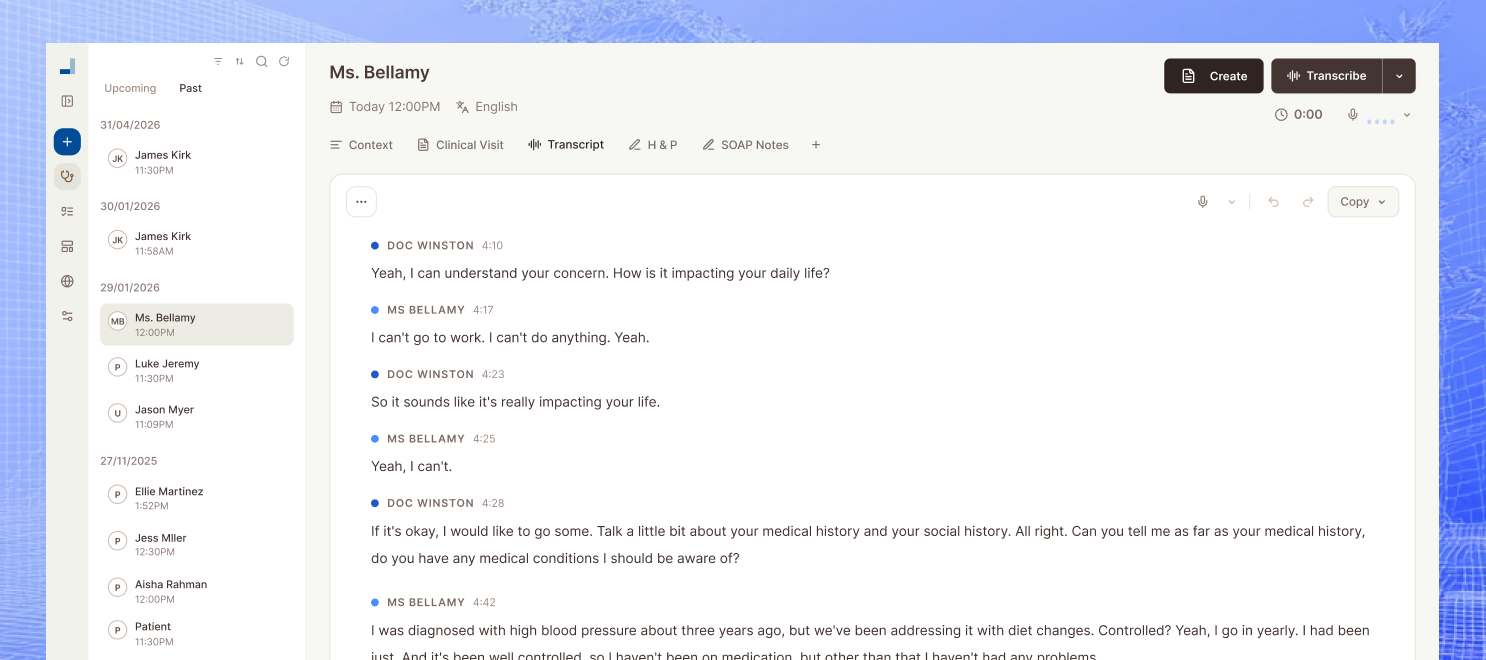
Mcoy AI is an AI medical scribe that records and transcribes patient encounters, then generates multiple clinical note types (H&P, progress notes, consult notes, follow-up notes, procedure notes, discharge summaries, referral letters, and more). With access to 200+ customizable templates and an AI chat to create letters/forms/documents, it helps clinicians focus more on patient care and less on the administrative burden of paperwork.
Frequently Asked Questions
Implementing new technology in a mental health setting often brings up practical questions. Here are the most common inquiries regarding AI documentation in psychology.
How accurate are AI medical scribes in real clinics?
In clinical settings, AI scribes are remarkably accurate at capturing the dialogue and context of a session. They are specifically trained to understand medical and psychological terminology, which often results in more detailed notes than manual entry. However, the clinician must always review the output to ensure the final clinical interpretation is correct and reflected accurately in the psychology session notes.
Do I still need to review every note?
Yes, reviewing every note is a professional and legal necessity for any clinician. While the AI does the transcription and formatting, you are the person responsible for the medical record. Most users find that reviewing and editing takes only a fraction of the time it would take to write a note from scratch, but that final human oversight is what ensures patient safety and quality of care.
What note types can an AI scribe generate besides SOAP?
Modern AI scribes are very flexible and can generate a wide array of documents including intake H&Ps, psychiatric evaluations, BIRP or DAP notes, and discharge summaries. They can also create referral letters to other specialists and detailed treatment plans. Because the AI understands the context of the conversation, it can reformat the same session data into multiple different document types as needed.
Will this work for telehealth and in-person consults?
Yes, AI scribes are designed to work across various platforms. For in-person sessions, the tool usually runs on a smartphone, tablet, or laptop mic. For telehealth, it can often capture audio directly from the computer output. This versatility makes it ideal for hybrid practices that see patients both in an office and via video conferencing.
How do I explain recording/transcription to patients?
The best approach is to be direct and highlight the benefit to the patient. Explain that by using an AI assistant, you can give them your full attention without the distraction of typing or writing. Most patients are comfortable with this once they understand that it helps the provider provide better care and that their data is protected by high-level security standards.
How do clinics prevent note bloat?
Note bloat is prevented by using high-quality, concise templates and directing the AI to focus on ‘clinical significance’ rather than transcribing every ‘um’ and ‘ah.’ Clinicians should also be trained to review notes for brevity, ensuring that only the most relevant therapeutic information is saved into the permanent patient record.
How long does template setup take?
Setting up basic templates usually takes just a few minutes, as many systems come with pre-built psychiatric and psychological templates. Customizing them to fit your specific workflow might take an hour or two of testing. Once they are set, the AI will use them consistently, saving you hours of formatting work every single week moving forward.
What’s the safest way to start if I’m skeptical?
The safest way to start is to use the tool for your own self-reflection or de-identified ‘shadow’ notes for a few days. This allows you to see the quality of the output without it immediately becoming part of a legal record. Once you see the accuracy and time-saving potential, you can move forward with patient consent and clinical integration.
Conclusion
Integrating an AI scribe into your workflow is one of the most effective ways to modernize a mental health practice. By following a structured rollout plan and focusing on high-quality templates, you can significantly reduce the time spent on administrative tasks. Using a tool like this for your psychology session notes allows you to return your focus to where it belongs: the patient. Start your pilot today and experience the difference that automated documentation can make for your professional well-being.
What a serious review table should cover
| Decision area | Common mistake | Better clinic-ready approach | Metric to watch |
|---|---|---|---|
| Workflow design | Treat best way to use ai scribe for psychology session notes as a one-off documentation task | Build a repeatable process with clear ownership and review points | Time to complete documentation |
| Team adoption | Assume every clinician will naturally use the same process | Train for consistency and define exception handling early | Active user adoption |
| Quality review | Only check notes when a problem is reported | Audit a sample of notes weekly and review edge cases | Edit rate per note |
| Operational follow-through | Leave admin actions outside the documentation workflow | Use the same encounter data for referrals, letters, and follow-up tasks | Completion rate for next-step tasks |
Related reading
If you are working through best way to use ai scribe for psychology session notes, it helps to read this alongside Specialty Guides: How to Run a More Efficient Medical Practice in 2026, Specialty Guides: How to Improve Patient Encounters, and Specialty Guides: Document Chronic Disease Reviews Faster With AI. Those guides cover adjacent workflow, implementation, and evaluation questions so the decision does not sit in isolation.
FAQ
{“How accurate are AI medical scribes in real clinics?”: “AI scribes are highly accurate in capturing clinical dialogue but require a quick final review by the clinician.”, “Do I still need to review every note?”: “Yes, clinicians are legally responsible for their records; the AI acts as a drafter, not a signer.”, “What note types can an AI scribe generate besides SOAP?”: “It can generate H&Ps, BIRP notes, DAP notes, referral letters, and discharge summaries.”, “Will this work for telehealth and in-person consults?”: “Yes, these tools are designed to capture audio via mobile apps for in-person or direct computer audio for telehealth.”, “How do I explain recording/transcription to patients?”: “Frame it as a way to provide better, more focused care without the distraction of a computer screen.”, “How do clinics prevent note bloat?”: “By using concise templates that focus on clinical relevance rather than verbatim transcription.”, “How long does template setup take?”: “Basic setup is instant with pre-built templates; customization usually takes less than an hour.”, “What’s the safest way to start if I’m skeptical?”: “Start by using it for draft-only notes or a small subset of non-complex patients to get comfortable.”}