Specialty Guides: How to Use an AI Scribe for Oncology Visit Notes
Learn how an AI medical scribe automates oncology documentation, reduces burnout, and improves patient care efficiency in clinical practice.
Oncology practice is uniquely demanding, characterized by complex treatment regimens, fluctuating staging protocols, and deeply emotional patient interactions. For many oncologists, the weight of after-hours charting has become a primary driver of professional burnout. When you are managing intricate chemotherapy cycles and coordinating with multidisciplinary teams, the last thing you want is a mountain of incomplete visit notes looming over your weekend. Inconsistent documentation can lead to medico-legal anxiety and, more importantly, a sense of being disconnected from the patients who need your full attention.
This guide will teach you exactly how to integrate an AI medical scribe into your oncology workflow. We will explore various note formats that go far beyond the standard SOAP note, look into quality control measures, and discuss privacy frameworks. Whether you are a solo practitioner, part of a large oncology group, or managing a university clinic, these strategies are designed to help you regain your time without sacrificing the clinical depth required for high-stakes cancer care.
What a medical scribe solves in modern practice
The real cost of manual documentation in oncology is measured in more than just hours; it is measured in cognitive load. When a clinician is forced to split their attention between a laptop screen and a patient discussing a new diagnosis, the quality of both the note and the encounter suffers. Delayed notes often lead to missed nuances in symptoms or subtle changes in a patient’s physical status that might be critical for the next cycle of treatment.
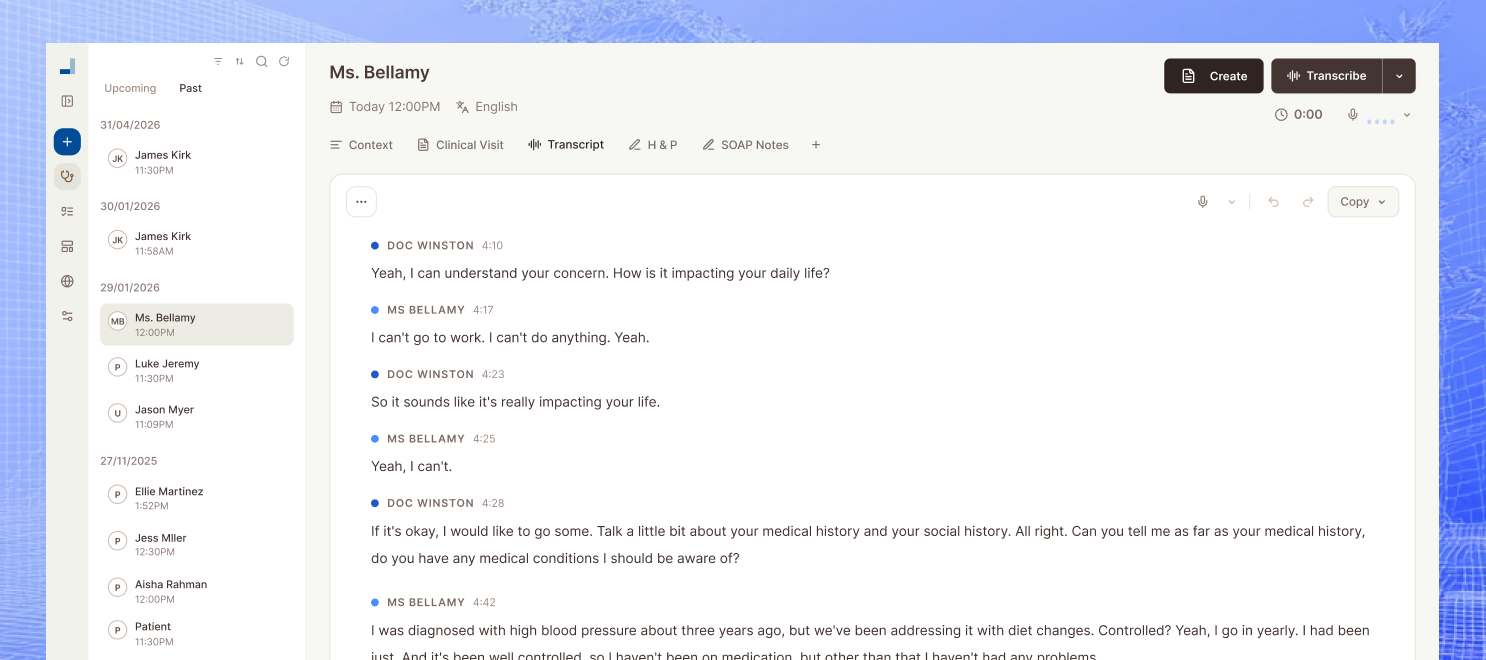
An AI medical scribe serves as a sophisticated digital assistant that captures the dialogue in real-time, allowing the oncologist to maintain eye contact and engage fully. It is important to remember that these tools are assistive. While the AI high-level summaries and draft notes, the clinician remains the final authority and is ultimately responsible for the accuracy and clinical validity of the record. This shift from ‘writer’ to ‘editor’ significantly reduces the friction of administrative tasks.
- Eliminates the ‘pajama time’ spent on finishing charts at home.
- Enhances patient satisfaction by allowing for focused, face-to-face communication.
- Reduces cognitive fatigue by capturing details automatically during the visit.
- Ensures clinical capture is contemporaneous rather than reconstructed from memory.
Note types you can generate beyond SOAP (H&P and more)
Oncology visits rarely fit into a one-size-fits-all documentation box. While a standard SOAP note might suffice for a quick check-in, complex cases require comprehensive History and Physical (H&P) reports, detailed consult notes for referring physicians, and specific procedure notes for biopsies or port placements. Using a structured approach ensures that the entire care team—from infusion nurses to radiation oncologists—is aligned on the patient’s status.
Consistency in note structure is not just about compliance; it is about audit readiness and continuity of care. High-quality discharge summaries and referral letters are essential for oncology patients who frequently move between different levels of care. By leveraging varied note types, you ensure that the narrative of the patient’s journey is clear, which is vital for long-term longitudinal monitoring and clinical trials.
- H&P and Consult Notes for initial staging and treatment planning.
- Detailed Progress Notes for monitoring chemotherapy toxicity and response.
- Procedure Notes for specialized interventions and supportive care.
- Referral Letters that summarize complex histories for other specialists.
How to implement an AI scribe for oncology visit notes step-by-step
To begin implementing an AI scribe for oncology visit notes, start small by selecting one specific visit type, such as follow-up surveillance appointments. This allows you to get comfortable with the technology in a lower-stakes environment before moving on to complex initial consultations. Familiarize yourself with the system by setting up templates tailored to oncology, ensuring they include sections for performance status, toxicities, and staging updates.
During the encounter, whether it is in-person or via telehealth, simply activate the capture tool and focus entirely on the patient. The AI will listen to the nuances of the conversation, including the discussion of lab results and treatment adjustments. Once the visit is over, review the generated draft immediately. Quick editing while the details are fresh is the most efficient way to ensure the note is perfect.
Finally, leverage the outputs to maximize your productivity. Once the primary note is finalized, you can easily repurpose the information to generate referral letters or patient education summaries. This holistic approach ensures that your documentation works for you, rather than you working for your documentation.
- Choose a specific, repeatable visit type for a one-week pilot phase.
- Use oncology-specific templates to ensure all relevant metrics are captured.
- Review and edit notes immediately after the encounter for maximum accuracy.
- Repurpose finalized data for administrative forms and coordination of care.
How to keep note quality high and reduce mistakes
Maintaining high note quality requires a proactive approach to common failure points. In oncology, these often include missing specific dosage adjustments, incorrect lab values, or ‘note bloat’ where irrelevant history obscures the current clinical plan. It is essential to establish a lightweight review habit where you verify the problem list and medications for ogni patient.
Setting team standards for documentation can also help. When every clinician in a clinic follows the same review protocol, the overall quality of the record increases. By treating the AI-generated draft as a high-quality starting point rather than a finished product, you maintain the clinical integrity required for oncology care.
- Verify medication dosages and chemotherapy cycles in every draft.
- Check the problem list for accuracy regarding staging and comorbidities.
- Adopt a consistent review workflow to ensure ‘note bloat’ is minimized.
- Engage in periodic peer reviews of AI-assisted notes to maintain high standards.
Privacy, consent, and patient trust
In the oncology setting, trust is the foundation of the patient-provider relationship. When introducing an AI scribe, transparency is key. While consent requirements vary by region, it is best practice to follow local policies and clearly explain to the patient that a digital tool is being used to help you focus on their care rather than your computer.
You might say: “To help me give you my full attention today, I am using a secure digital tool that records our conversation and helps me write your medical note. It uses encrypted technology to keep your data safe, and I will review everything it writes.” Most patients appreciate the increased eye contact and are comfortable with the technology when it is explained simply.
- Always follow local healthcare privacy laws regarding recording and data storage.
- Provide a clear, simple explanation to patients to maintain transparency.
- Ensure the technology used adheres to high-level security and encryption standards.
- Keep a record of patient consent according to clinic operational policies.
Rolling it out across a clinic without disruption
Successfully introducing an AI scribe across a larger clinic requires a phased approach. A 2-week pilot plan with a few ‘super-users’ allows you to identify any workflow bottlenecks before a full-scale rollout. During this period, track metrics such as time saved per note and the reduction in after-hours charting to demonstrate value to the rest of the team.
Training should focus on template alignment and the best ways to prompt the AI for specific outputs. When everyone is on the same page regarding how to use the tool, the transition is seamless. This structured rollout prevents the frustration that often comes with adopting new clinical technology under pressure.
- Start with a small pilot group to gather feedback and refine templates.
- Track time-saving metrics to build internal support for the technology.
- Conduct brief training sessions focused on oncology-specific documentation.
- Standardize templates across the clinic for consistent data reporting.
Mcoy AI is an AI medical scribe that records and transcribes patient encounters, then generates multiple clinical note types (H&P, progress notes, consult notes, follow-up notes, procedure notes, discharge summaries, referral letters, and more). With access to over 200+ customizable templates and an AI chat feature to create letters, forms, and documents, it streamlines the administrative burden for busy clinicians. This tool is designed to move your focus back to the patient by automating the tedious parts of clinical documentation.
FAQ
Below are some of the most common questions clinicians ask when considering the switch to an AI-assisted documentation workflow.
How accurate are AI medical scribes in real clinics?
AI medical scribes are remarkably accurate in capturing the dialogue and clinical intent of a visit. They are designed to filter out ‘filler’ conversation and focus on relevant medical facts, providing a draft that is typically 80-90% complete. However, the clinician must always review the note to ensure that specific dosages, dates, and medical nuances are captured with 100% accuracy before signing off.
Do I still need to review every note?
Yes, reviewing every note is a fundamental requirement for both clinical safety and legal responsibility. The AI scribe is an assistive tool that creates a draft, but the physician is the one who validates the information. Most clinicians find that reviewing and editing a draft takes a fraction of the time it would take to write a note from scratch, often saving several hours per day.
What note types can an AI scribe generate besides SOAP?
Modern AI scribes are capable of generating a wide variety of documentation beyond the standard SOAP format. This includes comprehensive H&P reports, detailed consult notes, follow-up summaries, and even complex procedure notes. Many systems also offer templates for discharge summaries and referral letters, ensuring that all aspects of the patient’s care journey are documented appropriately.
Will this work for telehealth and in-person consults?
Yes, AI medical scribes are designed to be versatile and function equally well in both in-person and telehealth settings. For telehealth, the scribe can often be integrated into the audio stream of the video call. For in-person visits, it typically uses the microphone on a smartphone, tablet, or computer to capture the conversation, making it a flexible solution for various practice models.
How do I explain recording/transcription to patients?
The best way to explain the scribe is to frame it as a benefit to the patient. You can explain that it allows you to look at them instead of a computer screen and ensures that their medical record is as accurate as possible. Honesty and a focus on improved care quality usually result in very high patient acceptance rates for the technology.
How do clinics prevent note bloat?
Clinics prevent note bloat by using concise templates and setting clear expectations for what the AI should include. You can configure the tool to focus only on new information and changes to the treatment plan, rather than restating the entire medical history every time. This ensures that the final note is a useful clinical summary rather than an unmanageable wall of text.
How long does template setup take?
Setting up basic templates usually takes only a few minutes, as many AI scribes come with pre-built oncology options. Customizing these templates to fit your specific workflow or preferences might take an additional hour or two during the first week of use. Once established, these templates save a significant amount of time on every subsequent patient visit.
What’s the safest way to start if I’m skeptical?
The safest way to start is with a ‘shadow’ trial. Use the AI scribe during a few non-complex visits and continue your usual documentation method in parallel. Compare the AI’s draft to your own notes to see how well it captures the details. Most skeptical clinicians find that once they see the quality and accuracy of the AI-generated drafts, they quickly gain the confidence to switch over.
In conclusion, adopting an AI scribe for oncology visit notes is a powerful way to combat burnout and improve the quality of clinical documentation. By following a structured implementation plan and focusing on a review-based workflow, you can ensure that your notes are both comprehensive and accurate. Start your pilot today and see how this technology can transform your practice. Using an AI scribe for oncology visit notes is no longer a futuristic concept—it is a practical solution for the modern oncologist.
What a serious review table should cover
| Decision area | Common mistake | Better clinic-ready approach | Metric to watch |
|---|---|---|---|
| Workflow design | Treat how to use an ai scribe for oncology visit notes as a one-off documentation task | Build a repeatable process with clear ownership and review points | Time to complete documentation |
| Team adoption | Assume every clinician will naturally use the same process | Train for consistency and define exception handling early | Active user adoption |
| Quality review | Only check notes when a problem is reported | Audit a sample of notes weekly and review edge cases | Edit rate per note |
| Operational follow-through | Leave admin actions outside the documentation workflow | Use the same encounter data for referrals, letters, and follow-up tasks | Completion rate for next-step tasks |
Related reading
If you are working through how to use an ai scribe for oncology visit notes, it helps to read this alongside Specialty Guides: How to Run a More Efficient Medical Practice in 2026, Specialty Guides: How to Improve Patient Encounters, and Specialty Guides: Document Insurance Reports with AI Scribe: Full Guide. Those guides cover adjacent workflow, implementation, and evaluation questions so the decision does not sit in isolation.
FAQ
How accurate are AI medical scribes in real clinics?
AI medical scribes are remarkably accurate in capturing the dialogue and clinical intent of a visit. They are designed to filter out ‘filler’ conversation and focus on relevant medical facts, providing a draft that is typically 80-90% complete. However, the clinician must always review the note to ensure that specific dosages and medical nuances are captured with 100% accuracy before signing off.
Do I still need to review every note?
Yes, reviewing every note is a fundamental requirement for both clinical safety and legal responsibility. The AI scribe is an assistive tool that creates a draft, but the physician is the one who validates the information. Most clinicians find that reviewing and editing a draft takes a fraction of the time it would take to write a note from scratch, often saving several hours per day.
What note types can an AI scribe generate besides SOAP?
Modern AI scribes are capable of generating a wide variety of documentation beyond the standard SOAP format. This includes comprehensive H&P reports, detailed consult notes, follow-up summaries, and even complex procedure notes. Many systems also offer templates for discharge summaries and referral letters, ensuring that all aspects of the patient’s care journey are documented appropriately.
Will this work for telehealth and in-person consults?
Yes, AI medical scribes are designed to be versatile and function equally well in both in-person and telehealth settings. For telehealth, the scribe can often be integrated into the audio stream of the video call. For in-person visits, it typically uses the microphone on a device to capture the conversation, making it a flexible solution for various practice models.
How do I explain recording/transcription to patients?
The best way to explain the scribe is to frame it as a benefit to the patient. You can explain that it allows you to look at them instead of a computer screen and ensures that their medical record is as accurate as possible. Honesty and a focus on improved care quality usually result in very high patient acceptance rates for the technology.
How do clinics prevent note bloat?
Clinics prevent note bloat by using concise templates and setting clear expectations for what the AI should include. You can configure the tool to focus only on new information and changes to the treatment plan, rather than restating the entire medical history every time. This ensures that the final note is a useful clinical summary rather than an unmanageable wall of text.
How long does template setup take?
Setting up basic templates usually takes only a few minutes, as many AI scribes come with pre-built oncology options. Customizing these templates to fit your specific workflow or preferences might take an additional hour or two during the first week of use. Once established, these templates save a significant amount of time on every subsequent patient visit.
What’s the safest way to start if I’m skeptical?
The safest way to start is with a ‘shadow’ trial. Use the AI scribe during a few non-complex visits and continue your usual documentation method in parallel. Compare the AI’s draft to your own notes to see how well it captures the details. Most skeptical clinicians find that once they see the quality and accuracy of the AI-generated drafts, they quickly gain the confidence to switch over.