Specialty Guides: AI Scribe for Rheumatology Notes: Efficiency Guide
Learn how to optimize your rheumatology documentation with an AI scribe. Master complex H&Ps and follow-ups while reducing clinician burnout and charting time.
The Documentation Burden in Modern Rheumatology
For rheumatologists, the primary challenge of the workday often isn’t the complex diagnostic puzzles, but the exhaustive documentation that follows. Rheumatology visits involve intricate joint counts, systemic reviews, and longitudinal medication tracking. Many practitioners find themselves finishing charts long after the clinic doors have closed, leading to significant burnout and a feeling of being rushed during actual patient interactions.
This guide will teach you how to implement a smarter workflow using an AI scribe for rheumatology notes. We will cover moving beyond basic SOAP formats to capture detailed History and Physicals (H&P), managing quality control, ensuring patient privacy, and executing a seamless rollout plan. Whether you are a solo practitioner, part of a multispecialty group, or managing a university clinic, these strategies will help you reclaim your time.
Transitioning to an automated system allows specialists to focus on the nuance of inflammation and autoimmunity rather than the mechanics of data entry. By following a structured implementation, you can ensure that your documentation is not only faster but more accurate and medico-legally sound.
What a medical scribe solves in modern practice
The real cost of traditional documentation is measured in more than just minutes; it is measured in cognitive load. When a clinician is pre-occupied with capturing every word of a patient’s history, they often lose the ability to observe subtle non-verbal cues. An AI medical scribe acts as a secondary set of ears, capturing the raw data of the encounter so the doctor can remain fully present.
It is important to understand that an AI scribe is an assistive tool, not a replacement for clinical judgment. The clinician remains the final authority on the note’s accuracy. However, by removing the manual transcription and formatting tasks, the tool eliminates the ‘pajama time’ spent on EHR entry and ensures that notes are completed while the encounter is still fresh in the mind.
- Significantly reduces after-hours charting and administrative burnout.
- Captures detailed patient narratives that might be missed in manual typing.
- Maintains clinician responsibility while automating the formatting process.
- Improves the quality of face-to-face time during complex consults.
Note types you can generate beyond SOAP (H&P and more)
Rheumatology requires a diverse range of documentation formats that go far beyond a standard SOAP note. For new referrals or systemic workups, a comprehensive History and Physical (H&P) is essential to document the presence or absence of systemic manifestations. Similarly, consult notes need to clearly communicate findings back to primary care physicians with high precision.
Procedure notes for joint aspirations or biologics administration, as well as detailed follow-up notes tracking disease activity scores like DAS28 or CDAI, require specific structures. Having these notes generated automatically ensures continuity of care and high audit readiness, which is critical for reimbursement and longitudinal patient tracking.
Properly structured documentation also facilitates smoother handovers and referral letters. When the AI can instantly turn an encounter into a formal letter, it removes a massive bottleneck in the referral cycle, ensuring that other members of the care team are informed in real-time.
- Generate comprehensive H&P and complex consult notes automatically.
- Streamline procedure notes for injections and aspirations.
- Improve referral letter turnaround times for better care coordination.
- Ensure audit readiness with consistent, structured documentation.
How to implement AI Scribe for Rheumatology Notes step-by-step
To begin implementing an AI scribe for rheumatology notes, start by selecting one specific visit type to pilot, such as standard follow-up visits for stable RA or Lupus patients. This allows you to get comfortable with the technology in a lower-stakes environment before applying it to complex 60-minute initial consults.
Next, set up your templates tailored to rheumatology. You might want specific sections for joint counts, skin findings, and current immunosuppressant regimens. Having these templates ready allows the AI to categorize the transcribed data into the exact format you prefer for your EHR.
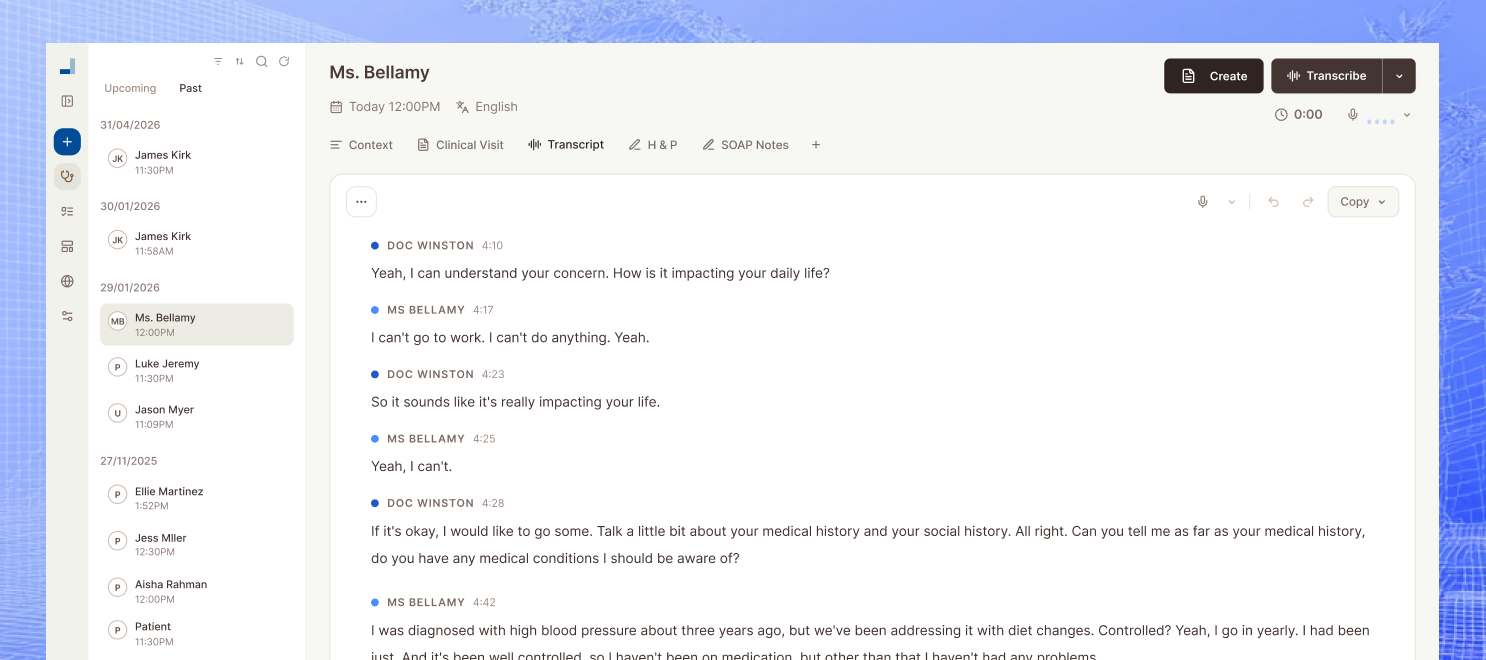
During the encounter, simply let the AI capture the audio in the background. Whether it is an in-person physical exam or a telehealth discussion about lab results, the AI monitors the conversation without requiring you to look at a screen. Once the visit is over, the draft is generated almost immediately.
Review the generated note and make quick edits. Because the AI captures the specific terminology of rheumatology—like ‘malar rash’ or ‘crepitus’—the edits are usually minimal. Finally, you can reuse this output to instantly generate letters for referring physicians or authorizations for biologics.
- Start with one simple visit type to build workflow confidence.
- Configure specialty-specific templates for joint exams and systemic reviews.
- Capture audio naturally during both in-person and virtual consults.
- Review, edit, and repurpose the text for letters and external forms.
How to keep note quality high and reduce mistakes
The most common failure points in clinical notes include missing medication dosages or an outdated problem list. To prevent this, develop a lightweight review habit. Spend sixty seconds scanning the ‘Assessment and Plan’ section immediately after the AI generates the note to ensure the clinical reasoning is reflected accurately.
Setting team standards for how specific findings are dictated can also improve quality. For example, explicitly stating ‘Joint count: 2 swollen, 4 tender’ ensures the AI places these values in the correct field. This proactive approach reduces ‘note bloat’ and keeps the records concise and useful for future visits.
- Implement a quick post-encounter review to verify clinical logic.
- Dictate specific values loudly and clearly to guide the AI.
- Standardize templates across the clinic to maintain record consistency.
Privacy, consent, and patient trust
Consent is the foundation of using recording technology in a clinical setting. While legal requirements vary by region, transparency is always the best policy. Most patients are supportive once they realize the technology allows their doctor to look at them instead of a computer screen.
A simple way to explain this is: ‘I am using an AI assistant to help me take accurate notes today so I can focus entirely on our conversation. It records the audio and transcribes it into your chart, and the recording is deleted afterward. Is that okay with you?’
- Follow local regulations regarding patient consent for audio recording.
- Use a simple script to explain the benefits of the AI to the patient.
- Ensure your chosen platform adheres to strict data security and retention policies.
Rolling it out across a clinic without disruption
For a smooth rollout, start with a two-week pilot program involving one or two ‘tech-champion’ doctors. Track specific metrics such as the number of hours spent charting after 5 PM and the speed of note completion. This data will help convince more skeptical colleagues of the system’s value.
Training should focus on template alignment. When everyone in the clinic uses the same structure for rheumatology notes, it makes it easier for staff to find information and for the AI to learn the specific ‘style’ of the practice.
- Conduct a 2-week pilot to gather data and refine templates.
- Monitor time-saved and note-completeness as key KPIs.
- Align all providers on common documentation standards for consistency.
Mcoy AI is an AI medical scribe that records and transcribes patient encounters, then generates multiple clinical note types (H&P, progress notes, consult notes, follow-up notes, procedure notes, discharge summaries, referral letters, and more). With over 200+ customizable templates and an integrated AI chat to create letters, forms, and documents, it streamlines the administrative side of medicine so clinicians can focus on patient care.
FAQ
Integrating new technology into a busy rheumatology practice often brings up practical questions. Here are the answers to the most common inquiries regarding the use of AI in clinical documentation.
How accurate are AI medical scribes in real clinics?
In real-world clinical settings, AI scribes are remarkably accurate at capturing the dialogue and medical terminology used during a visit. They are particularly good at following the narrative flow of a conversation, though they may occasionally need minor corrections on specific drug dosages or complex brand names. Overall, they provide a much higher level of detail than most clinicians can capture manually while typing.
Do I still need to review every note?
Yes, as the licensed clinician, you are legally and professionally responsible for the contents of the medical record. The AI is a powerful assistant that does the heavy lifting of drafting, but you should always perform a quick review to ensure the assessment and plan accurately reflect your clinical findings. This typically takes less than a minute per note once you are accustomed to the format.
What note types can an AI scribe generate besides SOAP?
Beyond the standard SOAP format, AI scribes can generate comprehensive H&Ps, detailed procedure notes for things like arthrocentesis, and formal referral letters. They can also create discharge summaries and follow-up notes that track disease progression over time. This versatility makes them much more useful than simple transcription tools.
Will this work for telehealth and in-person consults?
Yes, AI scribes are designed to work across multiple modalities. For in-person visits, the device (phone or tablet) captures ambient audio, while for telehealth, it can often be integrated into the computer’s audio stream. The AI is capable of filtering out background noise to focus on the conversation between the doctor and patient.
How do I explain recording/transcription to patients?
Most clinicians find that being direct and framing the technology as a benefit to the patient works best. By explaining that the tool allows you to stop typing and start listening, patients generally feel more cared for and are happy to provide consent. It is helpful to mention that the recording is used only to generate the note and is not stored permanently.
How do clinics prevent note bloat?
Clinics prevent note bloat by using well-defined templates that instruct the AI to only include relevant clinical information. Instead of transcribing every ‘um’ and ‘ah,’ the AI is programmed to extract key medical data points. Clinicians can also further refine these outputs by specifying which sections of the encounter are most important to document.
How long does template setup take?
Basic template setup can take as little as 15 to 30 minutes. Most platforms come with pre-built templates for various specialties, including rheumatology, which can then be tweaked to fit your specific workflow. Refining them as you go based on the AI’s initial outputs is usually the most efficient way to achieve the perfect setup.
What’s the safest way to start if I’m skeptical?
The safest way to start is by using the AI scribe for your most routine, repetitive visits. By trying it out on stable follow-up patients, you can see how the tool handles your typical documentation style without any pressure. Once you see the time savings on these ‘easy’ notes, you can naturally progress to using it for more complex cases.
Conclusion
Implementing a structured workflow with an AI scribe for rheumatology notes is one of the most effective ways to combat clinician burnout and improve practice efficiency. By automating the transcription and formatting of complex H&Ps, procedure notes, and referral letters, you can dedicate more of your cognitive energy to patient diagnosis and treatment. The key is to start with a clear pilot plan, use specialty-specific templates, and maintain a consistent review habit. When you use an AI scribe for rheumatology notes, you aren’t just saving time—you are improving the quality of care for your patients.
What a serious review table should cover
| Decision area | Common mistake | Better clinic-ready approach | Metric to watch |
|---|---|---|---|
| Workflow design | Treat ai scribe for rheumatology notes: efficiency guide as a one-off documentation task | Build a repeatable process with clear ownership and review points | Time to complete documentation |
| Team adoption | Assume every clinician will naturally use the same process | Train for consistency and define exception handling early | Active user adoption |
| Quality review | Only check notes when a problem is reported | Audit a sample of notes weekly and review edge cases | Edit rate per note |
| Operational follow-through | Leave admin actions outside the documentation workflow | Use the same encounter data for referrals, letters, and follow-up tasks | Completion rate for next-step tasks |
Related reading
If you are working through ai scribe for rheumatology notes: efficiency guide, it helps to read this alongside Specialty Guides: How to Run a More Efficient Medical Practice in 2026, Specialty Guides: How to Improve Patient Encounters, and AI & Medicine: Standardize Clinical Notes Between Supervisors & Trainees. Those guides cover adjacent workflow, implementation, and evaluation questions so the decision does not sit in isolation.
FAQ
{
“How accurate are AI medical scribes in real clinics?”: “AI scribes are highly accurate at capturing medical terminology and narrative flow, though clinicians should always perform a final review for nuance.”,
“Do I still need to review every note?”: “Yes, the clinician remains responsible for the medical record; a quick review ensures the assessment and plan are 100% accurate.”,
“What note types can an AI scribe generate besides SOAP?”: “It can generate H&Ps, consult notes, procedure notes, referral letters, and discharge summaries tailored to rheumatology.”,
“Will this work for telehealth and in-person consults?”: “Yes, the technology is built to capture audio from ambient room noise or direct computer streams for virtual visits.”,
“How do I explain recording/transcription to patients?”: “Frame it as a way to focus on the patient instead of the computer, ensuring a more personal and attentive consultation.”,
“How do clinics prevent note bloat?”: “By using structured templates that direct the AI to extract only medically relevant information rather than a full transcript.”,
“How long does template setup take?”: “Initial setup takes about 15-30 minutes, with minor refinements made over the first few days of use.”,
“What’s the safest way to start if I’m skeptical?”: “Start with routine follow-up visits to see the time-saving benefits before moving to complex new patient consults.”
}