Specialty Guides: AI Scribe for Psychiatry Progress Notes: The Full Guide
Master psychiatry progress notes with AI. Reduce burnout and improve documentation accuracy using an AI medical scribe in your psychiatric practice.
What a medical scribe solves in modern practice
Psychiatrists often face a unique documentation burden compared to other specialties. Mental health encounters are heavy on nuance, verbatim quotes, and complex behavioral observations. Capturing these details while maintaining eye contact and building therapeutic rapport is a constant struggle. Many practitioners find themselves finishing notes late at night, leading to significant burnout and a decreased quality of life.
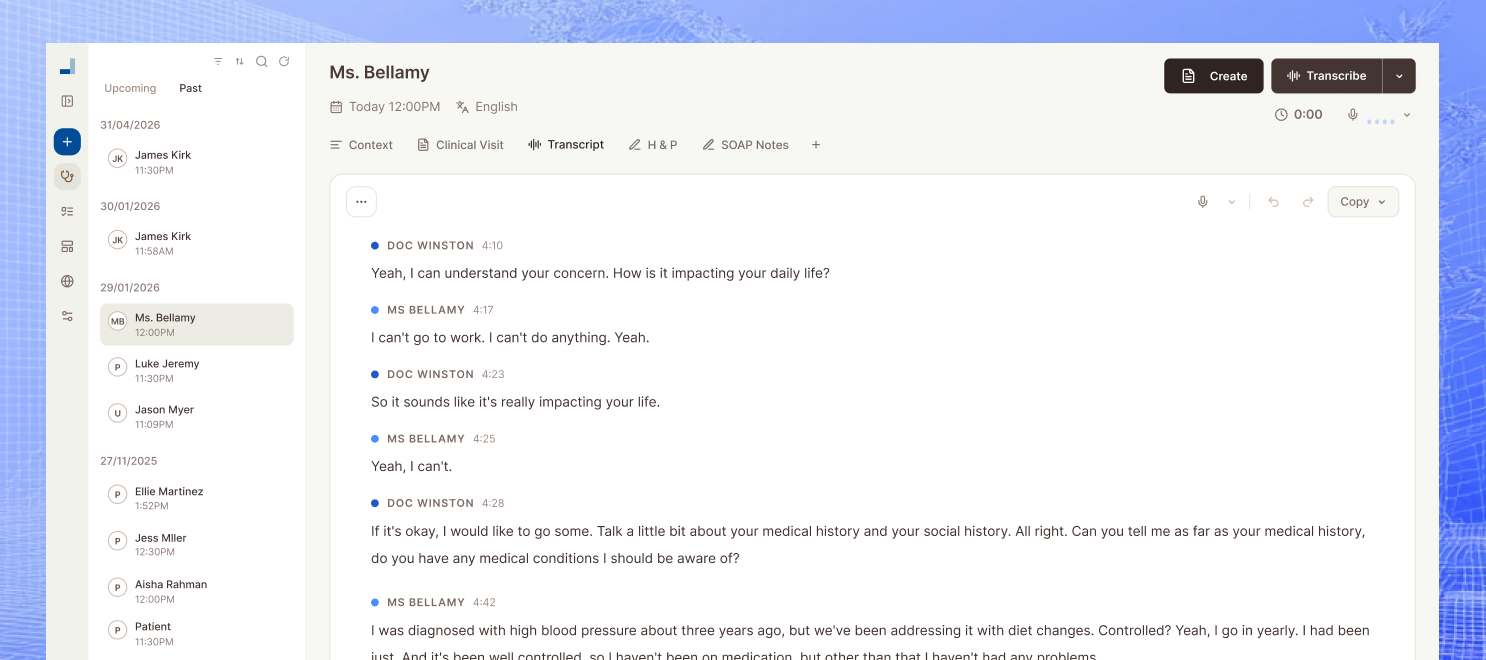
An AI medical scribe acts as a digital assistant that listens to the session and organizes the narrative into a structured format. It is important to remember that these tools are assistive, not autonomous; the clinician remain legally and ethically responsible for the accuracy of every entry. By offloading the mechanical task of writing, psychiatrists can focus entirely on the patient’s emotional state and mental status examination without the distraction of a keyboard.
- Eliminates after-hours charting and reduces cognitive load during sessions.
- Captures specific patient quotes and subtle behavioral descriptions more accurately.
- Ensures notes are completed promptly, improving billing cycles and audit readiness.
- Allows for better clinician-patient engagement by removing the screen barrier.
Note types you can generate beyond SOAP (H&P and more)
While the SOAP format is a staple in medicine, psychiatry often requires more specialized documentation. A comprehensive psychiatric evaluation, or History and Physical (H&P), requires a deep dive into developmental history, family dynamics, and a detailed mental status exam. AI tools can now parse these lengthy conversations into structured sections, ensuring that no critical part of the patient’s history is overlooked during the intake process.
Beyond the initial evaluation, practitioners frequently need to generate consultation notes for primary care physicians, follow-up notes for medication management, and complex referral letters. In a university clinic or hospital setting, discharge summaries and procedure notes for treatments like TMS or ECT are also vital. Having a system that understands the specific requirements of these different formats ensures continuity of care across the entire healthcare team.
The choice of structure significantly impacts the quality of handovers and forensic defensibility. For example, a well-structured progress note clearly delineates between the patient’s subjective experience and the clinician’s objective observations. This level of detail is essential for tracking treatment progress over months or years and provides a robust record for any future clinical audits.
- H&P and comprehensive psychiatric evaluations for new patient intakes.
- Medication management follow-ups and detailed psychotherapy progress notes.
- Specialized referral letters and consultation reports for multidisciplinary teams.
- Discharge summaries that synthesize complex hospital stays into actionable plans.
How to implement AI Scribe for Psychiatry Progress Notes step-by-step
Transitioning your psychiatry progress notes to an automated workflow starts with selecting a single visit type to pilot. Most practitioners find it easiest to begin with standard 15-minute medication management appointments before moving on to 50-minute therapy sessions. This allows you to get a feel for how the AI summarizes shorter, more direct clinical data before tackling long-form narratives.
Next, you should configure your templates according to your specific psychiatric specialty, whether that is child and adolescent psychiatry, addiction medicine, or geriatric care. Most platforms allow you to set your preferred style, such as focusing on the Mental Status Exam (MSE) or prioritizing the biopsychosocial formulation. Having these templates ready before the patient walks in ensures the AI knows exactly how to categorize the information it hears.
During the encounter, whether it is in-person or via a telehealth platform, simply initiate the recording. Conduct the session naturally, as the AI is designed to filter out ambient noise and side conversations. You no longer need to type shorthand or look away from the patient; the system captures the essential clinical facts as you discuss symptoms, side effects, and life stressors.
Once the session concludes, take a few minutes to review the generated output. The AI will provide a draft that you can quickly edit for nuance or clinical judgment. This final human touch is where you add your professional expertise, such as the specific rationale for a diagnostic change or a subtle adjustment in a treatment plan. Finally, once the note is perfected, you can reuse the data to instantly generate referral letters or school accommodation forms without retyping a single word.
- Start with one session type to build confidence in the AI generation.
- Select specialty-specific templates to ensure the MSE is correctly formatted.
- Conduct natural sessions while the AI captures the clinical dialogue.
- Review and edit the draft immediately to ensure clinical nuance is preserved.
How to keep note quality high and reduce mistakes
Maintaining high-quality documentation requires more than just good technology; it requires a consistent review habit. AI can occasionally misinterpret specific medical dosages or psychiatric jargon if the audio is unclear. By establishing a routine of double-checking medication names and specific quantities, you prevent the risk of downstream errors in the patient’s record. This is especially critical in psychiatry where small changes in dosage can have significant clinical impacts.
Another common pitfall is “note bloat,” where the AI includes too much irrelevant conversational data. To combat this, set clear standards for what your notes should contain. Focus on the progression of symptoms, risk assessments (such as suicide or homicide risk), and the clinical reasoning behind the treatment plan. A concise, high-quality note is always more valuable than a long one that lacks clear clinical insight.
- Verify all medication names, dosages, and frequencies for absolute accuracy.
- Ensure the risk assessment section is explicitly reviewed and correctly stated.
- Standardize templates to prevent unnecessary length and focus on clinical relevance.
- Perform periodic peer reviews of AI-generated notes to maintain clinic standards.
Privacy, consent, and patient trust (plain English)
Privacy is paramount in mental health, and patients need to know their sensitive information is handled with care. Consent requirements for recording vary by jurisdiction, so it is essential to follow your local healthcare regulations and clinic policies. Most patients are comfortable with the technology when they understand it helps their doctor focus more on them and less on a computer screen.
You can explain the process to patients simply: “To focus entirely on our conversation today, I use a secure AI tool that helps me draft my clinical notes. It records our session and transcribes the medical details, which I then review and finalize. The recording is encrypted and handled according to strict privacy laws.” This transparency builds trust and often improves the patient experience.
- Always check local and state/provincial laws regarding recording consent.
- Use a simple script to explain the benefits of the technology to patients.
- Ensure the AI platform used meets enterprise-grade security and encryption standards.
- Maintain a clear record of patient consent within their medical file.
Rolling it out across a clinic without disruption
For clinic owners or university department heads, a phased rollout is the most effective way to introduce an AI scribe for psychiatry progress notes. Start with a two-week pilot program involving a small group of “early adopter” clinicians. This group can identify any workflow bottlenecks and help refine the templates before the technology is introduced to the wider staff.
During this pilot, track specific metrics to measure the return on investment. Look at the reduction in after-hours documentation time, the speed of note completion, and clinician satisfaction scores. If the data shows a significant improvement in work-life balance and note quality, the full rollout becomes much easier to justify to board members or stakeholders.
- Begin with a 2-week pilot phase with a small, tech-savvy group of doctors.
- Monitor time-saving metrics and note completion rates to prove value.
- Hold weekly sessions during the rollout to share best practices for template use.
- Align AI outputs with existing EMR workflows to ensure a seamless transition.
Mcoy AI is an AI medical scribe that records and transcribes patient encounters, then generates multiple clinical note types (H&P, progress notes, consult notes, follow-up notes, procedure notes, discharge summaries, referral letters, and more). It features 200+ customizable templates and an integrated AI chat that allows clinicians to instantly create letters, forms, and other essential documents, ensuring documentation is both fast and comprehensive.
What a serious review table should cover
| Decision area | Common mistake | Better clinic-ready approach | Metric to watch |
|---|---|---|---|
| Workflow design | Treat ai scribe for psychiatry progress notes: the full guide as a one-off documentation task | Build a repeatable process with clear ownership and review points | Time to complete documentation |
| Team adoption | Assume every clinician will naturally use the same process | Train for consistency and define exception handling early | Active user adoption |
| Quality review | Only check notes when a problem is reported | Audit a sample of notes weekly and review edge cases | Edit rate per note |
| Operational follow-through | Leave admin actions outside the documentation workflow | Use the same encounter data for referrals, letters, and follow-up tasks | Completion rate for next-step tasks |
Related reading
If you are working through ai scribe for psychiatry progress notes: the full guide, it helps to read this alongside Specialty Guides: How to Run a More Efficient Medical Practice in 2026, Specialty Guides: How to Improve Patient Encounters, and Specialty Guides: Master AI Scribe for Family Medicine | 2024 Workflow Guide. Those guides cover adjacent workflow, implementation, and evaluation questions so the decision does not sit in isolation.
FAQ
How accurate are AI medical scribes in real clinics?
In modern psychiatric settings, AI scribes are highly accurate at capturing the core clinical narrative and mental status exam details. However, they are sensitive to audio quality, so using a good microphone and minimizing background noise is helpful. Always remember that the AI provides a draft that must be reviewed and validated by the clinician before being finalized in the EMR.
Do I still need to review every note?
Yes, reviewing every note is a professional and legal requirement for all clinicians. While the AI does the heavy lifting of transcribing and formatting, only a human therapist or psychiatrist can ensure the clinical nuances, risk assessments, and diagnostic impressions are perfectly accurate. The review process usually takes only a minute or two compared to twenty minutes of manual typing.
What note types can an AI scribe generate besides SOAP?
A robust AI scribe can generate a wide variety of documents including H&P evaluations, psychiatric intake forms, consultation reports, and discharge summaries. It can also produce referral letters and follow-up notes specifically tailored for medication management. The flexibility to switch between these formats ensures that all aspects of psychiatric care are documented appropriately.
Will this work for telehealth and in-person consults?
Most AI scribes are designed to work seamlessly across both environments. For telehealth, the software can often capture the audio directly from the computer, while for in-person visits, a smartphone or tablet app is typically used. This versatility is essential for modern psychiatry practices that often offer a mix of virtual and face-to-face sessions.
How do I explain recording/transcription to patients?
The best approach is to be direct and highlight the benefit to the patient. You can say that the tool allows you to give them your full attention without the distraction of typing. Most patients appreciate the increased eye contact and engagement, and they are generally comfortable once they know the data is encrypted and secure.
How do clinics prevent note bloat?
To prevent notes from becoming too long or filled with irrelevant information, it is important to use concise templates. Clinics should set standards for what the AI should focus on, such as specific psychiatric symptoms and treatment plans. Regularly refining your templates ensures the AI learns to prioritize the most clinically significant information.
How long does template setup take?
Initial template setup usually takes as little as 10 to 15 minutes. Many platforms come with pre-built psychiatric templates that can be used immediately or tweaked to fit your specific style. Once the templates are set, they automatically apply to your sessions, requiring very little ongoing maintenance.
What’s the safest way to start if I’m skeptical?
The best way to start is with a small pilot using non-sensitive sessions or mock encounters to see how the AI handles your speaking style. Once you see the accuracy and the time saved, you can gradually move to your standard medication management appointments. Starting slow allows you to build trust in the system’s ability to handle psychiatric data.
Conclusion
Implementing a modern documentation workflow is the most effective way to combat the rising rates of burnout in the mental health field. By moving from manual typing to an automated system, psychiatrists can reclaim hours of their day while improving the clinical depth of their records. Transitioning to an AI scribe for psychiatry progress notes allows you to focus on what matters most: the therapeutic relationship and patient outcomes. Take the first step by piloting a solution in your clinic today and experience the difference in your daily practice.