Specialty Guides: AI Scribe for Mental Health: Better Notes in Less Time
Learn how to use an AI scribe for mental health notes to stop after-hours charting, improve clinical accuracy, and reclaim your time. Read our expert guide.
What a medical scribe solves in modern practice
Documentation in mental health presents a unique challenge because the nuance of a conversation—pauses, emotional shifts, and complex narratives—is just as important as the clinical facts. For many practitioners, the real cost of manual documentation is measured in cognitive load and delayed follow-ups. When you are rushing to finish a note before the next session, you risk missing the subtle behavioral cues that form the backbone of a successful treatment plan.
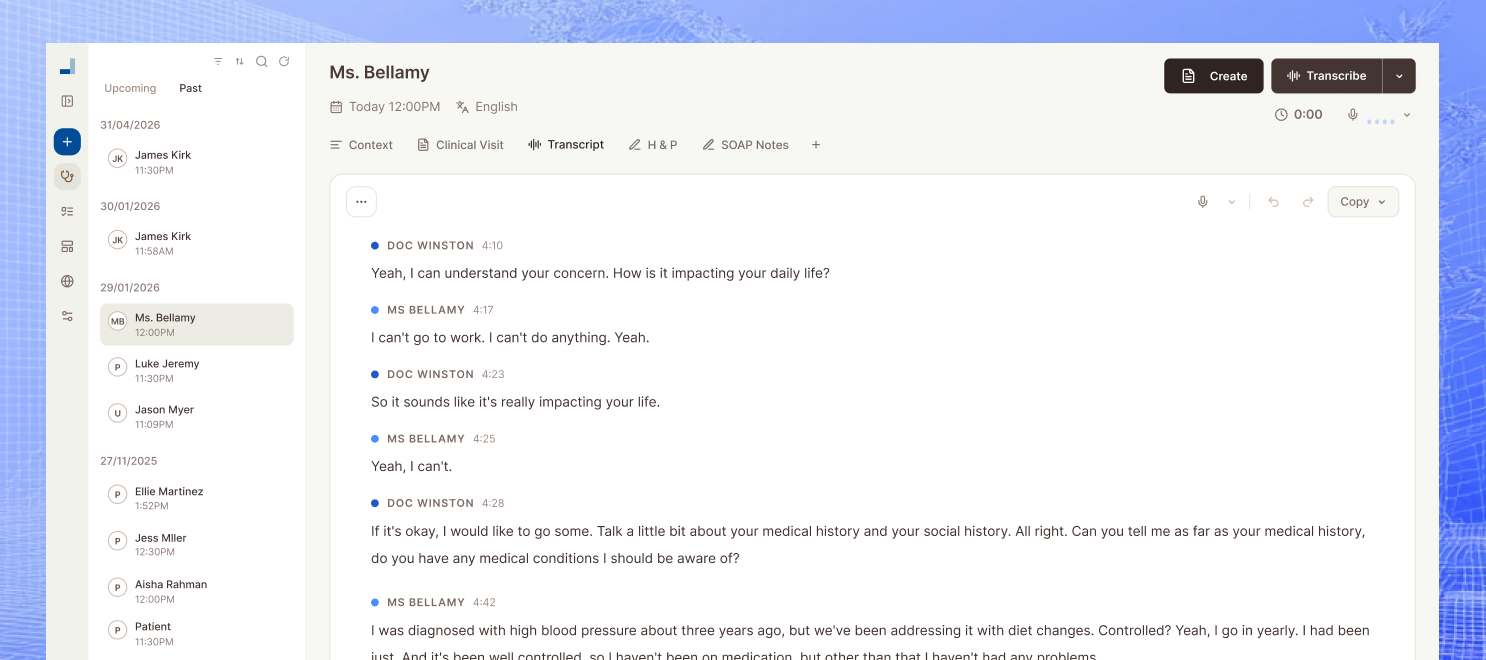
An AI medical scribe serves as an assistive layer that captures the session in real-time, allowing the clinician to remain fully present with the patient. It transforms the raw audio of a therapy session into structured data, ensuring that the clinician isn’t distracted by a keyboard or notepad. However, it is important to remember that the scribe is a tool for efficiency; the clinician remains the final authority on the note’s accuracy and clinical judgment.
- Captures nuanced dialogue without manual shorthand.
- Reduces the cognitive burden of remembering session details.
- Eliminates the ‘pajama time’ spent on late-night charting.
- Allows for 100% eye contact and engagement with patients.
Note types you can generate beyond SOAP (H&P and more)
While the SOAP format is a staple in general medicine, mental health professionals often require a broader range of documentation to provide high-quality care. Comprehensive intake assessments, or H&Ps, are critical for establishing a baseline for new patients. These notes must capture family history, social determinants of health, and previous psychiatric interventions with high precision to inform future sessions.
Beyond the standard progress note, clinicians frequently need to generate consult notes for interdisciplinary teams or complex referral letters for specialized treatment programs. Clinical workflow is significantly smoothed when you can effortlessly produce discharge summaries or procedure notes for specific interventions like TMS or ketamine therapy. Having these varied formats ready at a moment’s notice ensures that every hand-off and audit is handled with professional rigor.
The structure of these notes matters deeply for continuity of care. When a patient moves between a university clinic and a private specialist, the clarity of the documentation dictates the quality of the transition. Using a system that supports varied templates ensures that no matter the context, the record is balanced, professional, and compliant with modern healthcare standards.
- H&P and intake assessments for comprehensive baselines.
- Specialized referral letters for collaborative care.
- Discharge summaries that clearly outline treatment outcomes.
- Follow-up notes that track longitudinal progress over time.
How to implement AI scribe for mental health step-by-step in a real clinic
Starting with an AI scribe for mental health doesn’t require a total practice overhaul; the best approach is to begin with one specific visit type. Choose your most common session—perhaps a 45-minute psychotherapy session—and use the technology exclusively for that type for the first few days. This allows you to get comfortable with the interface without feeling overwhelmed by your entire caseload.
Once you are comfortable, you should set up your templates by specialty or treatment modality. Whether you practice Cognitive Behavioral Therapy (CBT), DBT, or medication management, having a template that mirrors your thought process is essential. During the encounter, simply record the audio, allowing the AI to capture the organic flow of the conversation whether it’s in-person or via a secure telehealth platform.
Immediately after the session, review the generated output. The AI provides a finished draft that usually only requires a quick ‘sanity check’ or minor edits to match your specific voice. Once satisfied, you can reuse parts of that output to auto-populate referral forms or summary letters for the patient’s primary care physician, streamlining your entire administrative day into a few minutes per patient.
- Start small by piloting the tool with one session type.
- Select or customize templates that match your therapy style.
- Review drafts immediately to ensure high clinical accuracy.
- Leverage the AI to generate secondary documents like letters.
How to keep note quality high and reduce mistakes
Clinical documentation excellence is built on a foundation of accuracy and brevity. One common failure point in automated systems is ‘note bloat,’ where the AI includes every ‘um’ and ‘ah’ or irrelevant side-talk. To counter this, practitioners should adopt a lightweight review habit, spending sixty seconds at the end of each note to ensure that medications, dosages, and specific safety plans are perfectly recorded.
It is also helpful to set team standards if you are working in a larger clinic or university setting. Consistent heading usage and a shared understanding of how to document risk assessments (like suicidality or self-harm) ensure that the AI learns to prioritize the most critical safety data. Regularly auditing a small sample of notes for quality and ‘hallucinations’ keeps the system sharp and the clinician protected from medico-legal risks.
- Verify all medication names and dosages for accuracy.
- Cross-check safety assessments for clarity and detail.
- Adopt a consistent review timeframe post-session.
- Limit irrelevant patient chatter to prevent note bloat.
Privacy, consent, and patient trust (plain English)
Privacy is the cornerstone of the therapeutic relationship, especially when recording technology is involved. Consent requirements vary significantly by jurisdiction, so it is vital to follow your local board’s policies and legal guidelines. In most cases, a simple addendum to your standard informed consent paperwork, explaining that you use a secure transcription tool to focus more on the patient, is sufficient.
When introducing the tool to a patient, you might say: ‘I’m using a secure clinical tool that listens to our session so I can focus entirely on you rather than taking notes. It’s encrypted, and I’ll be the only person reviewing the final notes.’ Most patients appreciate the undivided attention and are comfortable with the technology once they understand it serves their care.
General security principles should always be practiced, such as ensuring that the data is encrypted both at rest and in transit. Choosing a tool that prioritizes clinician-led review means that sensitive information is never ‘signed off’ by a machine, maintaining the human bond that is so essential to mental health treatment.
- Update informed consent forms to include AI transcription.
- Use a patient-friendly script to explain the benefits.
- Ensure the platform uses high-level clinical encryption.
- Maintain human oversight over all sensitive psychiatric data.
Rolling it out across a clinic without disruption
Rolling out an AI scribe for mental health across a multi-provider clinic requires a structured two-week pilot plan. During the first week, designate a few ‘super users’ to test the templates and integration. In the second week, collect feedback and adjust templates based on the specific needs of different clinicians—some may prefer narrative notes, while others want highly structural checklists.
Metrics for success should be clearly defined. Track things like the reduction in after-hours charting time and the speed of note completion. If clinicians are finishing their notes by 5:00 PM rather than 9:00 PM, the rollout is a success. This data incentivizes the rest of the staff to adopt the technology, seeing it as a tool for wellness rather than another task to manage.
- Appoint super users to lead the initial implementation.
- Track time saved as a primary metric for staff buy-in.
- Standardize templates across the clinic for better audits.
- Provide brief, hands-on training sessions for late adopters.
Mcoy AI is an AI medical scribe that records and transcribes patient encounters, then generates multiple clinical note types (H&P, progress notes, consult notes, follow-up notes, procedure notes, discharge summaries, referral letters, and more). It features 200+ customizable templates and an AI chat function to help you easily create custom letters, forms, and documents based on your session data. The tool is designed to integrate seamlessly into your workflow, ensuring you spend less time on administrative tasks and more time providing high-quality patient care.
Conclusion
The transition to using an AI scribe for mental health can transform a burdened practice into a more focused and sustainable environment. By automating the heavy lifting of transcription and formatting, you are free to engage more deeply with your patients and focus on the complexities of their care. Implement these steps, choose the right templates, and you will see an immediate improvement in your work-life balance. Adopting an AI scribe for mental health is the modern solution to a long-standing clinical problem, and the best way to start is with a small pilot today.
What a serious review table should cover
| Decision area | Common mistake | Better clinic-ready approach | Metric to watch |
|---|---|---|---|
| Workflow design | Treat ai scribe for mental health: better notes in less time as a one-off documentation task | Build a repeatable process with clear ownership and review points | Time to complete documentation |
| Team adoption | Assume every clinician will naturally use the same process | Train for consistency and define exception handling early | Active user adoption |
| Quality review | Only check notes when a problem is reported | Audit a sample of notes weekly and review edge cases | Edit rate per note |
| Operational follow-through | Leave admin actions outside the documentation workflow | Use the same encounter data for referrals, letters, and follow-up tasks | Completion rate for next-step tasks |
Related reading
If you are working through ai scribe for mental health: better notes in less time, it helps to read this alongside Specialty Guides: How to Run a More Efficient Medical Practice in 2026, Specialty Guides: How to Improve Patient Encounters, and Specialty Guides: How to Use an AI Scribe for Sports Medicine Notes Guide. Those guides cover adjacent workflow, implementation, and evaluation questions so the decision does not sit in isolation.
FAQ
How accurate are AI medical scribes in real clinics?
AI scribes are remarkably accurate, often capturing over 95% of clinical details correctly. However, they may occasionally struggle with heavy accents or very technical jargon. This is why a final review by the clinician is always required. In a mental health context, they excel at capturing the narrative arc of the session, though the doctor must ensure the psychiatric interpretation remains precise.
Do I still need to review every note?
Yes, reviewing every note is a mandatory part of the clinical process. While the AI does the heavy lifting of transcription and formatting, the clinician is legally responsible for the medical record. A quick review ensures there are no errors in medication dosages or clinical conclusions. Most practitioners find this review takes less than a minute per patient.
What note types can an AI scribe generate besides SOAP?
An AI scribe can generate a wide array of documents including intake assessments (H&P), progress notes, and complex referral letters. It can also produce discharge summaries and consult notes for other specialists. This flexibility is particularly useful for mental health professionals who need different formats for therapy sessions versus medication management visits. Many systems offer customizable templates to suit specific needs.
Will this work for telehealth and in-person consults?
Yes, modern AI scribes are designed to work across both modalities. For telehealth, the system can often capture audio directly from your computer’s output, while in-person sessions use the microphone on your workstation or mobile device. This makes it an ideal solution for hybrid practices that balance remote and office-based care. The quality of transcription remains high as long as the audio is clear.
How do I explain recording/transcription to patients?
Honesty and transparency are the best approach when talking to patients about AI tools. Explain that the tool helps you give them your full attention instead of typing during the session. Mention that the data is handled securely and that you are the only one who reviews and approves the final note. Most patients prioritize having their doctor’s undivided attention over the traditional pen-and-paper method.
How do clinics prevent note bloat?
Note bloat is prevented by using smart templates that summarize conversation rather than transcribing it verbatim. Clinicians can also train the AI by providing feedback on which sections are too wordy or irrelevant. Setting specific instructions within the software to maintain a concise style helps keep records professional. Regularly auditing notes for length and relevance ensures the documentation stays high-quality.
How long does template setup take?
Setting up your initial templates usually takes less than thirty minutes. Most platforms come with pre-built mental health templates that you can use immediately or tweak to fit your specific style. Once these are set, they apply to all future notes, making the ongoing process nearly instant. You can always add or adjust templates as your practice specialty evolves.
What’s the safest way to start if I’m skeptical?
The safest way to start is with a small pilot—choose just 2 or 3 non-complex patients who you have a long-standing relationship with. This low-pressure environment allows you to see how the software handles your recording and how the notes look. Once you see the time savings and the quality of the draft, your skepticism will likely fade. It’s always best to move at a pace that feels comfortable for your professional standards.