Specialty Guides: How to Use an AI Scribe for Dermatology Consult Notes
Learn how to implement an AI scribe for dermatology. Optimize consult notes, procedural documentation, and H&P with our comprehensive guide for clinicians.
What a medical scribe solves in modern practice
The administrative burden in dermatology is uniquely intense due to the high volume of patients and the visual nature of the specialty. Clinicians often find themselves trapped in a cycle of after-hours charting, where the exhaustion of documenting every lesion, biopsy, and treatment plan leads to significant burnout. This cognitive load doesn’t just tire the doctor; it risks the omission of subtle details that are critical for long-term patient monitoring and medico-legal protection.
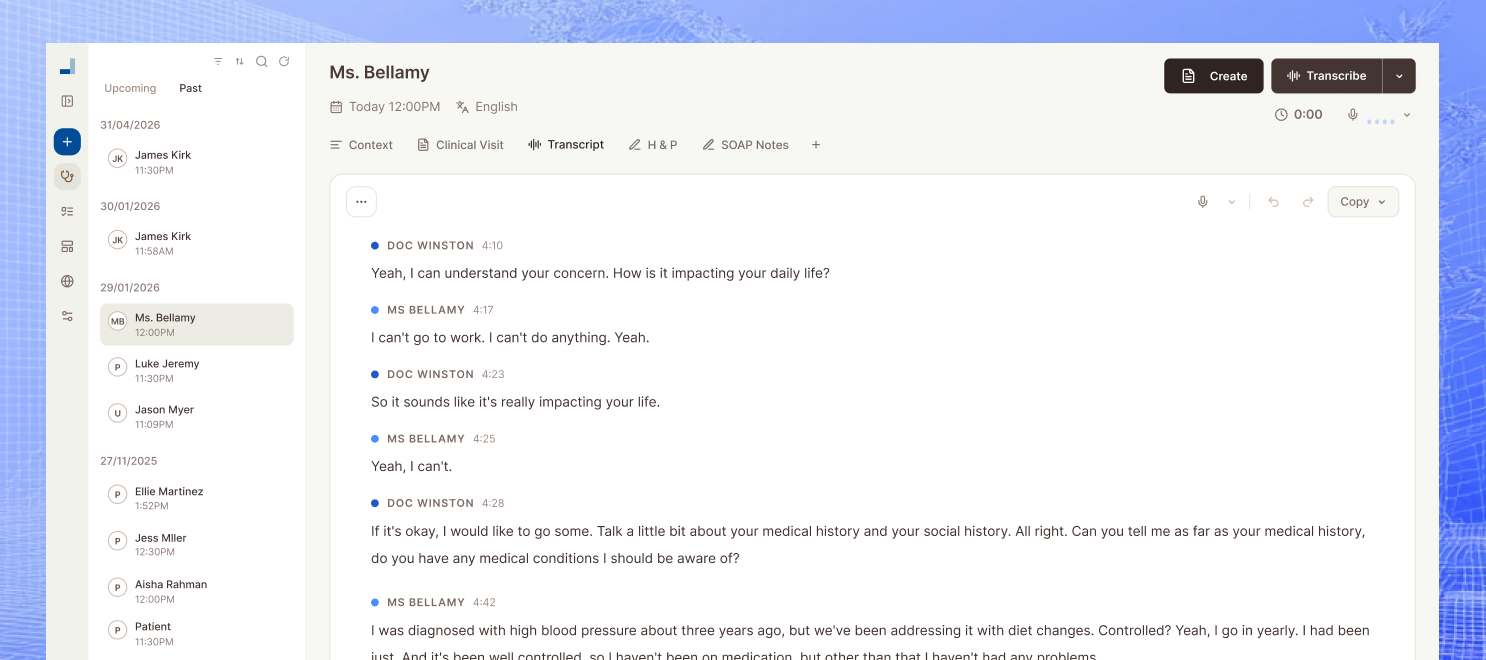
Using an AI scribe for dermatology consult notes addresses these pain points by acting as a sophisticated listening and drafting partner. While the clinician focuses entirely on the physical examination and patient interaction, the AI captures the nuances of the history of present illness and the proposed management plan. It is important to remember that these tools are assistive—the dermatologist remains the final authority, ensuring that the clinical judgment reflected in the note is accurate and personalized.
- Eliminates the ‘pajama time’ spent on evening documentation.
- Improves patient eye contact by removing the screen barrier.
- Captures complex terminology accurately in real-time.
- Reduces the risk of human error during manual data entry.
Note types you can generate beyond SOAP (H&P and more)
Dermatology requires more than just a standard SOAP note to capture the complexity of skin care. Comprehensive documentation includes History and Physical (H&P) reports that detail chronic skin conditions, as well as detailed consult notes for secondary referrals. These documents serve as the foundation for the patient’s longitudinal record, ensuring that any physician reviewing the file understands the progression of a condition like psoriasis or melanoma.
Beyond standard visits, specialized outputs like procedure notes for biopsies, excisions, or Mohs surgery are essential. Follow-up notes track the efficacy of biologics or topical regimens, while referral letters ensure seamless communication between the primary care provider and the specialist. Proper structure in these documents is not just about compliance; it is about audit readiness and providing high-quality handouts for care coordination.
- H&P and Consult Notes for initial assessments.
- Procedure Notes for biopsies, cryotherapy, and excisions.
- Follow-up Notes to track treatment response over time.
- Referral letters for external specialists and PCPs.
How to implement an AI scribe for dermatology consult notes step-by-step in a real clinic
Starting with an AI scribe for dermatology consult notes should be a phased process to ensure staff and patient comfort. Begin by selecting one specific visit type—such as routine skin checks or follow-up acne visits—to test the workflow. This allows you to normalize the presence of the tool without the pressure of a complex surgical day. Ensure your templates are pre-configured to reflect your specific clinical style and the terminology you use most frequently.
During the encounter, whether it is in-person or via telehealth, simply activate the recording and conduct the visit naturally. Explicitly state your findings aloud during the physical exam; for example, ‘erythematous plaque on the right elbow with silvery scale.’ This verbalization serves the dual purpose of informing the patient and providing the AI with precise data points for the objective section of the note. After the patient leaves, the AI generates the draft almost instantly. Spend sixty seconds reviewing the output to ensure the morphology and site locations are exact. Finally, utilize the AI’s ability to repurpose that data into various forms, such as lab requisitions or patient education summaries, effectively closing the loop on the visit documentation in minutes rather than hours.
- Start with low-complexity visits to build confidence in the tool.
- Verbalize physical exam findings clearly to ensure high note accuracy.
- Review drafts immediately while the encounter is fresh in your mind.
- Leverage the AI to create letters and forms from the note data.
How to keep note quality high and reduce mistakes
Quality control is paramount when using AI in a clinical setting. Common failure points often involve ‘note bloat’ or the inclusion of irrelevant information gathered during casual conversation. In dermatology, the risk also includes the misidentification of anatomical locations if the clinician isn’t specific. To combat this, clinicians should adopt a lightweight review habit: scanning the ‘Assessment and Plan’ section first, as this is the most legally and clinically sensitive area of the document.
Establishing team standards for documentation also helps maintain high quality. If multiple providers in a clinic use the tool, having a shared set of templates ensures that regardless of who sees the patient, the note structure remains consistent. This consistency is vital for multidisciplinary teams at university clinics where residents and attending physicians must align on patient management.
- Check anatomical sites and lesion measurements for exactness.
- Prune unnecessary dialogue to prevent excessive note length.
- Standardize templates across the clinic for consistent records.
- Verify that all prescribed medications and dosages are correct.
Privacy, consent, and patient trust (plain English)
Patient privacy is the cornerstone of the therapeutic relationship, and introducing new technology requires transparency. Most patients are comfortable with AI transcription when they understand it improves the quality of their care and allows their doctor to focus on them rather than a keyboard. Consent requirements vary significantly by state and country, so it is essential to follow your local healthcare board’s specific privacy guidelines.
A simple way to present this to a patient is: ‘I’m using a secure medical AI to record our conversation so I can focus on your skin exam today instead of typing. It helps me create a more accurate record of our plan. Is that okay with you?’ This approach frames the technology as a benefit to the patient. From a technical standpoint, ensure the platform you use adheres to industry-standard encryption and data retention policies that protect patient identifiers.
- Always obtain verbal or written consent as per local regulations.
- Frame the AI as a tool for better clinical focus and accuracy.
- Ensure data is encrypted and handled according to HIPAA or GDPR.
- Inform patients that the recording is used for documentation only.
Rolling it out across a clinic without disruption
A successful rollout involves more than just software; it requires a change management plan. Start with a two-week pilot program involving one or two ‘tech-forward’ clinicians. This small group can identify potential friction points in the workflow before the entire clinic adopts the system. During this phase, focus on metrics such as time saved per day and the reduction in ‘documentation debt’—notes that remain unsigned at the end of the week.
Training sessions should be short and focused on template alignment. When university clinics or private practices align their templates, it reduces the learning curve for new staff. By the end of the pilot, the time saved usually becomes the greatest motivator for the rest of the team to transition, transforming documentation from a chore into a seamless part of the patient care journey.
- Run a 14-day pilot with a small group of providers.
- Measure ‘time to sign’ and clinician satisfaction scores.
- Align templates across the specialty for uniform output.
- Conduct brief training focused on specific dermatology workflows.
Mcoy AI is an AI medical scribe that records and transcribes patient encounters, then generates multiple clinical note types (H&P, progress notes, consult notes, follow-up notes, procedure notes, discharge summaries, referral letters, and more). With over 200 customizable templates and an integrated AI chat to create letters, forms, and documents, it allows clinicians to streamline their entire administrative process. This intelligent assistant ensures that every dermatology visit is documented with precision, helping providers maintain a high standard of care without the burnout of manual charting.
Conclusion
Implementing a workflow for an AI scribe for dermatology consult notes is a transformative step for any modern practice. By moving away from manual typing and toward intelligent, voice-driven documentation, clinicians can reclaim hours of their day and return their focus to where it belongs: the patient. Whether you are managing a high-volume university clinic or a boutique private practice, the shift toward structured, AI-generated notes ensures better continuity of care and improved professional well-being. Start your pilot today and experience the difference that modern documentation can make for your dermatology practice.
What a serious review table should cover
| Decision area | Common mistake | Better clinic-ready approach | Metric to watch |
|---|---|---|---|
| Workflow design | Treat how to use an ai scribe for dermatology consult notes as a one-off documentation task | Build a repeatable process with clear ownership and review points | Time to complete documentation |
| Team adoption | Assume every clinician will naturally use the same process | Train for consistency and define exception handling early | Active user adoption |
| Quality review | Only check notes when a problem is reported | Audit a sample of notes weekly and review edge cases | Edit rate per note |
| Operational follow-through | Leave admin actions outside the documentation workflow | Use the same encounter data for referrals, letters, and follow-up tasks | Completion rate for next-step tasks |
Related reading
If you are working through how to use an ai scribe for dermatology consult notes, it helps to read this alongside Specialty Guides: How to Run a More Efficient Medical Practice in 2026, Specialty Guides: How to Improve Patient Encounters, and Specialty Guides: Document Diabetes Reviews with AI Scribe: Complete Guide. Those guides cover adjacent workflow, implementation, and evaluation questions so the decision does not sit in isolation.
FAQ
How accurate are AI medical scribes in real clinics?
AI medical scribes currently offer very high accuracy, typically capturing 95% or more of the clinical conversation correctly. In a dermatology setting, they excel at capturing the terminology related to skin morphology and treatment plans. However, accuracy is highest when the clinician verbalizes physical exam findings clearly. They are designed to supplement the doctor’s workflow, not replace their clinical judgment.
Do I still need to review every note?
Yes, the clinician is legally and ethically responsible for the accuracy of the medical record. While AI does the heavy lifting by drafting the note, you should perform a quick review to ensure specific details like lesion locations or medication dosages are exact. Most doctors find that this review takes less than a minute, which is still a massive time saving compared to typing from scratch.
What note types can an AI scribe generate besides SOAP?
Beyond the standard SOAP format, an AI scribe can generate History and Physicals (H&P), detailed procedure notes for biopsies, and consult notes for specialists. It can also create follow-up summaries, discharge instructions, and referral letters. This versatility makes it particularly useful for the varied tasks found in a dermatology practice or university clinic.
Will this work for telehealth and in-person consults?
Yes, AI scribes are highly adaptable and work effectively in both environments. For in-person visits, the device typically sits on the desk and captures the ambient room audio. For telehealth, the system can integrate with your video platform or capture audio directly from your computer, ensuring the documentation is just as seamless as it would be in a physical clinic.
How do I explain recording/transcription to patients?
The best approach is to be direct and positive about the benefits. You might say, ‘I’m using an AI assistant today to help me with my notes so I can spend more time looking at your skin and less time at my computer screen.’ Most patients appreciate the extra attention and are happy to consent when they know their data is being handled securely and privately.
How do clinics prevent note bloat?
AI scribes prevent note bloat by using intelligent templates that filter out small talk and irrelevant conversation. By selecting a dermatology-specific template, the AI knows to focus on clinical findings, history, and treatment plans. Clinicians can further refine this by providing feedback to the AI or adjusting their templates to prioritize brevity and high-value clinical data.
How long does template setup take?
Initial template setup usually takes only a few minutes, especially if you start with pre-built specialty templates. Most clinicians spend about 30 minutes in their first week fine-tuning their preferences to match their specific ‘voice’ and documentation style. Once set, these templates automate the format of every subsequent note, providing immediate long-term time savings.
What’s the safest way to start if I’m skeptical?
The safest way to start is with a small pilot program involving low-risk, routine visits. Use the AI scribe for five to ten simple follow-up appointments to see how it handles your natural speaking style. This allows you to build trust in the tool’s accuracy and witness the time-saving benefits firsthand before committing to using it for complex surgical or initial consult visits.