Physician Wellbeing: Why Documentation Is the Biggest Time Drain for Doctors
Why documentation is the biggest time drain for doctors and how smarter workflows and AI tools can reduce admin without compromising care.
Ask almost any doctor what takes the most time outside of patient care, and the answer is rarely surprising. Documentation. Notes, letters, forms, referrals, compliance requirements, and follow-ups now consume a significant portion of the clinical day. For many doctors, documentation does not end when the clinic closes. It follows them home, into evenings, and often into weekends.
This time drain is not just inconvenient. It affects how doctors practise medicine, how present they feel with patients, and how sustainable their careers are long term. Documentation has quietly become one of the largest contributors to burnout, dissatisfaction, and reduced clinical capacity.
Understanding why documentation takes so much time is the first step toward fixing it.
Documentation has expanded far beyond clinical necessity
Documentation exists for good reasons. It supports continuity of care, communication between providers, legal accountability, and patient safety. However, over time, the scope of documentation has expanded far beyond its original purpose.
Doctors are now expected to document not only what happened clinically, but also what supports billing, compliance, audits, and reporting. Many of these requirements do not directly improve patient care, yet they still demand time and attention.
The result is documentation that is longer, more complex, and more detailed than what clinicians would naturally write for clinical purposes alone. Each additional requirement adds minutes, and those minutes accumulate quickly.
Documentation competes directly with patient care
One of the most damaging aspects of documentation is that it competes with patient care in real time.
During consultations, doctors are expected to listen, think, explain, and document simultaneously. This divided attention makes encounters more mentally taxing and less satisfying for both doctor and patient. Many clinicians feel forced to choose between being fully present or keeping up with notes.
To protect patient flow, doctors often postpone documentation until later. This keeps clinics running on time, but it shifts the workload into after-hours charting, which is where documentation becomes even more draining.
Writing notes from memory takes longer
Delayed documentation is slower documentation.
When notes are written hours after a consultation, doctors must reconstruct conversations, decisions, and reasoning from memory. This process is cognitively demanding, especially after a long clinical day. Uncertainty creeps in. To compensate, many clinicians document more than necessary, adding detail “just in case.”
This combination of recall effort and over-documentation significantly increases time spent per note. What could have taken minutes during the day now takes much longer at night.
Electronic records did not reduce the workload
Electronic health records were meant to make documentation faster and more efficient. In practice, many systems added complexity instead.
Digital records often prioritise billing and compliance over clinical flow. Mandatory fields, alerts, templates, and duplicated data entry increase the number of steps required to complete a note. Doctors become the connectors between systems that do not communicate well with each other.
Instead of replacing paperwork, many EHRs digitised it. The work did not disappear. It simply changed form.
This is why documentation time has continued to rise even as healthcare has become more digital.
Documentation is cognitively exhausting, not just time-consuming
Documentation drains more than time. It drains mental energy.
Every note requires dozens of small decisions. What to include. How to phrase it. What structure to use. What level of detail is enough. These micro-decisions add up over the day and contribute to decision fatigue.
By the time doctors sit down to finish notes, their cognitive reserves are already depleted. Tasks take longer. Errors are more likely. Frustration builds.
This is why documentation feels heavier than other tasks, even when the time spent is similar.
Fear drives over-documentation
Another major driver of documentation time is fear.
Doctors worry about audits, complaints, and medico-legal risk. To protect themselves, they document more than is clinically necessary. Notes become longer and more detailed, even when that detail adds little value.
This defensive documentation culture increases workload without improving care quality. In many cases, long, unfocused notes make it harder for other providers to identify key information.
Clear standards and better structure can reduce this fear, but without them, doctors default to documenting everything.
Documentation creates a ripple effect of extra work
Poor documentation does not just take time to create. It creates more work downstream.
When notes are unclear, staff follow up. When referrals lack detail, specialists request clarification. When plans are vague, patients call back.
Each of these follow-ups adds to administrative workload. Ironically, documentation meant to reduce risk often increases it by generating confusion.
Clear, structured documentation reduces this ripple effect, but achieving that clarity manually takes time, which is why the cycle continues.
Why documentation has become the biggest time drain
When all these factors combine, documentation becomes uniquely burdensome.
It expands endlessly. It competes with patient care. It is delayed and reconstructed from memory. It is cognitively demanding. It is driven by fear. And it creates additional work when done poorly.
No other task in medicine carries this combination of time pressure and mental load. This is why documentation consistently ranks as the biggest time drain for doctors.
Why working harder does not fix the problem
Many doctors try to solve documentation overload by working harder. Typing faster. Staying later. Catching up on weekends.
This approach is unsustainable. The problem is not individual efficiency. It is system design.
As long as documentation is created manually, after the fact, and duplicated across formats, no amount of personal effort will eliminate the time drain.
The solution must change how documentation is created, not just how quickly it is typed.
Smarter documentation changes everything
The most effective way to reduce documentation time is to change documentation from a writing task into a review task.
When clinical encounters are captured at the source and structured automatically, doctors no longer start from a blank page. Instead, they review, refine, and approve.
This reduces both time spent and cognitive load. It also allows doctors to stay present with patients during consultations, knowing documentation is being handled in the background.
This is where modern AI-assisted documentation plays a critical role.
How Mcoy AI addresses the documentation time drain
Mcoy AI is designed specifically to tackle the core reasons documentation consumes so much time.
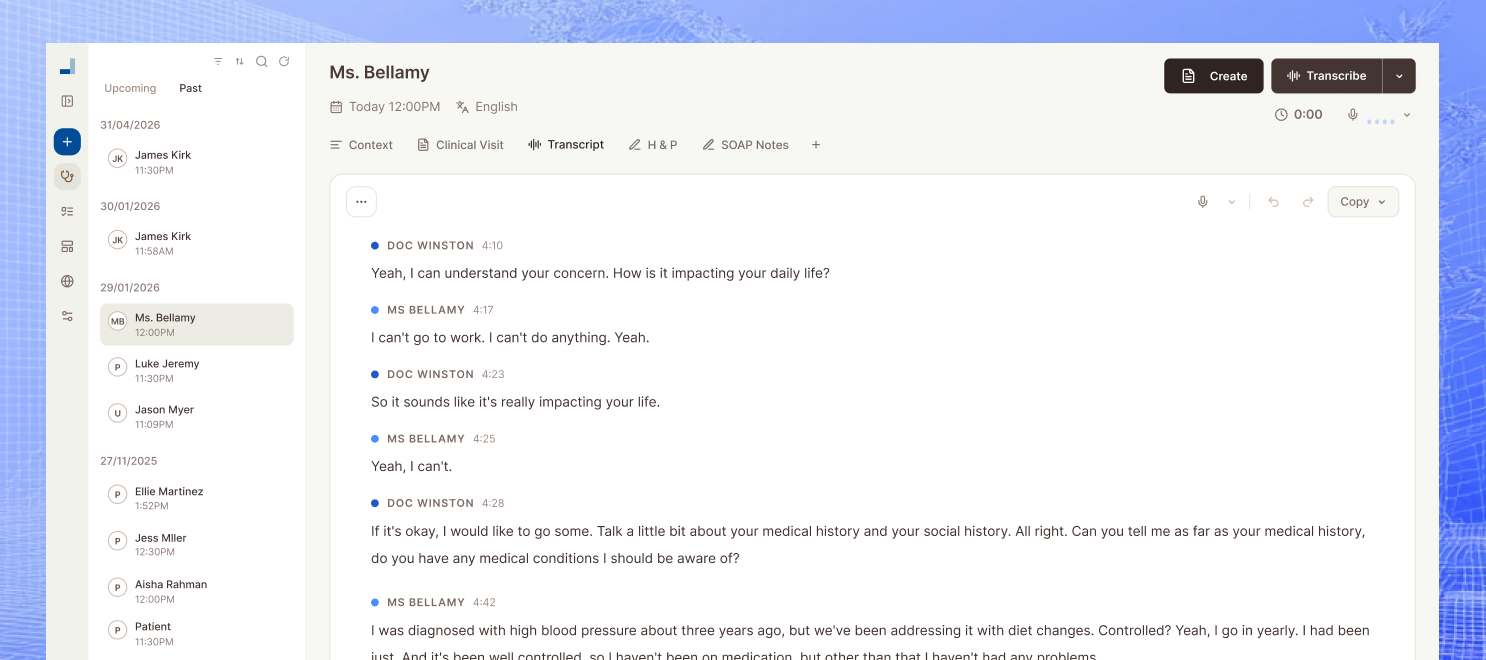
Mcoy AI records and transcribes patient encounters, then turns those conversations into structured SOAP notes automatically. Instead of reconstructing visits from memory, doctors receive a draft note based on what was actually said.
With over 200 customisable templates built for different specialties, documentation aligns with real clinical practice rather than generic formats. Doctors can also generate referral letters, forms, and reports from the same captured encounter, eliminating duplication.
By turning documentation into a review task and removing repetitive writing, Mcoy AI helps clinicians drastically reduce the time and mental energy spent on notes, without compromising care quality or clinical responsibility.
The downstream benefits of reducing documentation time
When documentation stops being the biggest time drain, the effects are immediate.
Doctors finish work earlier. Evenings become restorative again. Cognitive fatigue decreases. Patient encounters improve because clinicians are less distracted.
Clinics also benefit. Fewer errors, clearer communication, faster turnaround on referrals, and better staff morale all follow from smarter documentation workflows.
Reducing documentation time is not just about convenience. It is about sustainability.
Documentation is a system problem, not a doctor problem
The most important shift is reframing documentation as a system issue. Doctors are not slow. They are overloaded. They are working within systems that demand too much manual effort When systems are redesigned to capture information efficiently and reduce duplication, documentation stops dominating the day. Medicine becomes more humane again.
The path forward
Documentation will always be part of healthcare. Records matter. Accountability matters. Communication matters.
But documentation does not have to be the biggest time drain for doctors.
With smarter workflows, better structure, and AI-assisted documentation tools, practices can reduce administrative burden without compromising care.
When documentation fades into the background, doctors regain time, focus, and satisfaction. And that benefits everyone.
What a serious review table should cover
| Decision area | Common mistake | Better clinic-ready approach | Metric to watch |
|---|---|---|---|
| Workflow design | Treat why documentation is the biggest time drain for doctors as a one-off documentation task | Build a repeatable process with clear ownership and review points | Time to complete documentation |
| Team adoption | Assume every clinician will naturally use the same process | Train for consistency and define exception handling early | Active user adoption |
| Quality review | Only check notes when a problem is reported | Audit a sample of notes weekly and review edge cases | Edit rate per note |
| Operational follow-through | Leave admin actions outside the documentation workflow | Use the same encounter data for referrals, letters, and follow-up tasks | Completion rate for next-step tasks |
Related reading
If you are working through why documentation is the biggest time drain for doctors, it helps to read this alongside Physician Wellbeing: How Doctors Can Reduce Paperwork Without Compromising Care, Physician Wellbeing: How Doctors Can Reduce Paperwork Without Compromising Care, and AI & Medicine: What is Medical Charting?. Those guides cover adjacent workflow, implementation, and evaluation questions so the decision does not sit in isolation.
FAQ
Why does documentation take more time than patient care for many doctors
Documentation has expanded far beyond clinical storytelling. Doctors are now documenting for billing, compliance, audits, and legal protection, often all at once. These requirements add layers of structure, duplication, and detail that do not directly improve care but still require time and mental effort. Because appointments have not grown longer to match this workload, documentation is pushed into after-hours time.
Is documentation overload a problem of efficiency or system design
It is primarily a system design problem. Most doctors are already working efficiently within the constraints they are given. The issue is that documentation systems require too much manual input, too late in the workflow, and often ask doctors to repeat the same information in multiple formats. No amount of typing speed can fix a system that demands unnecessary work.
Why does after-hours charting happen even for experienced clinicians
Experience improves clinical decision-making, but it does not reduce documentation requirements. In many cases, senior doctors carry more complex patients and higher compliance responsibility, which increases documentation load. After-hours charting happens because there is not enough protected time during the day to complete notes without compromising patient flow.
Do shorter notes increase medico-legal risk
Not necessarily. Clear, structured, and relevant notes are often safer than long, unfocused ones. Overly verbose documentation can obscure key clinical reasoning and decisions. Medico-legal risk is reduced when documentation clearly explains assessment, decision-making, and follow-up, not when it includes excessive detail.
Can documentation really be reduced without lowering care quality
Yes. In fact, reducing low-value documentation often improves care quality. Doctors who are less burdened by paperwork are more present, think more clearly, and communicate better. Smarter documentation focuses on what matters clinically, rather than capturing everything possible.
Why do electronic health records feel like they made things worse
Many electronic systems were designed around billing and reporting rather than clinical workflow. They often introduce more steps, mandatory fields, and duplicated entry. Instead of replacing paperwork, they digitised it. This is why documentation time increased even as clinics went paperless.
Is documentation burden a major contributor to burnout
Yes. After-hours charting is one of the strongest predictors of physician burnout. It reduces recovery time, disrupts work-life balance, and creates a constant sense of unfinished work. Over time, this leads to emotional exhaustion and disengagement from clinical work.