Physician Wellbeing: How to Reduce Interruptions During Consultations With AI
Learn how to reduce interruptions during consultations with AI tools. Discover workflows for H&P, SOAP notes, and faster documentation for clinic owners.
The Hidden Burden of the Modern Consultation
For most clinicians, the sacred space of the patient encounter has become increasingly fragmented. Whether it is the constant clicking of a keyboard, the need to verify a specific detail in the EHR, or the mental fatigue of trying to remember every symptom while maintaining eye contact, interruptions are everywhere. These disruptions often lead to after-hours charting, clinician burnout, and a nagging anxiety that a critical detail might be missed in a rushed note. This guide is designed for private practitioners, university clinics, and specialists who want to reclaim their time and focus.
In the following sections, we will explore how to reduce interruptions during consultations with AI. We will go beyond basic dictation to look at comprehensive clinical workflows, various note formats like H&P and discharge summaries, and a practical rollout plan for your clinic. You will learn how to maintain high-quality documentation while significantly reducing the cognitive load that leads to burnout. Whether you manage a busy GP practice or a high-volume telehealth service, implementing these strategies will transform your daily operations.
What a medical scribe solves in modern practice
The true cost of traditional documentation isn’t just the minutes spent typing; it is the cognitive load of multitasking. When a doctor has to document while listening, they are essentially performing two high-stakes tasks simultaneously. This split attention can lead to delayed notes, missed non-verbal cues from patients, and a sense of being a ‘data entry clerk’ rather than a healer. The administrative burden is a primary driver of the current burnout crisis in healthcare.
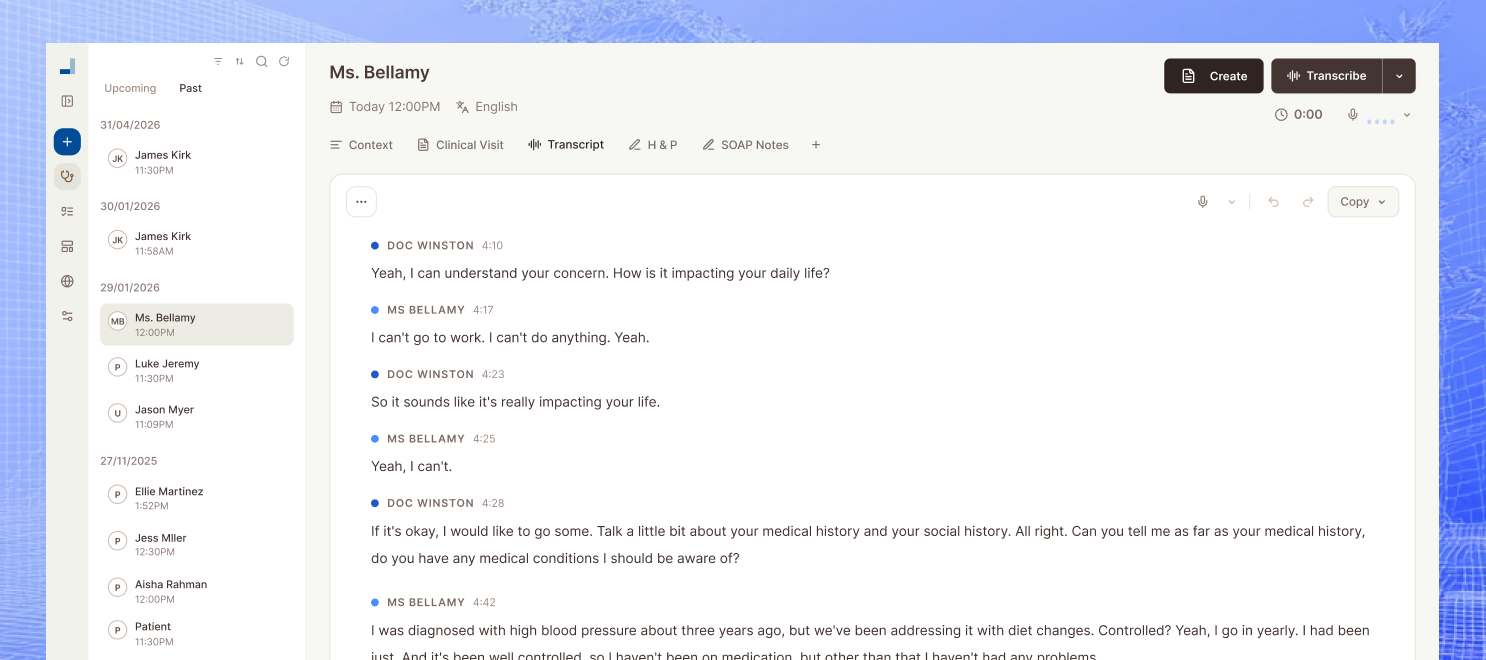
An AI medical scribe serves as an invisible assistant that captures the ambient conversation in the room. It does not replace the doctor’s judgment; rather, it provides a draft for the clinician to review and finalize. The scribe handles the heavy lifting of transcription and structured formatting, allowing the doctor to remain present and engaged. It is important to remember that these tools are assistive—the clinician remains legally and ethically responsible for the accuracy of the final medical record.
- Captures ambient audio to eliminate the need for manual typing during the visit.
- Reduces cognitive load by allowing the doctor to focus entirely on the patient.
- Speeds up the documentation process by providing structured drafts instantly.
- Ensures that subtle details mentioned by the patient are not lost to memory fatigue.
Note types you can generate beyond SOAP (H&P and more)
While the SOAP note is the industry standard for daily progress, medical practice requires a Much broader range of documentation. Comprehensive History and Physical (H&P) reports, for instance, are essential for new admissions or complex consultations. Relying on a single format for all interactions leads to data bloat or, conversely, missing information. Structured documentation is not just about compliance; it is about ensuring continuity of care and audit readiness for the entire clinical team.
Modern AI tools can now distinguish between different clinical scenarios. For example, a procedure note requires a specific focus on technique and patient tolerance, while a referral letter needs a concise summary of findings and a clear clinical question. Consult notes must bridge the gap between primary care and specialized treatment. Having a system that understands these nuances allows for better handovers and clearer communication between providers, which is vital in university settings and multidisciplinary clinics.
- H&P and Progress Notes: Detailed tracking for new and ongoing patient management.
- Consultation and Follow-up: Clear communication for specialized care pathways.
- Procedure Notes: Specific documentation of interventions and patient outcomes.
- Referral and Discharge: High-quality summaries that ensure safe transitions of care.
How to implement how to reduce interruptions during consultations with ai step-by-step in a real clinic
Implementing an AI scribe starts with a strategic selection of visit types. Instead of overhauling your entire schedule on day one, choose a specific type of encounter, such as new patient intakes or routine follow-ups. This allows you to calibrate the tool’s performance in a controlled environment. Once you have selected the visit types, ensure you have the correct templates ready. Most specialties have unique requirements, so setting up these templates early prevents the need for heavy editing later.
During the encounter, whether it is in-person or via telehealth, simply activate the capture tool. Do not feel the need to change how you speak; the goal is to have a natural conversation. After the visit is over, the AI will generate a structured draft in seconds. Take a moment to review the output for clinical accuracy. This small habit ensures that the high-quality note is finalized while the details are still fresh in your mind. Finally, utilize the generated content to quickly populate referral letters or patient instruction forms, maximizing the utility of a single recording.
- Start with one or two specific visit types to build confidence and refine the flow.
- Select specialty-specific templates to ensure the output matches your clinical needs.
- Review and edit the draft immediately after the session to maintain maximum accuracy.
- Repurpose the AI-generated text for secondary documents like referral letters.
How to keep note quality high and reduce mistakes
Even with advanced technology, quality control remains the clinician’s responsibility. Common failure points in AI-generated notes often include the misinterpretation of specific dosages, the inclusion of irrelevant ‘note bloat,’ or inaccuracies in the problem list. To combat this, clinics should establish a lightweight review habit. A quick 30-second scan of the generated note is usually enough to verify that the key medications and findings are correct before the note is signed off.
Consistency across the clinic is also vital. When all practitioners follow the same standards for reviewing and finalizing notes, the quality of the entire facility’s medical records improves. Setting team-wide standards for what constitutes a ‘complete’ note helps in reducing variability and ensures that every patient record is audit-ready. This proactive approach to quality management significantly reduces medico-legal risks and improves the experience for the next provider reading the chart.
- Verify high-risk data like medication dosages and critical lab values manually.
- Trim unnecessary text to prevent ‘note bloat’ and keep records concise and useful.
- Develop a standard review checklist for the clinical team to ensure consistency.
- Ensure the AI output aligns with the established clinical standards of your facility.
Privacy, consent, and patient trust (plain English)
Patient privacy is paramount when introducing recording technology into the consultation room. While consent requirements vary by region, the best practice is always to be transparent. Most patients are supportive when they understand that the tool allows their doctor to listen better and spend less time staring at a screen. It is important to follow your local healthcare privacy regulations diligently, though this guide does not constitute legal advice.
A simple way to explain this to a patient is: ‘To help me focus entirely on you today and keep my records accurate, I’m using a secure digital tool that takes notes for us. It records our conversation and turns it into a medical summary. Is that okay with you?’ This approach positions the technology as a benefit to the patient, reinforcing trust. Security-wise, always ensure that any tool you use adheres to industry-standard encryption and data retention policies.
- Always obtain verbal or written consent based on your local jurisdictional requirements.
- Explain the technology as a tool that improves the quality of the doctor-patient interaction.
- Use only secure, encrypted platforms designed specifically for healthcare environments.
- Maintain a clear record of your clinic’s privacy and data handling policies.
Rolling it out across a clinic without disruption
A successful rollout requires a gradual approach rather than a ‘flip the switch’ mentality. Begin with a two-week pilot involving a small group of tech-forward clinicians. During this period, track metrics such as time saved on documentation per day and the reduction in after-hours charting. These data points are essential for gaining buy-in from more skeptical staff members and for proving the return on investment to clinic owners.
Training should focus on template alignment and how to integrate the tool into the existing EHR workflow. By ensuring that the AI outputs can be easily copied or integrated into the current system, you minimize friction. Once the pilot group is successful, you can scale the implementation to the rest of the clinic, using the initial participants as ‘super-users’ to help their colleagues. This structured transition ensures that the introduction of AI enhances the practice rather than disrupting it.
- Execute a 14-day pilot with a small team to identify potential workflow bottlenecks.
- Measure time savings and staff satisfaction to justify the full-scale implementation.
- Train staff on how to use AI-generated outputs effectively within the existing EHR.
- Designate internal ‘super-users’ to provide peer-to-peer support during the rollout.
Mcoy AI is an AI medical scribe that records and transcribes patient encounters, then generates multiple clinical note types (H&P, progress notes, consult notes, follow-up notes, procedure notes, discharge summaries, referral letters, and more). It offers 200+ customizable templates and an AI chat feature to help clinicians create letters, forms, and documents quickly and efficiently, ensuring that documentation is both comprehensive and tailored to the specific needs of the practice.
Conclusion
Streamlining clinical documentation is the most effective way to improve provider satisfaction and patient outcomes. By following the steps in this guide, you can successfully implement a system that captures every detail without the need for manual interference. Learning how to reduce interruptions during consultations with AI is no longer a luxury—it is a necessity for the modern, high-performing clinic. Start with a small pilot today and watch as your clinic regains the focus it deserves.
What a serious review table should cover
| Decision area | Common mistake | Better clinic-ready approach | Metric to watch |
|---|---|---|---|
| Workflow design | Treat how to reduce interruptions during consultations with ai as a one-off documentation task | Build a repeatable process with clear ownership and review points | Time to complete documentation |
| Team adoption | Assume every clinician will naturally use the same process | Train for consistency and define exception handling early | Active user adoption |
| Quality review | Only check notes when a problem is reported | Audit a sample of notes weekly and review edge cases | Edit rate per note |
| Operational follow-through | Leave admin actions outside the documentation workflow | Use the same encounter data for referrals, letters, and follow-up tasks | Completion rate for next-step tasks |
Related reading
If you are working through how to reduce interruptions during consultations with ai, it helps to read this alongside Physician Wellbeing: Why Documentation Is the Biggest Time Drain for Doctors, Physician Wellbeing: How Doctors Can Reduce Paperwork Without Compromising Care, and Specialty Guides: Mental Health Note Template Guide: Free Resources & Setup. Those guides cover adjacent workflow, implementation, and evaluation questions so the decision does not sit in isolation.
FAQ
How accurate are AI medical scribes in real clinics?
In most real-world clinical settings, AI medical scribes are highly accurate at capturing the core of the medical conversation. They excel at identifying relevant symptoms, past medical history, and clinical plans. However, like any automated tool, they may occasionally misunderstand specific nuance or complex terminology. Because of this, they are designed to provide a high-quality draft that a human clinician must finalize.
Do I still need to review every note?
Yes, reviewing every note is a fundamental requirement for both clinical accuracy and legal compliance. While the AI significantly reduces the time spent drafting the note, the clinician remains the final authority. A quick review ensures that all dosages, diagnoses, and patient instructions are perfectly captured. This habit prevents errors from entering the permanent medical record and ensures high standards of care.
What note types can an AI scribe generate besides SOAP?
Modern AI scribes are incredibly versatile and can generate a wide array of documentation beyond the standard SOAP format. This includes History and Physical (H&P) reports, consultation notes, and progress notes. They can also create specialized documents like procedure notes, discharge summaries, and referral letters. This variety ensures that every type of patient interaction is documented in the most appropriate and useful format.
Will this work for telehealth and in-person consults?
Yes, AI medical scribes are designed to function effectively in both environments. For in-person visits, they use ambient recording via a smartphone or computer. For telehealth, they can often integrate directly with the video conferencing software or record the audio output from the computer. This flexibility makes them an ideal solution for modern practices that offer a hybrid model of care.
How do I explain recording/transcription to patients?
Transparency is the best approach when discussing recording with patients. You can explain that you are using a secure tool to help you focus more on them and less on your computer. Most patients appreciate the extra attention and are happy to consent when they see it improves the quality of their visit. Frame it as a way to ensure their medical record is as accurate and detailed as possible.
How do clinics prevent note bloat?
Note bloat is prevented by using specialized templates that focus only on relevant clinical information. Instead of transcribing every single word of the conversation, the AI is trained to extract only the medically significant data. Clinicians can also adjust settings to dictate the level of detail required. A brief review post-consultation allows the doctor to remove any remaining redundancies before the note is saved.
How long does template setup take?
Setting up templates is typically a very fast process, often taking only a few minutes per clinician. Most systems come with pre-built templates for various specialties that can be used immediately. Customizing these to fit your personal writing style or specific clinic requirements is straightforward. Once the templates are set, they automatically apply to every future encounter, saving hours of configuration time in the long run.
What’s the safest way to start if I’m skeptical?
The safest way to start is by running a small pilot with one or two non-complex patient visits per day. This allows you to see the quality of the output without any pressure. You don’t have to rely on the AI note for the official record initially; simply compare it to your manual note. Once you see the consistency and accuracy for yourself, you can gradually increase its use across more complex clinical cases.