Physician Wellbeing: How to Reduce Documentation Time With an AI Medical Scribe
Learn how to reduce documentation time and eliminate after-hours charting using an AI medical scribe. Best practices for clinics, GPs, and specialists.
Introduction
For many clinicians, the workday doesn’t end when the last patient leaves the exam room. Instead, it transitions into hours of tedious manual data entry, often referred to as ‘pajama time.’ This constant struggle with after-hours charting is a leading cause of burnout among doctors, private practitioners, and those managing busy university clinics. When you are rushed, notes can become inconsistent, and the looming fear of a medico-legal audit only adds to the cognitive load.
This guide provides a roadmap for reclaiming your schedule. We will explore how an AI medical scribe can transform your clinical workflow, moving far beyond basic SOAP notes to include a full spectrum of high-quality documentation. Whether you are a general practitioner, a specialist, or running a large-scale telehealth operation, learning how to leverage this technology is the key to maintaining quality control and personal well-being.
What a medical scribe solves in modern practice
The real cost of documentation isn’t just measured in minutes; it is measured in cognitive energy. When a clinician is forced to type while a patient is speaking, the human connection is severed. This leads to delayed notes, missed clinical nuances, and a heavy mental burden that persists long after the clinic closes. An AI medical scribe addresses these pain points by acting as a passive listener, allowing the provider to focus entirely on the patient’s narrative.
It is important to understand that an AI medical scribe is an assistive tool, not a replacement for clinical judgment. The AI handles the heavy lifting of capturing dialogue and structuring it into a readable format, but the clinician remains the final authority. By automating the objective and subjective capture of a visit, the tool ensures that no detail is lost to memory lapses while maintaining the provider’s ultimate responsibility for the medical record.
- Eliminates the ‘pajama time’ spent on manual data entry after clinic hours.
- Reduces cognitive load by allowing clinicians to focus on the patient, not the screen.
- Ensures high-fidelity capture of patient details that are often forgotten by the end of the day.
- Acts as a supportive assistant while keeping the clinician in full control of the final output.
Note types you can generate beyond SOAP (H&P and more)
While the SOAP format is a staple in medical training, many clinical encounters require more specialized structures. A comprehensive AI tool allows you to generate History and Physical (H&P) reports, consult notes, and complex procedure notes without starting from a blank page. This variety ensures that the documentation matches the specific intent of the encounter, whether it is an initial specialist evaluation or a routine follow-up.
The quality of handovers and continuity of care depends on the clarity of these documents. Using diverse formats like discharge summaries and referral letters ensures that the next provider in the care chain has exactly what they need. Proper structure isn’t just about aesthetics; it is about audit readiness and meeting the specific coding requirements for various insurance and institutional standards.
In addition to standard encounters, AI-driven documentation can produce specialized progress notes for mental health or longitudinal chronic disease management. Having a system that adapts to your specialty’s unique requirements means you are no longer forcing a square peg into a round SOAP-shaped hole. This flexibility enhances both the speed and the value of your medical records.
- Generate H&P, consult notes, and discharge summaries tailored to specific specialties.
- Improve continuity of care with clear, structured referral letters and follow-up notes.
- Ensure audit readiness by maintaining high-quality documentation for every procedure.
- Use diverse templates to meet various administrative and billing requirements effectively.
How to implement an AI medical scribe step-by-step in a real clinic
Reducing documentation time starts with a strategic rollout. Rather than attempting to switch every visit type over to AI at once, begin with a single, common visit type. For instance, a GP might start with standard respiratory infections or routine check-ups. This allows the staff and the clinician to get used to the workflow without the pressure of a high-stakes complex encounter.
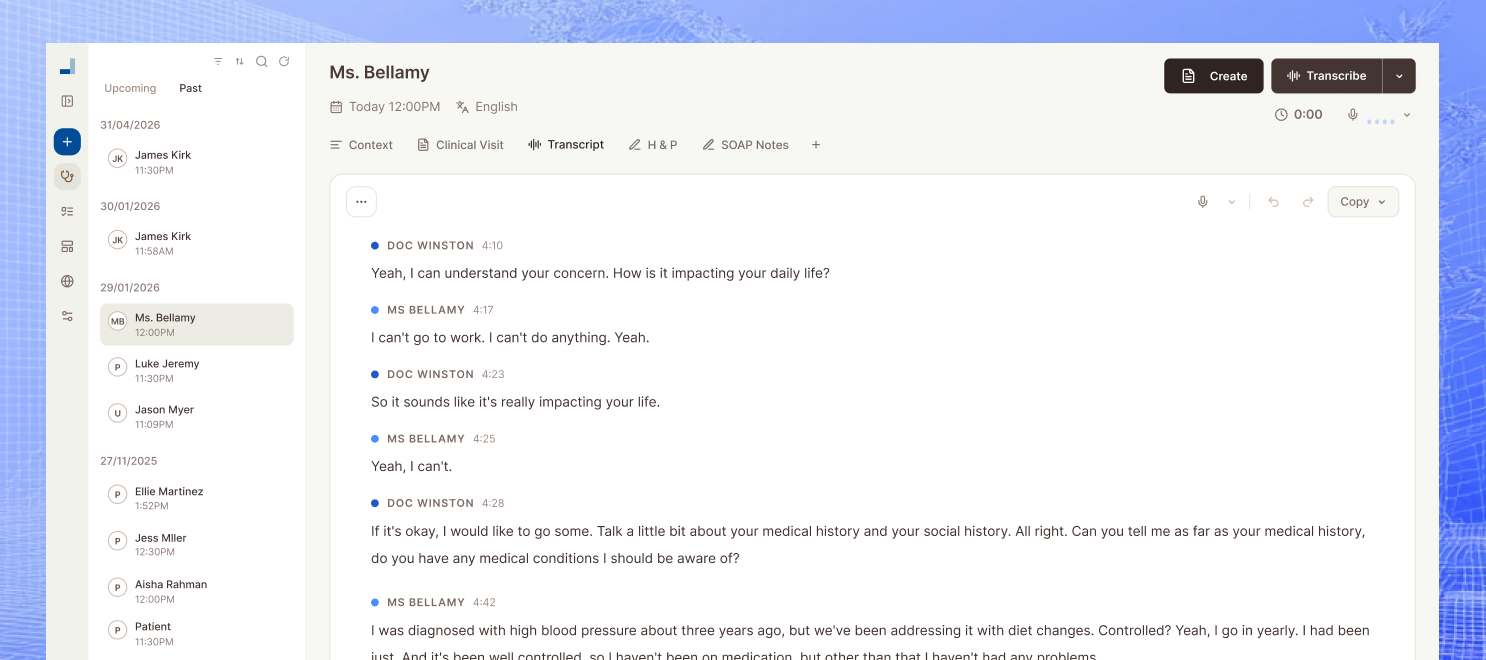
Once you are comfortable, set up templates specific to your specialty. These templates act as the ‘brain’ of the AI, guiding it on what information to prioritize and how to structure the output. During the encounter, whether it is in-person or via a telehealth platform, simply activate the scribe. The AI captures the natural flow of the conversation, allowing you to ask questions and interact with the patient as you normally would.
After the patient leaves, the AI presents a draft. Instead of writing from scratch, your role shifts to a reviewer. Quickly read through the draft, make any necessary edits, and confirm the details. Because the AI has already formatted the data, this review takes a fraction of the time it would take to type the note manually. Finally, you can reuse parts of these outputs to instantly generate referral letters or patient instruction sheets.
- Begin with one visit type to master the workflow before expanding.
- Utilize specialty-specific templates to ensure the AI prioritizes relevant data.
- Shift from ‘author’ to ‘editor’ to drastically reduce charting time.
- Leverage the generated note to quickly produce secondary documents like referrals.
How to keep note quality high and reduce mistakes
AI tools are powerful but require human oversight to prevent common failure points like ‘note bloat’ or the inclusion of irrelevant information. Occasionally, an AI might misunderstand a specific medication dosage or a complex lab value if the audio wasn’t clear. Clinicians must establish a lightweight review habit—spending 60 to 90 seconds per note—to verify objective data like medications, dosages, and the final problem list.
Setting team standards for documentation also helps maintain quality across a clinic. Encourage practitioners to speak clearly when discussing the ‘Assessment and Plan’ portion of the visit, as this often provides the most critical data for the scribe. By treating the AI as a highly skilled but junior assistant, you can maintain a high standard of accuracy while still reaping the time-saving benefits.
- Always verify objective data such as dosages and lab results during the review.
- Minimize note bloat by selecting templates that emphasize concise reporting.
- Speak clinical thoughts out loud during the encounter to help the AI capture the plan.
- Establish a quick 1-minute review standard for every note before finalization.
Privacy, consent, and patient trust (plain English)
Patient privacy is paramount, and clinicians must follow local guidelines regarding recording and data retention. Generally, consent is the first step in maintaining trust. When introducing the tool, use a simple script: ‘I’m using an AI assistant to help me stay focused on you instead of my computer; it’s going to record our talk to help me write my medical notes. Is that alright?’ Most patients appreciate the increased eye contact and focus.
From a security perspective, ensure that the tool you choose aligns with modern healthcare security principles, such as encryption and data protection standards. Being transparent about how long data is kept and who can access it ensures that the patient feels safe and the clinic remains compliant with regional regulations.
- Always follow local legal and institutional policies regarding patient consent.
- Use a simple, transparent script to explain the benefits of the AI to the patient.
- Ensure the chosen platform adheres to strict data security and encryption protocols.
- Maintain trust by being clear about how the recording is used and stored.
Rolling it out across a clinic without disruption
For clinic managers and university clinics, a structured 2-week pilot plan is the most effective way to roll out an AI medical scribe. During the first week, select a ‘champion’—a tech-savvy clinician—to test the tool and refine templates. In the second week, gather feedback and adjust the templates to align with clinical standards before a full-team launch.
Tracking specific metrics can help justify the implementation to stakeholders. Look for a reduction in ‘after-hours’ EHR activity, an increase in note completion rates, and qualitative feedback on clinician stress levels. Training should be focused on template alignment, ensuring that every doctor is producing notes that meet the high standards of the organization.
- Start with a 2-week pilot led by a clinician champion to identify best practices.
- Measure success through time saved and the reduction of after-hours charting.
- Align templates across the clinic to ensure standardized, high-quality documentation.
- Provide brief, practical training sessions to get the entire team up to speed quickly.
Mcoy AI is an AI medical scribe that records and transcribes patient encounters, then generates multiple clinical note types (H&P, progress notes, consult notes, follow-up notes, procedure notes, discharge summaries, referral letters, and more). With over 200+ customizable templates and an integrated AI chat, clinicians can easily create letters, forms, and complex documents. It is designed to be a helpful assistant that fits naturally into the clinical workflow, ensuring you spend less time on administration and more time with your patients.
Conclusion
Embracing a modern workflow doesn’t have to be overwhelming. By implementing an AI medical scribe, you can move from the exhaustion of manual entry to a more sustainable, editor-based workflow. This guide has outlined how to choose note types, maintain quality, and ensure patient privacy while rolling out the technology across your clinic. If you are looking for a way to reduce documentation time and focus on what truly matters—patient care—starting a pilot with this technology is the most effective next step.
SEO description: Learn how to reduce documentation time using an AI medical scribe. Improve clinic efficiency, reduce burnout, and master clinical note quality today.
What a serious review table should cover
| Decision area | Common mistake | Better clinic-ready approach | Metric to watch |
|---|---|---|---|
| Workflow design | Treat how to reduce documentation time with an ai medical scribe as a one-off documentation task | Build a repeatable process with clear ownership and review points | Time to complete documentation |
| Team adoption | Assume every clinician will naturally use the same process | Train for consistency and define exception handling early | Active user adoption |
| Quality review | Only check notes when a problem is reported | Audit a sample of notes weekly and review edge cases | Edit rate per note |
| Operational follow-through | Leave admin actions outside the documentation workflow | Use the same encounter data for referrals, letters, and follow-up tasks | Completion rate for next-step tasks |
Related reading
If you are working through how to reduce documentation time with an ai medical scribe, it helps to read this alongside Physician Wellbeing: Why Documentation Is the Biggest Time Drain for Doctors, Physician Wellbeing: How Doctors Can Reduce Paperwork Without Compromising Care, and Admin Management: How to Create Medical Certificates: A Clinician’s Guide. Those guides cover adjacent workflow, implementation, and evaluation questions so the decision does not sit in isolation.
FAQ
Implementing new technology often raises practical questions about workflow and quality. Here are some of the most common questions from clinicians.
How accurate are AI medical scribes in real clinics?
In most clinical settings, AI medical scribes are highly accurate in capturing the dialogue between a doctor and a patient. They are specifically trained to filter out ‘small talk’ and focus on medically relevant facts. However, the accuracy can depend on audio quality and the clarity of the conversation. Most clinicians find that the drafts require only minor adjustments to be perfectly clinical.
Do I still need to review every note?
Yes, medical responsibility always rests with the licensed clinician. While the AI does the heavy lifting of transcribing and formatting, you must review the output to ensure clinical accuracy and safety. Think of it like reviewing a note written by a medical student or a human scribe. A quick check of the medication names, dosages, and the final assessment is essential before signing off.
What note types can an AI scribe generate besides SOAP?
Beyond the standard SOAP format, advanced AI scribes can generate History and Physicals (H&P), specialty-specific consult notes, and detailed procedure notes. They are also incredibly effective at producing discharge summaries and referral letters based on the encounter data. This flexibility allows the documentation to match the specific needs of the medical specialty or visit type.
Will this work for telehealth and in-person consults?
Most AI medical scribes are designed to be platform-agnostic, meaning they work equally well during in-person visits using a mobile device or during telehealth sessions. For telehealth, the scribe can often capture the audio directly from the computer output. This makes it a versatile tool for modern hybrid practices that offer both virtual and office-based care.
How do I explain recording/transcription to patients?
The best approach is transparency and a focus on the benefit to the patient. You can explain that using the AI allows you to look at them instead of a computer screen, ensuring a better quality of care. Most patients are very supportive when they realize it means their doctor is actually listening to them rather than typing throughout the entire appointment.
How do clinics prevent note bloat?
Preventing note bloat is achieved by using concise, specialized templates rather than ‘catch-all’ formats. You can configure the AI to prioritize structured data and brief summaries rather than transcribing every single word of the conversation. Regularly auditing a sample of notes can also help ensure the team is maintaining a high standard of brevity and relevance.
How long does template setup take?
Basic template setup is often instantaneous if you use pre-built clinical libraries. Customizing a template to fit your specific ‘voice’ or specialty nuances typically takes about 10 to 15 minutes. Once a template is set, it can be used for thousands of future encounters, making the initial time investment very worthwhile for long-term efficiency.
What’s the safest way to start if I’m skeptical?
The safest way to start is with a ‘shadow’ pilot. Record a few encounters that you were going to document manually anyway, then compare the AI’s output to your own notes. This allows you to build trust in the system’s accuracy without any pressure. Once you see the time saved on those few notes, you can gradually integrate it into your live daily workflow.