Physician Wellbeing: Keep Consultations On Time With AI Scribing | Full Guide
Learn how AI scribing helps doctors stay on schedule. Drastically reduce after-hours charting and improve patient care with our professional clinic guide.
Speed Up Your Clinic Workflow
Every clinician knows the dreaded feeling of seeing the afternoon schedule slip further and further behind. Dealing with after-hours charting, physician burnout, and the anxiety of incomplete medical records has become the norm rather than the exception. When you are rushing to finish notes between patients, clinical accuracy often suffers, and the quality of the patient-doctor connection declines.
This comprehensive guide will teach you how to implement a high-efficiency workflow using modern technology. We will explore various note formats, quality control measures, and a concrete rollout plan for private practices and university clinics. Whether you are a general practitioner or a specialist, restoring the balance between patient care and documentation is the key to a sustainable medical career.
What a medical scribe solves in modern practice
The real cost of documentation isn’t just the time spent typing; it is the cognitive load required to recall details hours after a visit has ended. When doctors spend three minutes on a note that should take thirty seconds, they lose hours of productivity every week. This delay often leads to missed nuances and a constant state of mental fatigue known as the ‘pajama time’ documentation crisis.
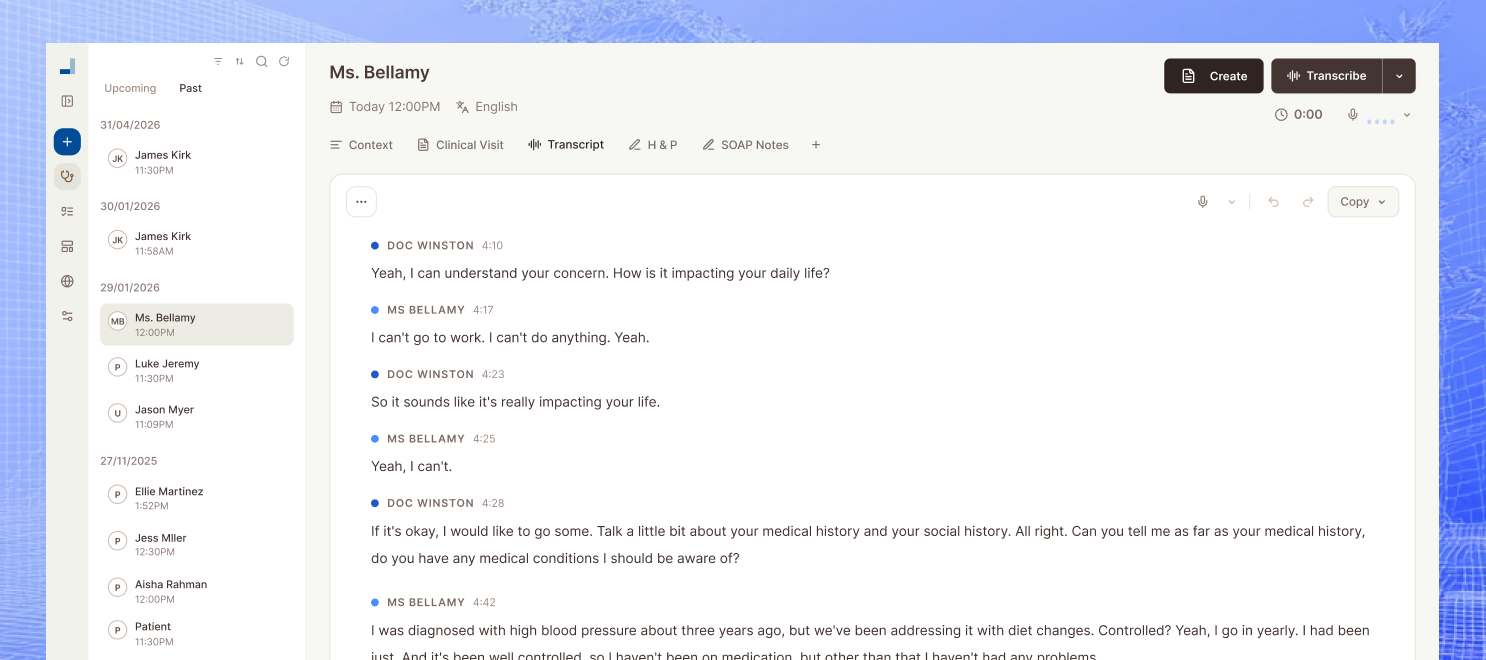
An AI medical scribe acts as an assistive layer that captures the natural conversation between the clinician and the patient. It is important to remember that these tools are not replacements for clinical judgment; the clinician remains the final authority and must review every output. By automating the mechanical act of transcription and formatting, the provider can focus entirely on the physical exam and diagnostic reasoning.
- Eliminates the ‘computer wall’ between doctor and patient.
- Reduces cognitive fatigue by providing a draft immediately.
- Ensures clinical details aren’t lost to memory decay.
- Speeds up the transition between consecutive patient appointments.
Note types you can generate beyond SOAP (H&P and more)
While the SOAP note is a standard in many clinics, complex care requires more diverse documentation. Comprehensive History and Physical (H&P) notes are essential for new admissions, while detailed procedure notes are critical for specialists performing minor surgeries or injections. Using a single format for every encounter often leads to unnecessary fluff or missing data points.
Structuring your documentation specifically for the encounter type—be it a consult note, a follow-up, or a discharge summary—ensures continuity of care across the medical team. High-quality handover documents and referral letters are much easier to generate when the source documentation is robust and well-organized from the start. This consistency is also vital for audit readiness and medico-legal protection.
- H&P and comprehensive assessments for new patient intake.
- Specialized procedure and post-operative notes.
- Clear discharge summaries and inter-office referral letters.
- Standardized follow-up notes that track chronic disease progression.
How to implement AI scribing step-by-step in a real clinic
To start using AI scribing effectively, you should begin by selecting one specific visit type to pilot, such as routine follow-ups or wellness checks. This allows you to get comfortable with the technology without the pressure of a complex diagnostic case. Before the patient enters the room, ensure your mobile device or desktop interface is ready to record with a single click.
Set up your templates according to your specialty and personal style preferences. During the encounter, speak naturally and focus on the patient; there is no need to dictate specific headers as the AI identifies the context. Once the visit concludes, the system processes the audio and generates a structured draft within seconds. Review the draft immediately while the conversation is fresh in your mind, then make any necessary edits before finalizing it.
- Start with one consistent visit type for the first week.
- Pre-configure specialty-specific templates for faster output.
- Review drafts in the 2-minute window between patients.
- Convert finalized notes into referral letters or forms instantly.
How to keep note quality high and reduce mistakes
Automated documentation is powerful, but it is not immune to errors if not supervised. Typical failure points include the system mishearing specific dosages, confusing ‘left’ and ‘right’ in a physical exam, or including ‘note bloat’—redundant information that doesn’t add clinical value. Establishing a standard for what a ‘gold standard’ note looks like in your clinic is the first step in quality control.
Develop a lightweight review habit where you scan the assessment and plan first, as these are the most critical sections for patient safety. Ensure your team follows a unified standard for how medications and allergies are reconciled within the note. By spending thirty seconds checking for ‘hallucinations’ or missing values, you maintain a high level of integrity in the medical record.
- Always verify medication names and specific dosage instructions.
- Ensure the problem list matches the current assessment.
- Prune unnecessary repetitive text to prevent note bloat.
- Establish a internal clinic peer-review process for auditing.
Privacy, consent, and patient trust (plain English)
Patient privacy is the cornerstone of the medical profession, and introducing recording technology requires transparency. Consent requirements vary significantly by region, so it is vital to follow your local healthcare regulations and hospital policies. Most patients are supportive of the technology when they realize it allows their doctor to listen more and type less.
You can explain the process simply by saying: ‘I’m using a digital assistant today to record our conversation so I can focus on you instead of my computer screen. It helps me create a more accurate record of our visit. Is that okay with you?’ Most clinicians find that once they explain the benefit to the patient, the response is overwhelmingly positive.
- Obtain verbal or written consent based on local law.
- Keep the device in a visible, unobtrusive location.
- Explain that the data is encrypted and handled securely.
- Provide an ‘opt-out’ for patients who prefer manual charting.
Rolling it out across a clinic without disruption
A successful rollout requires a gradual approach rather than a ‘big bang’ implementation. Start with a two-week pilot involving one or two champion clinicians who are tech-savvy. During this period, track metrics such as time saved per day, the reduction in after-hours charting, and the delay between the visit and note completion. Use this data to refine your templates and training protocols.
Training should focus on the transition from the old workflow to the new. University clinics, in particular, benefit from aligning their templates across departments to ensure records look professional and standardized. Once the pilot clinicians show success, use their feedback to onboard the rest of the staff, ensuring everyone understands the goal is better care, not just faster typing.
- Run a 14-day pilot with a small group of users first.
- Track time savings as a KPI for the transition.
- Schedule brief weekly check-ins to troubleshoot common issues.
- Align templates across the entire department for consistency.
Mcoy AI is an AI medical scribe that records and transcribes patient encounters, then generates multiple clinical note types (H&P, progress notes, consult notes, follow-up notes, procedure notes, discharge summaries, referral letters, and more). It features 200+ customizable templates and an AI chat function to help clinicians create letters, forms, and other documents instantly. This helps healthcare providers focus more on the patient while the system handles the heavy lifting of administrative documentation.
Conclusion
Implementing a structured workflow with an AI scribe is the most effective way to stay on schedule and recover your personal time. By following a step-by-step rollout and maintaining high standards for note quality, you can eliminate the administrative burden that leads to burnout. Using AI scribing allows you to be a more present, engaged clinician while ensuring your clinical records are more detailed and accurate than ever before. Start your pilot today and experience the difference of a truly efficient clinic.
What a serious review table should cover
| Decision area | Common mistake | Better clinic-ready approach | Metric to watch |
|---|---|---|---|
| Workflow design | Treat keep consultations on time with ai scribing | full guide as a one-off documentation task | Build a repeatable process with clear ownership and review points |
| Team adoption | Assume every clinician will naturally use the same process | Train for consistency and define exception handling early | Active user adoption |
| Quality review | Only check notes when a problem is reported | Audit a sample of notes weekly and review edge cases | Edit rate per note |
| Operational follow-through | Leave admin actions outside the documentation workflow | Use the same encounter data for referrals, letters, and follow-up tasks | Completion rate for next-step tasks |
Related reading
If you are working through keep consultations on time with ai scribing | full guide, it helps to read this alongside Physician Wellbeing: Why Documentation Is the Biggest Time Drain for Doctors, Physician Wellbeing: How Doctors Can Reduce Paperwork Without Compromising Care, and AI & Medicine: Build a Free SOAP Note Template Pack | Clinician Guide. Those guides cover adjacent workflow, implementation, and evaluation questions so the decision does not sit in isolation.
FAQ
How accurate are AI medical scribes in real clinics?
Modern AI scribes are highly accurate at capturing the context and medical terminology used during a consultation. However, accuracy can be affected by background noise, multiple people speaking at once, or heavy accents. Because they are assistive tools, the clinician must always review the generated text for errors before signing off on the medical record.
Do I still need to review every note?
Yes, reviewing every note is a professional and legal requirement for clinicians. While the AI does the heavy lifting of drafting the content, the physician is responsible for the accuracy of the final medical record. A quick 30 to 60-second review is usually sufficient to ensure all details are correct and relevant.
What note types can an AI scribe generate besides SOAP?
Beyond standard SOAP notes, an AI scribe can generate History and Physical (H&P) reports, consult notes, procedure notes, and even discharge summaries. Most advanced systems allow you to choose from hundreds of templates to fit specific specialties or encounter types. You can also generate referral letters and patient instructions based on the same session audio.
Will this work for telehealth and in-person consults?
AI scribing is highly effective for both in-person and telehealth consultations. For telehealth, the system can capture audio directly from the computer audio interface, while in-person visits typically use a mobile device or tablet. The result remains a high-quality, structured note regardless of the setting.
How do I explain recording/transcription to patients?
The best approach is to be brief and transparent about the benefits to the patient. Explain that using the tool allows you to look at them instead of a screen and ensures their medical record is as accurate as possible. Most patients appreciate the extra attention they receive when the doctor isn’t distracted by typing.
How do clinics prevent note bloat?
Note bloat is prevented by using concise templates and training the AI to prioritize relevant clinical information. Clinicians should also perform a quick edit to remove redundant phrases or non-essential details. Setting clear standards for what should and shouldn’t be in a final note helps maintain high-quality documentation across the clinic.
How long does template setup take?
Initial template setup usually takes only a few minutes per clinician, especially if you start with pre-built library templates. You can customize them over time as you see how the AI interprets your specific style. Most platforms allow for rapid iteration, so your templates can evolve as your practice grows.
What’s the safest way to start if I’m skeptical?
The safest way to start is by running a small pilot with non-complex cases or routine follow-up visits. This allows you to test the accuracy and workflow without the pressure of a high-acuity patient. Once you see the reliability of the system, you can gradually expand its use to all patient encounters.