Specialty Guides: Build a Template Pack for Discharge Summaries Efficiently
Learn how to build a professional template pack for discharge summaries to save time, reduce burnout, and ensure high-quality patient transitions.
For many doctors and private practitioners, the end of a patient’s stay marks the beginning of a daunting administrative hurdle: the discharge summary. After-hours charting often feels like a second shift, leading to clinical burnout and a constant sense of being rushed. When documentation is hurried, the risk of inconsistency or missing critical follow-up data increases, creating significant medico-legal anxiety for clinic owners and university hospital staff alike.
This guide provides a comprehensive roadmap for building a high-quality template pack for discharge summaries and other clinical documents. You will learn how to optimize your workflow, explore diverse note formats beyond the standard SOAP method, and implement quality control measures. Whether you are a GP, a specialist, or managing a high-volume university clinic, these strategies will help you maintain privacy standards while streamlining your rollout plan for modern documentation tools.
What a medical scribe solves in modern practice
The real cost of manual documentation is measured in more than just minutes; it is measured in cognitive load and emotional exhaustion. When clinicians spend hours typing after a long day of consults, they face ‘pajama time’—work that bleeds into personal life. This delays the availability of notes for the rest of the care team and increases the likelihood that nuanced patient details are forgotten before they hit the page.
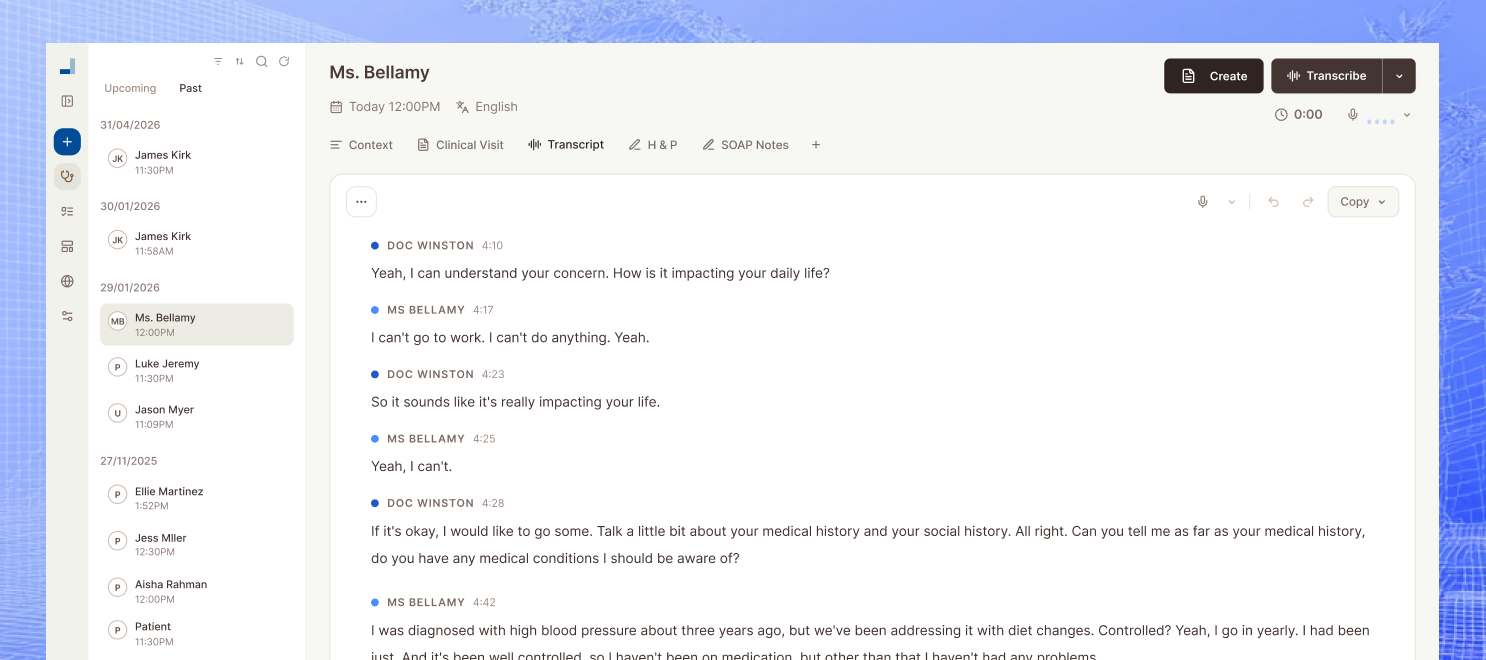
An AI medical scribe acts as an assistive partner to solve these challenges. It captures the nuances of a conversation in real-time, allowing the doctor to maintain eye contact and focus on the patient. It is important to remember that these tools are assistive; while they generate the draft, the clinician remains the final authority and is responsible for the accuracy of every recorded word.
- Eliminates after-hours charting by generating drafts instantly.
- Reduces cognitive load so doctors can focus on diagnostic reasoning.
- Improves note accuracy by capturing details in real-time.
- Accelerates the availability of summaries for referring providers.
Note types you can generate beyond SOAP (H&P and more)
While the SOAP note is a staple of clinical training, it often falls short for complex transitions of care. Building a template pack requires a broader perspective. A robust system should include comprehensive History and Physical (H&P) notes for admissions, detailed consult notes for specialist opinions, and precise procedure notes that capture the technical nuances of an intervention.
Effective discharge summaries and referral letters are crucial for continuity of care. They act as the primary communication tool between hospitalists, primary care physicians, and specialists. Without a structured format, critical medication changes or follow-up requirements can be lost in a wall of text, leading to patient readmissions or fragmented care.
Standardizing these different note types ensures audit readiness and high-quality handovers. When every clinician in a university clinic or private practice uses a consistent structure for follow-up notes and progress reports, the entire team can quickly scan and understand the patient’s trajectory without deciphering idiosyncratic styles.
- H&P and Consult Notes for initial assessments and expert opinions.
- Detailed Procedure Notes and Discharge Summaries for care transitions.
- Follow-up Notes and Referral Letters for long-term care coordination.
- Customizable templates that match specific specialty requirements.
How to implement template pack for discharge summaries step-by-step
Starting the implementation process doesn’t mean changing your entire workflow overnight. Begin by selecting one common visit type, such as routine post-operative checks or standard chronic disease follow-ups. Focus on perfecting the template for this single category before expanding to more complex discharge summaries.
Next, organize your templates by specialty or department. A cardiology discharge summary requires different data points than a psychiatric evaluation. By setting up these specialty-specific frameworks early, you ensure that the AI captures the specific metrics—such as ejection fraction or mental status exam parameters—relevant to that field.
During the patient encounter, whether in-person or via telehealth, focus entirely on the conversation. The recording system captures the dialogue, allowing you to narrate your findings naturally. Once the session concludes, the system processes the audio and populates your pre-selected templates with the relevant clinical data points.
The review and edit phase is the most critical step. Spend two minutes quickly scanning the generated draft for accuracy. Once satisfied, you can instantly reuse the output to generate auxiliary documents, such as patient instructions or referral letters, without re-typing the same information into multiple forms.
- Start with one common visit type to build confidence.
- Organize templates by specialty for smarter data capture.
- Focus on the patient while the system records the encounter.
- Use the generated note to auto-fill letters or follow-up forms.
How to keep note quality high and reduce mistakes
Template-driven documentation can occasionally lead to ‘note bloat’—large sections of redundant text that hide the most important information. Typical failure points include outdated medication lists or repetitive problem lists that no longer reflect the patient’s current status. To prevent this, clinicians must adopt a lightweight review habit.
Establishing team standards for documentation helps maintain high quality across the practice. Encourage a culture where the ‘Assessment and Plan’ sections are clear and concise. By reviewing a small sample of notes weekly, clinic owners can ensure that the AI-generated outputs remain sharp, relevant, and free of clinical hallucinations or errors.
- Avoid note bloat by prioritizing the Assessment and Plan sections.
- Cross-check medications and dosages against the electronic health record.
- Implement a weekly peer-review of a small sample of generated notes.
- Standardize template language across the entire clinical team.
Privacy, consent, and patient trust
Patient privacy is the cornerstone of the therapeutic relationship. When introducing new documentation technology, ensure you follow local regulations regarding recording and data storage. While consent requirements vary by region, transparency is always the best policy. Always inform the patient that you are using an assistive tool to help ensure their record is as accurate as possible.
You might use a simple script like: ‘To make sure I capture all our details accurately and can focus entirely on you, I’m using a secure medical assistant tool to help with my notes. Is that okay with you?’ Most patients appreciate the extra attention they receive when the doctor isn’t staring at a computer screen during the visit.
- Follow local and regional guidelines for patient recording consent.
- Use a transparent, patient-friendly script to explain the technology.
- Ensure all data is encrypted and stored according to medical standards.
- Emphasize that the tool helps you provide more focused, face-to-face care.
Rolling it out across a clinic without disruption
A successful rollout starts with a 2-week pilot involving a small group of ‘super-users.’ These clinicians can test the various templates and identify any friction points in the workflow. During this phase, focus on metrics like time saved per day and the reduction in after-hours charting to demonstrate the value to the rest of the staff.
Once the pilot is complete, align the entire team on template usage. Training sessions should be short and practical, focusing on how to review and edit rather than how the underlying technology works. By graduation day, every practitioner should feel confident that the new workflow will make their day easier rather than adding another task to their plate.
- Launch a 2-week pilot with a small group of clinicians.
- Track time saved and note completeness as key success metrics.
- Provide template-specific training for different departments.
- Phased expansion to ensure technical support is available for all.
Mcoy AI is an AI medical scribe that records and transcribes patient encounters, then generates multiple clinical note types including H&P, progress notes, consult notes, follow-up notes, procedure notes, discharge summaries, referral letters, and more. With over 200 customizable templates and an interactive AI chat, clinicians can effortlessly create custom letters, forms, and documents. This technology is designed to be a helpful partner, allowing practitioners to spend less time on admin and more time on direct patient care.
Conclusion
Building a professional template pack for discharge summaries is an investment in your practice’s efficiency and your own well-being. By moving away from manual typing and adopting a structured, AI-assisted workflow, you can ensure that patient transitions are safe and documentation is robust. Start with a simple pilot, refine your templates, and reclaim your time. Using a template pack for discharge summaries is the first step toward a more sustainable and focused clinical practice. Experience the difference in your daily workflow today.
SEO description: Learn how to build a template pack for discharge summaries to save time, prevent burnout, and improve note accuracy in your clinic today.
What a serious review table should cover
| Decision area | Common mistake | Better clinic-ready approach | Metric to watch |
|---|---|---|---|
| Workflow design | Treat build a template pack for discharge summaries efficiently as a one-off documentation task | Build a repeatable process with clear ownership and review points | Time to complete documentation |
| Team adoption | Assume every clinician will naturally use the same process | Train for consistency and define exception handling early | Active user adoption |
| Quality review | Only check notes when a problem is reported | Audit a sample of notes weekly and review edge cases | Edit rate per note |
| Operational follow-through | Leave admin actions outside the documentation workflow | Use the same encounter data for referrals, letters, and follow-up tasks | Completion rate for next-step tasks |
Related reading
If you are working through build a template pack for discharge summaries efficiently, it helps to read this alongside Specialty Guides: How to Run a More Efficient Medical Practice in 2026, Specialty Guides: How to Improve Patient Encounters, and AI & Medicine: How to Write Clearer Plans Faster With an AI Scribe. Those guides cover adjacent workflow, implementation, and evaluation questions so the decision does not sit in isolation.
FAQ
How accurate are AI medical scribes in real clinics?
In modern clinical settings, AI medical scribes are remarkably accurate at capturing the nuances of medical dialogue. They utilize advanced natural language processing to distinguish between social chatter and clinical data. However, accuracy often depends on the clarity of the audio and the specific terminology used, which is why a human review is always necessary. Most clinicians find that they only need to make minor stylistic tweaks to the generated drafts.
Do I still need to review every note?
Yes, reviewing every note is a mandatory part of the clinical workflow. While the AI does the heavy lifting of transcribing and formatting, the clinician is the person with the medical expertise. You must verify that the medications, dosages, and clinical plans are recorded exactly as intended. This review process usually takes only a minute or two but is essential for patient safety and legal compliance.
What note types can an AI scribe generate besides SOAP?
Modern AI scribes are highly versatile and go far beyond simple SOAP notes. They can generate comprehensive History and Physical (H&P) documents, consult notes for various specialties, and even detailed procedure notes. Additionally, they are excellent at drafting discharge summaries, referral letters, and follow-up notes, ensuring that every type of patient interaction is documented in the appropriate format.
Will this work for telehealth and in-person consults?
Yes, AI scribes are designed to function seamlessly in both environments. For in-person consults, the system typically uses a smartphone or tablet microphone to capture the conversation. For telehealth, the audio can be captured directly from the computer audio interface. The resulting note quality remains high in both scenarios as long as the audio quality is clear.
How do I explain recording/transcription to patients?
The best approach is to be direct and highlight the benefits to the patient. You can explain that using a digital assistant allows you to spend more time looking at them and listening to their concerns rather than typing on a computer. Most patients are very supportive when they realize it leads to a more focused and attentive doctor-patient interaction.
How do clinics prevent note bloat?
Clinics prevent note bloat by customizing their templates to prioritize essential information and using the ‘concise’ settings found in most AI tools. It is helpful to set internal standards that discourage the inclusion of every single word of dialogue, focusing instead on the clinical findings and the plan. Regularly reviewing and updating your templates also helps keep notes lean and readable.
How long does template setup take?
Initial template setup is surprisingly fast, often taking only a few minutes per template. Most systems come with pre-built libraries for hundreds of specialties that you can use immediately. Customizing these to fit your specific clinic’s style or branding usually takes an afternoon of focused work during the pilot phase of the rollout.
What’s the safest way to start if I’m skeptical?
The safest way to start is by running a pilot with just one or two types of non-critical visits, such as routine follow-ups. This allows you to verify the accuracy and security of the system without the pressure of high-acuity cases. Once you see the consistency of the outputs and the time saved on your easier notes, you can gradually expand to complex discharge summaries.