AI & Medicine: Choosing AI Scribe Templates by Specialty: A Complete Guide
Learn how to optimize your clinic workflow by selecting the right AI scribe templates for your specialty. Improve note accuracy and save time today.
The Crisis of the Modern Medical Note
Every practitioner knows the heavy weight of the ‘pajama time’ shift. After a full day of seeing patients, doctors often spend hours hunched over keyboards, racing to complete documentation before the next day begins. This cycle leads to chronic burnout, rushed patient interactions, and a constant fear of medico-legal repercussions due to incomplete or inconsistent charting. Whether you are a solo private practitioner or part of a bustling university clinic, the administrative burden is often the single greatest barrier to providing quality care.
This guide provides a comprehensive roadmap for integrating specialized AI scribe templates into your workflow. We will explore how to move beyond basic note-taking, investigate diverse formats like H&P and procedure notes, and establish a quality control framework that ensures your records remain clinical gold standards. By the end of this article, you will have a clear rollout plan to reclaim your time and improve the precision of your medical records.
What a medical scribe solves in modern practice
The real cost of documentation isn’t just measured in minutes; it is measured in cognitive load. When a clinician is forced to act as a data entry clerk during a consultation, the human connection with the patient suffers. AI medical scribes act as an assistive layer, capturing the nuances of a conversation so the doctor can focus on the person sitting across from them. This reduces the pressure to memorize every small detail, such as specific dosages or minor symptoms mentioned in passing, which are easily lost when charting is delayed until the end of the shift.
It is crucial to understand that an AI medical scribe is an assistant, not a replacement. While the technology can capture and organize data with incredible speed, the clinician remains the ultimate authority and person responsible for the note’s accuracy. The scribe handles the heavy lifting of structure and transcription, but the professional judgment and final validation must always come from the licensed provider. This partnership allows for richer, more descriptive notes that better reflect the complexity of modern medicine.
- Significantly reduces after-hours charting and administrative burnout.
- Captures high-fidelity details that might be forgotten hours later.
- Allows clinicians to maintain eye contact and build better patient rapport.
- Standardizes note quality across a multi-provider practice or clinic.
Note types you can generate beyond SOAP (H&P and more)
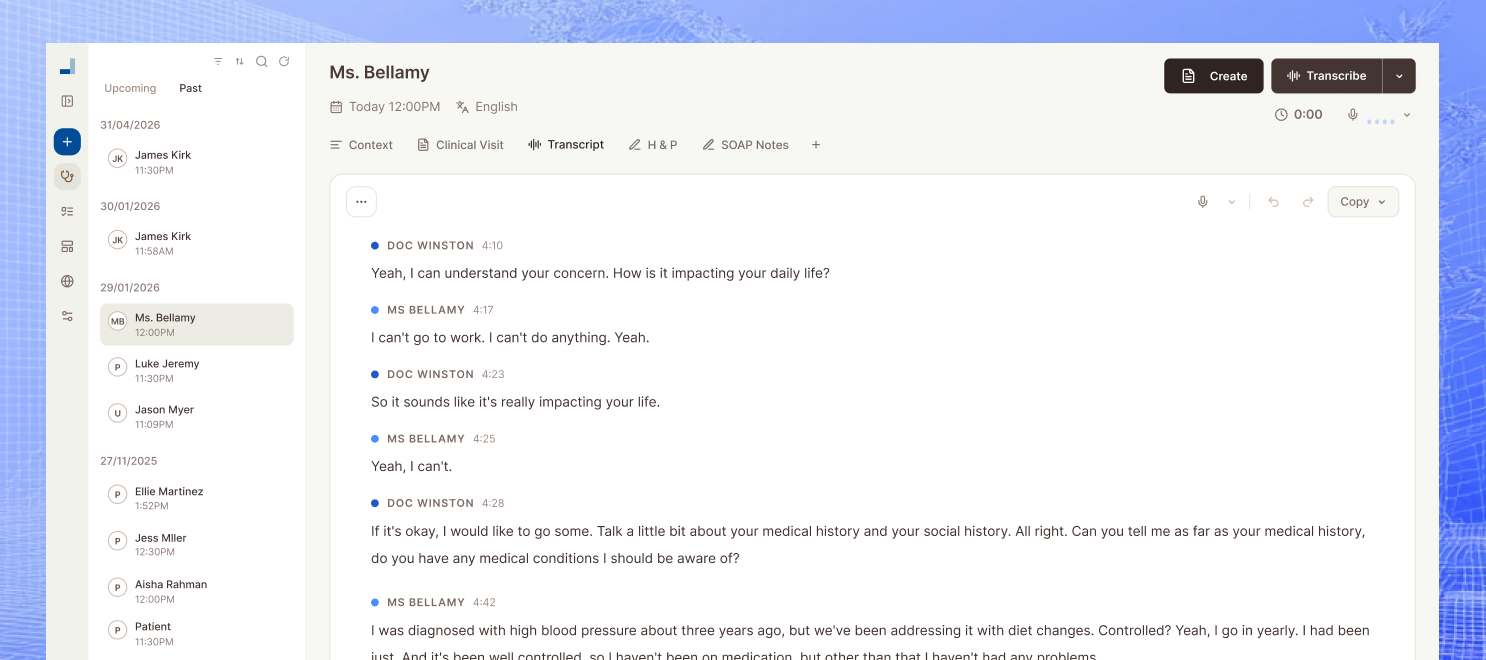
While the SOAP format is a staple of medical education, it is often insufficient for the diverse needs of specialized care. A complex new patient intake requires a thorough History and Physical (H&P) that captures surgical history, social determinants of health, and a comprehensive review of systems. Using a specialized AI scribe template allows the technology to parse the conversation specifically for these headers, ensuring that the final document is structured for hospital admission or complex specialty care rather than just a routine check-up.
Beyond the basics, clinics frequently require more technical documentation such as procedure notes, consult notes, and referral letters. Each of these serves a specific purpose in the continuum of care. For example, a procedure note must focus on the ‘how-to’ and the immediate patient response, while a referral letter needs to synthesize clinical findings into a persuasive and informative summary for another specialist. AI templates can automatically shift the tone and focus based on the intended output, ensuring the right information reaches the right person.
Consistent structure is also vital for audit readiness and insurance reimbursement. When notes follow a predictable, specialty-specific format, it becomes much easier for billing teams to find the necessary evidence for coding. It also improves handover quality; when a colleague reads a progress note or a discharge summary generated by a well-tuned AI template, they can quickly grasp the patient’s status without digging through paragraphs of disorganized text.
- H&P and Consult notes provide depth for complex new patient visits.
- Procedure notes capture technical details and immediate outcomes accurately.
- Discharge summaries and referral letters facilitate seamless transitions of care.
- Specialized templates ensure compliance with audit and billing requirements.
How to implement AI scribe templates step-by-step in a real clinic
Successful implementation begins with a narrow focus. Rather than trying to automate every visit type on day one, select a single high-volume visit type—such as routine follow-ups or standard physicals—and apply a specific template to those encounters. This allows the team to get comfortable with how the AI interprets the dialogue before moving on to more complex cases. Starting small minimizes friction and helps build confidence in the technology’s ability to handle your specific clinical vocabulary.
Once the initial phase is successful, you should begin setting up templates by specialty and sub-specialty. In a university clinic, this might mean having distinct configurations for cardiology, orthopedics, and family medicine. This categorization ensures the AI knows which clinical data points to prioritize. When you capture the encounter, whether it is an in-person physical exam or a telehealth session, the AI already understands the ‘filter’ through which it should process the conversation, leading to much cleaner first drafts.
The workflow then moves to a rapid review and edit phase. Instead of typing from scratch, the clinician simply scans the generated note for accuracy, making minor adjustments to the plan or assessment as needed. Because the structure is already perfect, editing takes a fraction of the time of traditional typing. Finally, these outputs can be instantly repurposed. A well-constructed follow-up note can be converted into a patient instruction sheet or a letter to a referring physician with just a few clicks, maximizing the utility of a single recording.
- Begin with one visit type to master the workflow without feeling overwhelmed.
- Organize your library with specialty-specific templates for precise data capture.
- Review and edit as a final check rather than drafting from a blank page.
- Reuse data to generate letters and forms, reducing redundant admin work.
How to keep note quality high and reduce mistakes
To avoid common pitfalls like ‘note bloat’ or missing medications, it is essential to establish a lightweight review habit. AI can sometimes include irrelevant small talk or miss a specific nuance if the audio is unclear. By spending sixty seconds reviewing the summary immediately after the encounter, you can catch these errors while the conversation is still fresh in your mind. This ‘immediate review’ technique is the most effective way to maintain a high-quality medical record.
Clinic owners should also set team-wide standards for what constitutes a ‘good’ note. This includes defining expectations for the level of detail in the Assessment and Plan sections. When all providers in a practice use the same AI scribe templates, the documentation becomes uniform, which is incredibly helpful during peer reviews or when multiple doctors are treating the same patient. High-quality documentation is a team sport, and AI provides the standardized playing field.
- Perform a quick 60-second review immediately after the patient encounter.
- Establish clear practice-wide standards for AI-generated documentation.
- Encourage clinicians to speak their thought processes aloud for better capture.
- Regularly audit a random sample of notes to ensure template alignment.
Privacy, consent, and patient trust
Patient privacy is the foundation of the clinical relationship. While AI scribing is highly beneficial, it must be handled with transparency. Consent requirements vary significantly by region and local health authority, so it is vital to follow your specific local policies. Generally, patients are very receptive to the technology when they understand that it allows their doctor to focus on them rather than a screen.
A simple way to explain this to a patient is: ‘I’m using an AI assistant today to help me capture our conversation so I can focus entirely on you instead of typing. It’s secure, and it helps me make sure your records are perfectly accurate. Are you okay with that?’ Most patients appreciate the honesty and the extra attention they receive as a result. Maintaining general security and retention principles, such as ensuring data is encrypted and only used for its intended purpose, is non-negotiable for maintaining trust.
- Always follow local laws and institutional policies regarding recording.
- Use a simple, transparent script to explain the benefits to patients.
- Ensure the AI solution meets robust encryption and data security standards.
- Focus on how the technology improves the patient-provider connection.
Rolling it out across a clinic without disruption
A successful rollout requires a structured pilot plan, typically lasting about two weeks. During this time, a few ‘super-users’ can test the AI scribe templates and provide feedback on which formats work best for your clinic’s specific needs. This pilot phase helps identify any technical hurdles, such as Wi-Fi dead zones in certain exam rooms or specific accents the AI might need to adjust to, before a full-scale launch.
During the rollout, it is helpful to track metrics like ‘time saved per day’ and ‘reduction in after-hours charting.’ When staff see tangible evidence that they are getting home an hour earlier, adoption rates skyrocket. Training should be focused on template alignment—ensuring everyone knows which template to select for which visit—to keep the data clean and the billing process smooth across the entire organization.
- Conduct a 2-week pilot with select providers to iron out the workflow.
- Track time-saving metrics to prove the value to the entire team.
- Align templates across specialties for consistent clinic-wide data.
- Provide brief, practical training sessions focused on the review process.
Mcoy AI is an AI medical scribe that records and transcribes patient encounters, then generates multiple clinical note types (H&P, progress notes, consult notes, follow-up notes, procedure notes, discharge summaries, referral letters, and more). It features 200+ customizable templates and an AI chat to create letters, forms, and documents quickly and accurately. This tool is designed to fit into your existing workflow, ensuring that you spend less time on paperwork and more time delivering high-quality patient care.
Conclusion
Implementing a structured workflow using specialized templates is the most effective way to transition from a bogged-down practice to an efficient, modern clinic. By choosing the right AI scribe templates, you ensure that every note, from a simple follow-up to a complex H&P, is accurate, professional, and useful for the entire care team. The reduction in burnout and the increase in patient face-time make this a vital upgrade for any medical professional. Start with a small pilot, find the templates that fit your specialty, and watch your documentation burden disappear.
What a serious review table should cover
| Decision area | Common mistake | Better clinic-ready approach | Metric to watch |
|---|---|---|---|
| Workflow design | Treat choosing ai scribe templates by specialty: a complete guide as a one-off documentation task | Build a repeatable process with clear ownership and review points | Time to complete documentation |
| Team adoption | Assume every clinician will naturally use the same process | Train for consistency and define exception handling early | Active user adoption |
| Quality review | Only check notes when a problem is reported | Audit a sample of notes weekly and review edge cases | Edit rate per note |
| Operational follow-through | Leave admin actions outside the documentation workflow | Use the same encounter data for referrals, letters, and follow-up tasks | Completion rate for next-step tasks |
Related reading
If you are working through choosing ai scribe templates by specialty: a complete guide, it helps to read this alongside AI & Medicine: How to Simplify Clinical Notes for Busy Doctors, AI & Medicine: How Doctors Can Improve SOAP Notes, and Specialty Guides: Patient-Centered Documentation with AI: A Full Guide. Those guides cover adjacent workflow, implementation, and evaluation questions so the decision does not sit in isolation.
FAQ
How accurate are AI medical scribes in real clinics?
In modern clinical settings, AI medical scribes are exceptionally accurate at capturing the dialogue and medical terminology used during an encounter. However, accuracy can be influenced by background noise or multiple people speaking at once. This is why the clinician’s role in reviewing the final note remains essential to ensure every clinical detail is captured perfectly.
Do I still need to review every note?
Yes, medical professionals are legally and ethically responsible for the accuracy of their documentation. While the AI does the heavy lifting by drafting and structuring the note, you should perform a quick review to verify dosages, confirm the plan, and ensure the tone reflects your professional assessment. Most doctors find this takes less than a minute per note.
What note types can an AI scribe generate besides SOAP?
The best AI tools go far beyond the SOAP format. They can generate History and Physical (H&P) notes, complex consult notes, detailed procedure notes, and discharge summaries. They can also synthesize the encounter into referral letters or specific insurance authorization forms, depending on the templates you choose.
Will this work for telehealth and in-person consults?
Absolutely. AI scribes are designed to capture audio from various sources, whether it is a conversation happening in a physical exam room or an encounter over a digital telehealth platform. The technology focuses on the spoken word, making it versatile enough to handle almost any consultation environment seamlessly.
How do I explain recording/transcription to patients?
The best approach is complete transparency focused on patient benefit. Let them know you are using a secure AI tool to help you document the visit so you can focus on them rather than your computer. Most patients value the increased eye contact and attention they receive when the doctor isn’t distracted by typing.
How do clinics prevent note bloat?
Note bloat is prevented by using concise, specialty-specific templates that tell the AI exactly what information is relevant. Instead of transcribing every single word of small talk, the AI is trained to extract only the medically significant data points, which keeps the records professional, brief, and actionable.
How long does template setup take?
Initial setup is usually very fast. Most practitioners can start with pre-built templates and see immediate results. Customizing a template to fit a specific sub-specialty or a personal shorthand preference usually takes only a few minutes, and once saved, it can be used for every subsequent encounter of that type.
What’s the safest way to start if I’m skeptical?
The safest way to begin is with a small pilot program. Choose your most routine, straightforward visit types and use the AI for those first. This allows you to see the quality of the output without any risk to complex cases, and you can scale up to more challenging consultations as you gain confidence in the system.