Specialty Guides: What is Ambient Listening? A Full Guide for Doctors and Clinics
A full guide explaining what ambient listening is in healthcare, how it works, benefits for doctors, clinics, and how AI transforms medical documentation.
In the last few years, healthcare has started shifting toward technology that doesn’t interrupt care. One of the clearest examples of this movement is ambient listening. The term is appearing in medical conferences, EHR updates, and conversations among private practitioners who are trying to reduce documentation load. Although it sounds simple on the surface, ambient listening represents one of the biggest changes in how clinicians will manage charting over the next decade.
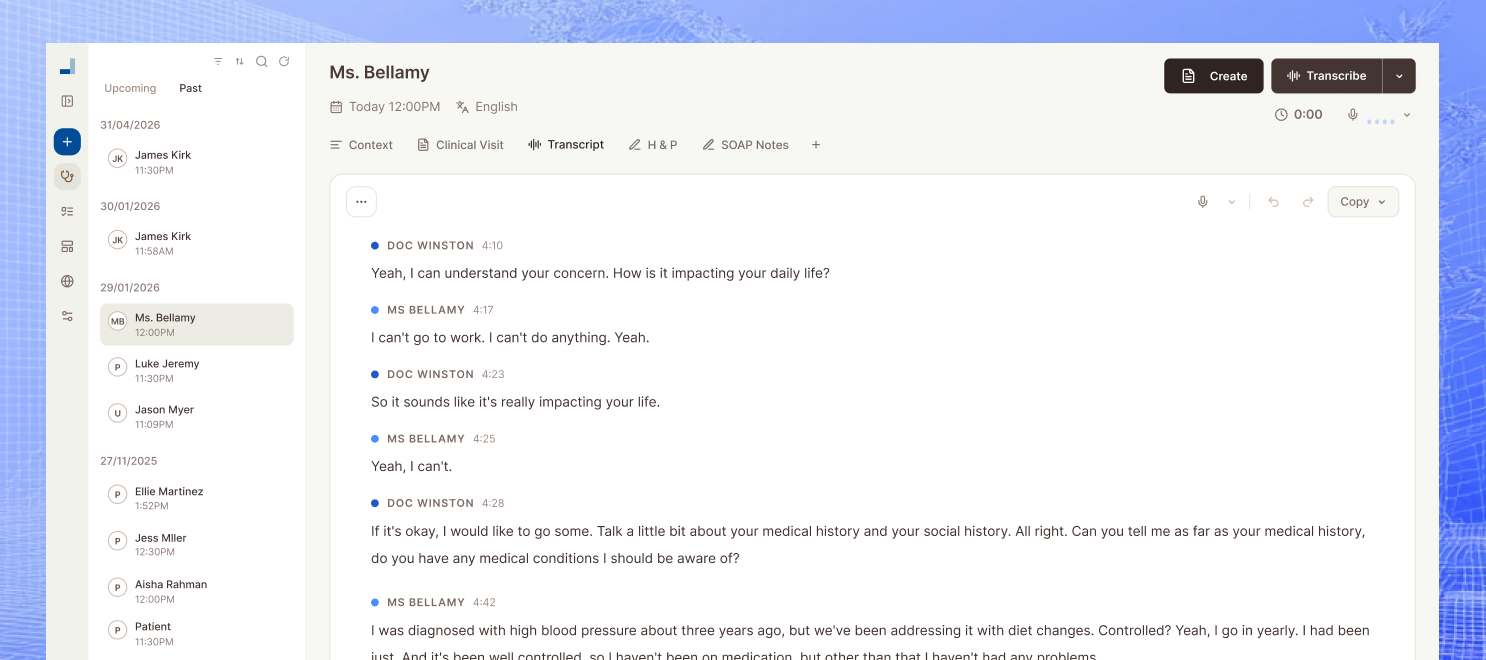
At its core, ambient listening is a technology that can hear what is happening in the clinic room, understand the medical context in real time, and generate structured documentation without requiring the doctor to type, dictate, or follow strict voice commands. Instead of speaking into a recorder or narrating a SOAP note line by line, the clinician just talks normally with the patient while the system works quietly in the background. It feels almost invisible. But the impact on administrative time is massive.
As more practitioners search for ways to streamline their workload, ambient listening is becoming one of the most important tools for modern clinical practice. It doesn’t aim to replace clinical judgment. It simply removes the administrative steps that surround it. When implemented properly, ambient listening lets doctors focus on the patient in front of them while still producing accurate, organized, compliant documentation with almost no extra effort.
The true definition of ambient listening in healthcare
Ambient listening refers to an AI system that passively listens during a patient encounter, captures the entire conversation, and automatically converts it into structured, medically relevant documentation. The key word is passive. There is no need to tap a microphone icon over and over, dictate in perfect sentences, or use phrases like “new paragraph” or “period.” The system simply listens in the background and processes the conversation.
This is very different from traditional dictation software. Dictation requires intentional input. You press record, speak your note clearly, and stop when you are finished. Ambient listening is designed around the flow of a real consultation. It stays active while you take a history, perform an exam, give instructions, or answer questions. The technology is becoming sophisticated enough to understand what matters medically and organize the note accordingly.
For clinicians, this means the documentation process becomes woven into the natural rhythm of the visit. You are not switching between listening, typing, dictating, and examining. Ambient listening enables the visit itself to become the documentation.
How ambient listening actually works
Most systems use a combination of real-time speech recognition, medical language models, and context-aware note generation. Although each company has its own implementation, the workflow usually follows a similar pattern.
The system begins by listening. It captures audio from both the physician and the patient. Then it transcribes the conversation into text using advanced speech-to-text technology. After that, the model identifies who is speaking, extracts key medical details, and organizes them into meaningful sections. It can detect symptoms, histories, findings, assessment details, plans, medications, and follow-up instructions.
Finally, the AI generates the full clinical note in a structured format like SOAP or whatever template the clinic uses. Some systems also produce summaries, letters, after-visit instructions, or referral notes from the same encounter. When the technology is integrated well, the doctor simply opens the finished note, reviews it, makes quick edits if needed, and signs.
While the underlying models are complex, the clinician’s experience is kept simple. You talk. The AI listens. The documentation is done.
Why doctors are turning to ambient listening
Every doctor knows that the administrative burden of medicine has increased dramatically. Charting, revising templates, documenting compliance elements, correcting formatting, and completing after-visit paperwork take up a large portion of the workday. Surveys repeatedly show that clinicians spend more time documenting than seeing patients, which leads to burnout, lower satisfaction, and reduced clinic flow.
Ambient listening solves this by reducing how much of the doctor’s time is consumed by documentation. When done right, it significantly shortens charting time during and after clinic. Doctors can finish their day earlier, reduce late-night charting, and maintain better accuracy. The visit also feels more natural because the clinician is no longer switching between the patient and the computer.
It also improves the quality of documentation. Because the AI is capturing everything in real time, it often picks up details that a rushed note would miss. Many physicians find that their notes become more complete and consistent. The accuracy of assessments and plans tends to improve because the AI can clearly reference what was said during the encounter.
Another benefit is emotional. Many clinicians say ambient listening allows them to reconnect with the core of patient care. It eliminates one of the biggest stressors of modern practice: the constant pressure to document every detail manually. With ambient listening, the conversation becomes the note, not an additional burden layered on top of it.
Ambient listening vs dictation vs manual charting
Manual charting is the traditional approach. It requires typing everything by hand, clicking through templates, and keeping track of formatting. It is accurate but slow. Dictation is faster, but still requires the doctor to speak in a structured, intentional way. Ambient listening, however, is a passive system that requires no additional effort from the clinician.
The difference is not just workflow. It’s cognitive load. Dictation still forces you to multitask. Manual charting takes time and attention away from the patient. Ambient listening aligns with how doctors naturally interact. You examine, talk, explain, educate, and reassure—and the AI builds the note in the background. The more natural the encounter, the better the documentation becomes.
Where ambient listening is heading
As clinical AI becomes more advanced, ambient listening may eventually become the standard for healthcare documentation. The next generation of these systems will be able to automatically generate multiple versions of the note: one for the EHR, one for the patient’s after-visit summary, and one for billing compliance. They will detect abnormal findings, remind clinicians of missing details, and streamline coding.
Even small practices will be able to access technology that previously required large hospital budgets. The future of charting is not louder dictation commands. It is quieter care, supported by smarter systems.
One paragraph about Mcoy AI
This is exactly the problem that Mcoy AI was built to solve. Mcoy uses ambient listening to capture patient encounters automatically and turn them into high-quality SOAP notes, summaries, letters, and more. It includes over 200 customizable templates built for different specialties, along with an AI assistant that can generate any document a doctor needs in seconds. Clinicians simply press record before a visit, speak naturally, and Mcoy handles the rest, allowing doctors to reduce admin time and devote more energy to patient care.
Why clinics benefit from ambient listening adoption
For private practices, time efficiency translates into financial efficiency. Faster documentation means shorter turnaround between appointments, fewer after-hours charting sessions, and better patient flow. Practices that adopt ambient listening often report higher patient satisfaction because the clinician appears more present and engaged during the visit.
It also reduces hiring costs. Many smaller clinics cannot afford a full-time medical scribe, and ambient listening gives them the same advantages without the ongoing expense. The system essentially becomes a digital scribe that never gets tired or distracted.
Clinics with multiple providers can also standardize documentation quality. Instead of relying on varied note styles, the AI produces consistent, complete documentation every time. This reduces errors, simplifies audits, and supports better continuity of care.
Implementation tips for clinics considering ambient listening
Clinics that plan to introduce ambient listening should focus on smooth adoption. Start with one or two clinicians, gather feedback, and adjust templates to match existing workflows. Ensure the system supports specialty-specific documentation. Encourage providers to speak naturally, which helps the AI capture context. Over time, most clinics find that the technology blends seamlessly into the daily routine.
The shift toward invisible technology in healthcare
Ambient listening represents a shift toward quieter, more integrated healthcare technology. Instead of adding steps, pop-ups, or new interfaces, it removes friction. The goal is not to turn doctors into assistants for the software. It is to make the software support the way doctors already practice.
As more clinics adopt the technology, ambient listening will likely become as common as digital charting itself. In the same way EHRs changed documentation forever, ambient listening is the next step in simplifying the clinical workflow. For doctors and patients, this means more time together, fewer administrative barriers, and smoother overall care.
What a serious review table should cover
| Decision area | Common mistake | Better clinic-ready approach | Metric to watch |
|---|---|---|---|
| Workflow design | Treat what is ambient listening? a full guide for doctors and clinics as a one-off documentation task | Build a repeatable process with clear ownership and review points | Time to complete documentation |
| Team adoption | Assume every clinician will naturally use the same process | Train for consistency and define exception handling early | Active user adoption |
| Quality review | Only check notes when a problem is reported | Audit a sample of notes weekly and review edge cases | Edit rate per note |
| Operational follow-through | Leave admin actions outside the documentation workflow | Use the same encounter data for referrals, letters, and follow-up tasks | Completion rate for next-step tasks |
Related reading
If you are working through what is ambient listening? a full guide for doctors and clinics, it helps to read this alongside Specialty Guides: How to Run a More Efficient Medical Practice in 2026, Specialty Guides: How to Improve Patient Encounters, and AI & Medicine: Faster Progress Notes: Medical Scribe App Guide. Those guides cover adjacent workflow, implementation, and evaluation questions so the decision does not sit in isolation.
FAQ
Frequently Asked Questions
What does ambient listening mean in healthcare?
Ambient listening refers to AI technology that passively listens to the doctor-patient conversation and automatically generates the clinical note. It does not require dictation or structured commands.
Does ambient listening replace medical scribes?
It doesn’t replace clinical judgment, but it can replace the manual documentation work scribes handle. Many clinics use it to avoid hiring additional staff.
Is ambient listening secure?
Modern systems are built with encryption, access controls, and compliance frameworks. Providers should confirm HIPAA alignment before adoption.
Does ambient listening understand medical context?
Yes. Advanced systems extract symptoms, findings, assessments, and plans while organizing them into structured notes like SOAP.
How does ambient listening save time?
It converts the natural patient encounter into documentation automatically, reducing typing, template editing, and after-hours charting.