AI & Medicine: Medical Scribing: Everything You Need to Know
Full guide on medical scribing for doctors and clinics. Learn how scribes, AI tools, and workflows improve documentation, reduce admin, and enhance patient care
Medical scribing has become one of the most transformative workflow improvements in modern healthcare. With patient volumes increasing, documentation demands rising, and burnout accelerating across every specialty, the role of the medical scribe has shifted from optional support to an essential part of clinical operations. Whether you run a private clinic, manage a small team of practitioners, or practice independently in a university setting, understanding how medical scribing works — and how AI is rapidly changing it — can significantly reduce your admin burden and improve patient care.
This guide breaks down what medical scribing is, how it fits into a clinical workflow, why doctors rely on it, and what the new wave of AI-powered scribing means for practices looking to cut admin time without compromising documentation quality.
What is Medical Scribing?
Medical scribing is the process of capturing, documenting, and structuring patient encounter information in real time. Traditionally, a medical scribe sits in the exam room or listens remotely, records the patient history, documents symptoms, organizes the SOAP note structure, and ensures the chart is complete before the physician signs off. The goal is to offload documentation so the clinician can focus on the patient instead of the screen.
Documentation is no longer just a clerical task. It influences clinical communication, continuity of care, billing accuracy, and medico-legal protection. Because of this, the quality of documentation has a measurable impact on both patient outcomes and practice efficiency.
Why Is Medical Scribing Important for Doctors?
The administrative load placed on clinicians has grown faster than the time allocated to complete it. Many doctors now spend multiple hours each evening on their EHR trying to catch up. This phenomenon — often referred to as “pajama time” — contributes heavily to physician burnout.
Having a reliable scribing system means:
You spend more time with patients and less time typing.Notes are more complete, structured, and consistent across encounters.Billing and coding accuracy improves because documentation supports it.You reduce after-hours charting and reclaim personal time.Clinical workflows become more predictable and less chaotic.
For private clinics where efficiency and profitability go hand-in-hand, well-documented encounters also mean smoother claims processing, fewer denials, and cleaner records for follow-up care.
Traditional vs AI Medical Scribing
Traditional human scribes have been used for more than a decade. They are trained professionals who listen in real time and document the encounter as it happens. While they can be accurate, reliable, and detail-oriented, they come with limitations. They require staffing, consistent scheduling, ongoing training, and often a subscription or hourly cost that adds up quickly. For many clinics, this becomes too expensive or too complex to maintain.
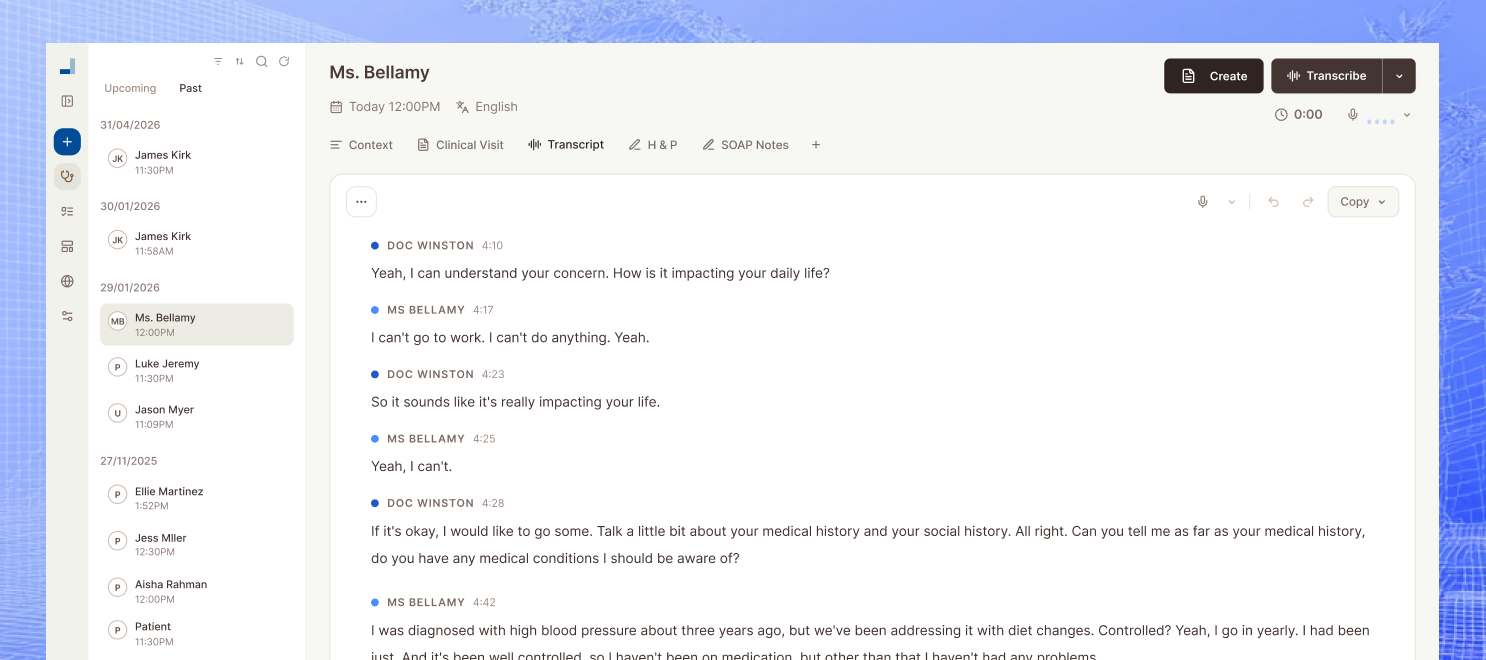
AI medical scribing is the new alternative. Instead of having a person join the encounter, an AI system processes the audio from the visit and automatically generates structured medical notes. These AI-powered tools are now capable of producing SOAP notes, assessment and plans, procedure notes, orders, letters, and more — all without requiring an additional staff member.
The newest generation of AI scribes can also interpret context, follow medical logic, and adapt to different specialties. For busy practitioners, this represents a leap forward in reducing documentation time without sacrificing accuracy.
How Medical Scribing Fits Into the Clinical Workflow
Medical scribing integrates into your daily routine with minimal friction. Whether you’re in a GP clinic, urgent care, psychiatry practice, dermatology center, or surgical specialty, the workflow remains similar: capture the encounter, generate the note, review, and sign.
The general flow looks like this:
Before the encounter: Review previous notes, set up relevant templates.During the encounter: AI or human scribe collects data while the clinician interacts with the patient.After the encounter: A structured note is generated, then reviewed and signed off by the clinician.
This simple workflow eliminates hours of manual input and lets clinicians stay present with their patients without worrying about missing anything important.
Common Documentation Tasks a Medical Scribe Handles
Although the role varies across specialties, scribes generally take care of:
Patient historyChief complaintHPI and review of systemsPast medical and surgical historyMedications and allergiesPhysical exam findingsAssessment and planFollow-up instructionsProcedure documentationOrders and referrals
For many doctors, these tasks represent the majority of their time spent in the EHR. Outsourcing or automating them leads to significant gains in productivity and accuracy.
How AI Is Transforming Medical Scribing
AI medical scribing is becoming the preferred option because it solves problems that human scribes cannot. It works 24/7, doesn’t require training, produces consistent outputs, and can generate documents instantly. As speech-to-text models become more accurate and specialized medical prompting improves, AI scribes can now create detail-rich notes that feel tailored to each clinician’s style.
Modern AI scribes also go beyond just transcription. They can analyze clinical content, understand sequencing, identify key information, and produce standardized notes that match your clinic’s expectations. Many also include features such as follow-up summaries, patient-friendly notes, and integration with practice management systems.
Where Mcoy AI Fits In
For clinics looking for a powerful but affordable AI scribing solution, Mcoy AI has emerged as one of the most practical tools available. It records and transcribes patient encounters, turns them into clean SOAP notes, and supports over 200 customizable templates created specifically for doctors across different specialties. Mcoy AI can also generate letters, forms, and documents directly from your encounter, and includes an AI assistant so you can query, edit, and expand your notes — all without increasing your admin load. Many doctors use it so they can focus on delivering care rather than wrestling with paperwork.
Benefits of Implementing a Medical Scribing Solution in Your Practice
Doctors who adopt medical scribing consistently report improvements across several dimensions. The first is time: reducing after-hours charting has an immediate impact on stress levels and work-life balance. Even saving 30 to 60 minutes per day adds up to dozens of hours per month.
Clinicians also experience better accuracy because the system captures details in the background that might otherwise be forgotten. Higher accuracy leads to better continuity of care, fewer patient misunderstandings, and more reliable documentation for medico-legal purposes.
Billing efficiency is another often-underappreciated benefit. Clean, well-structured notes mean fewer billing errors and rejected claims. When documentation supports the level of service provided, reimbursements come through faster and more consistently.
Many doctors also notice that patients perceive them as more attentive. When the clinician is no longer typing through the appointment, their focus is fully on the patient. This alone improves patient satisfaction scores and fosters stronger relationships.
How to Choose the Right Medical Scribing System
Selecting a medical scribing approach depends on your practice size, budget, workflow, and documentation requirements. Consider questions such as:
Do you need real-time documentation or is post-visit processing acceptable?How important is cost reduction in your clinic?Do you require specialty-specific templates?Do you prefer AI, human scribes, or a hybrid model?
Most small practices benefit from AI scribing because the setup is simple, the cost is predictable, and the output is consistent. Larger practices sometimes use a hybrid approach to handle complex visits or surgical cases. Regardless of the approach, the goal is the same: reduce your documentation burden and restore your clinical time.
The Future of Medical Scribing
The medical scribing landscape is shifting from human-powered to AI-assisted workflows. As models become smarter and more specialized, AI scribes will increasingly act as clinical documentation partners rather than simple transcription tools. Future systems may also integrate with diagnostic support, coding assistance, and care coordination workflows, creating an even more streamlined experience for doctors.
For now, the priority remains clear: reducing burnout and improving patient care by eliminating unnecessary administrative work.
Final Thoughts
Medical scribing is not just a convenience — it is becoming a core pillar of modern clinical practice. For doctors, private practitioners, and clinics looking to operate efficiently while maintaining high-quality documentation, scribing provides an immediate pathway to productivity and patient-focused care. Whether you adopt a human or AI-based solution, the right scribing system can transform your workflow, reduce stress, and give you back the time you need to practice medicine the way you intended.
What a serious review table should cover
| Decision area | Common mistake | Better clinic-ready approach | Metric to watch |
|---|---|---|---|
| Workflow design | Treat medical scribing: everything you need to know as a one-off documentation task | Build a repeatable process with clear ownership and review points | Time to complete documentation |
| Team adoption | Assume every clinician will naturally use the same process | Train for consistency and define exception handling early | Active user adoption |
| Quality review | Only check notes when a problem is reported | Audit a sample of notes weekly and review edge cases | Edit rate per note |
| Operational follow-through | Leave admin actions outside the documentation workflow | Use the same encounter data for referrals, letters, and follow-up tasks | Completion rate for next-step tasks |
Related reading
If you are working through medical scribing: everything you need to know, it helps to read this alongside AI & Medicine: How to Simplify Clinical Notes for Busy Doctors, AI & Medicine: How Doctors Can Improve SOAP Notes, and Specialty Guides: How to Use AI Scribe for GP consultations: A Guide. Those guides cover adjacent workflow, implementation, and evaluation questions so the decision does not sit in isolation.
FAQ
What does a medical scribe actually do during a patient encounter?
A medical scribe captures the details of the encounter so the doctor can focus on the patient. This includes documenting the chief complaint, history of present illness, past medical information, physical examination findings, and the assessment and plan. The scribe’s goal is to ensure the chart is complete, accurate, and ready for the clinician to review and sign.
Are AI scribes as accurate as human scribes?
Modern AI scribes have reached a level where they can reliably produce structured SOAP notes and clinically coherent documentation. They are not perfect, but they offer consistent quality, avoid human errors caused by fatigue, and can adapt through customizable templates. Many clinics now use AI exclusively because it reduces cost and administrative complexity.
Does medical scribing improve billing accuracy?
Yes. Proper documentation directly supports the correct billing level and reduces claim rejections. When notes are complete and structured, coders can easily identify the services provided and justify the level of care. This reduces revenue leakage for private clinics and ensures faster reimbursements.
Can small practices benefit from medical scribing?
Small clinics often benefit the most. The reduction in admin time is immediate, and doctors spend less time after hours catching up on charts. AI scribes are particularly helpful because they require no additional staff, no training, and operate at a predictable cost, making them ideal for solo practitioners or small teams.
Is AI medical scribing secure and compliant?
Most reputable AI scribing tools are designed with healthcare compliance in mind, using secure encryption, controlled access, and safe data handling practices. Clinics should still review the vendor’s compliance statements and ensure the tool aligns with their local privacy regulations before implementation.
How long does it take to adopt a medical scribing solution?
Most AI scribe systems take just a few minutes to set up and begin using. Human scribing services can require onboarding, training, and scheduling, which may take longer. AI scribes integrate smoothly into existing workflows without disrupting clinical operations.
Can I customize documentation to match my specialty?
Many AI scribe platforms, including Mcoy AI, offer customizable templates for different specialties. These templates allow doctors to generate notes that match their unique style, workflow, and clinical requirements. Customization ensures consistency and reduces editing time after each encounter.