AI & Medicine: How to Use an AI Medical Scribe - A Complete Guide for Doctors and Clinics
How to use an AI medical scribe in your clinic. Full guide for doctors and hospitals on recording, documenting, and simplifying notes with modern AI tools.
The rise of AI medical scribes has changed clinical documentation from a draining, time-consuming burden into something that happens quietly in the background. For doctors who already deal with patient care, admin overload, endless back-and-forth with templates, and an overflowing EMR inbox, AI scribes offer a real path to reclaiming time. But many clinicians still wonder how exactly to use an AI medical scribe, how it fits into their existing workflow, and how much effort it takes to adopt one.
This guide breaks down everything you need to know: what an AI scribe actually does during a consultation, how to integrate it with your routine, what preparation you need, and what to expect when reviewing notes, exporting documents, and reducing charting time. Whether you’re a solo practitioner or part of a university clinic, learning how to use an AI medical scribe can transform how you practice medicine every day.
What an AI Medical Scribe Actually Does
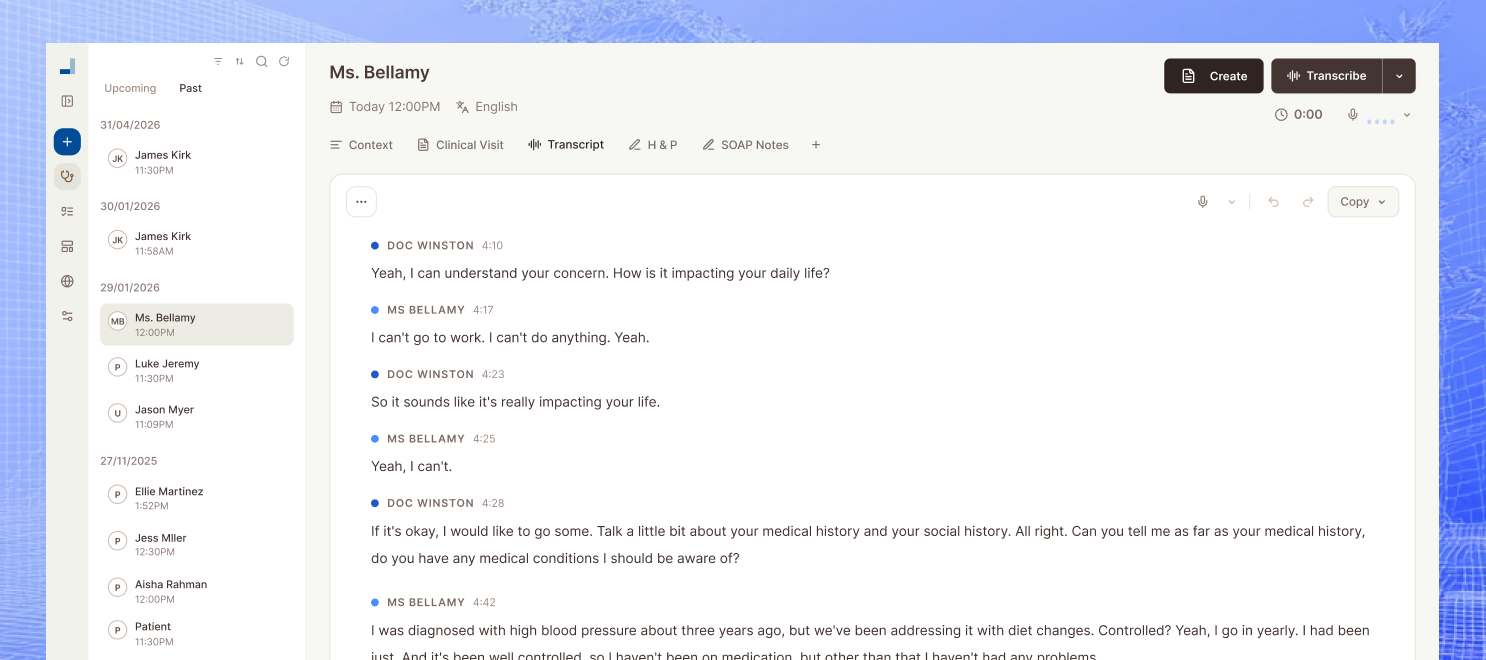
During a patient encounter, an AI scribe listens, interprets, and documents the conversation. Instead of toggling between speaking to the patient and typing into your EMR, you simply press record and move through your consultation as you normally would. The AI works in real time, identifying symptoms, impressions, histories, plans, and follow-ups. After the encounter ends, the system compiles everything into clear, structured medical notes you can review, edit, and finalize.
This means your hands stay free, your attention stays on the patient, and your notes come out neatly structured without needing to manually type long descriptions or reformat anything. For many doctors, it becomes the easiest way to handle charting because it matches the natural rhythm of patient care instead of interrupting it.
Preparing to Use an AI Medical Scribe in Your Clinic
Most AI scribes require almost no set-up, but a smooth start comes from a few simple steps. The first is choosing a device that records clearly. Your phone, laptop, or tablet is usually enough. You don’t need special microphones or fancy hardware. The second step is deciding when to start recording. Some clinicians press record as soon as the patient walks in. Others wait until they begin the history to avoid capturing small talk. Both approaches work as long as it fits your workflow.
The final piece is preparing your templates. Most AI scribes allow you to choose SOAP notes, summaries, referral formats, or specialty-specific structures. Preparing templates in advance helps the AI match your preferred style. Once the templates are set, you rarely need to adjust them again unless your practice changes.
Recording the Patient Encounter Step by Step
Using an AI scribe during a consultation is simple. The moment you begin, you press the record button and continue speaking naturally. You don’t need to narrate every detail or speak in a special tone. Just conduct the appointment the same way you always have.
If the patient mentions symptoms, concerns, or history, the AI will capture it. If you ask follow-up questions or explain care plans, the AI will document those appropriately. During physical exams, you can speak brief notes out loud, such as “abdomen soft, non-tender,” “lungs clear,” or “normal gait.” This is not for the patient’s benefit but simply to help the AI capture the clinical findings accurately.
When the appointment ends, you hit stop. The AI processes the audio and generates the encounter’s structured notes. In most cases, this takes only seconds or a minute depending on length.
Reviewing and Finalizing Notes
Once the AI produces the clinical notes, your role is to review and verify. The best AI scribes provide a SOAP format with neatly structured sections, allowing you to skim quickly. You can edit wording, rearrange details, or add anything the scribe missed. Over time, the AI becomes more aligned with your preferences and writing style.
After reviewing, you can export or integrate the notes into your EMR. Most clinicians find that reviewing takes far less time than manually typing notes because the heavy lifting has already been done. What used to require several minutes per patient now takes seconds.
Using Templates and Custom Document Generation
Many AI scribes go beyond encounter notes. They generate referral letters, discharge instructions, work certificates, chronic care plans, and procedure documentation. When your scribe supports customizable templates, you can build documents that match your exact formatting requirements. This reduces the back-and-forth editing that normally slows down clinicians.
For example, if you need standardised follow-up instructions for respiratory complaints or consistent formatting for mental health support letters, templates can automate these repetitive documents. Over time, you build a library of ready-to-use forms that match how your clinic operates.
Using AI Scribe Insights After the Appointment
The value of an AI medical scribe doesn’t end with documenting the appointment. Once notes and summaries are generated, they become a searchable history you can reference any time. If your patient returns with new symptoms, you can quickly look back at previous encounters. If you need to generate supporting documents later, your notes are there waiting.
Some AI scribes even include summarization, keyword extraction, or follow-up task identification. This transforms raw encounter data into actionable insights so you never forget important care steps or upcoming reviews.
How Mcoy AI Makes the Process Even Simpler
A single paragraph as requested.
Mcoy AI takes everything above and compresses it into the simplest workflow possible for doctors and private clinics. You press record before each encounter, speak naturally, and Mcoy AI automatically transcribes, structures, and formats the entire visit. It turns your conversation into SOAP notes, summaries, letters, and over 200 customizable templates built specifically for healthcare professionals. You can even use the built-in AI assistant to generate documents, instructions, forms, or clarifications instantly. For busy clinicians, this means less admin, less after-hours charting, and more time to focus on patient care.
Navigating AI Scribes in a University Clinic Setting
University clinics often handle higher patient turnover and more varied cases, making documentation especially time-heavy. Physicians, residents, and rotating practitioners all face the same challenge: staying on top of notes while maintaining smooth patient flow. AI medical scribes help keep things organised even when schedules get disrupted or appointment types change suddenly.
Using an AI scribe also supports continuity of care. Because notes are generated immediately, clinicians transitioning across shifts or rotations can see clear summaries instead of piecing together incomplete notes. For teaching environments, this reduces bottlenecks and improves supervision because faculty can quickly review trainee documentation.
Fitting the AI Scribe Into Your Current Workflow
Integration is where many doctors hesitate, but the process is easier than expected because AI scribes adapt to your routine instead of forcing you to change. Whether you prefer paper first, EMR-first, or voice-first workflows, an AI medical scribe fits right in.
Paper-first doctors can record the encounter and manually enter highlights into the EMR later using the AI-generated notes as a guide. EMR-first doctors can use AI scribes to fill in SOAP sections while they manually enter codes and billing. Voice-first doctors can rely almost completely on the AI to generate all documentation and then only tweak as needed.
Your workflow remains the same. The only difference is that documentation becomes dramatically easier.
Common Mistakes When Using an AI Scribe
Even though AI scribes are simple, a few mistakes can create unnecessary friction. Recording too late may cause missed details. Speaking findings too quietly may reduce accuracy. Forgetting to review notes before signing off can introduce small errors. These are normal learning phases and resolve quickly once clinicians get used to the tool.
The goal is not perfection on the first day but smoother charting over time.
The Impact on Quality of Care
When documentation becomes faster, clinicians can shift more energy into listening, diagnosing, educating, and guiding patients. Many doctors report feeling more present in consultations because they’re not thinking about the chart they need to complete later. Patients notice the difference too. Removing the laptop barrier, breaking fewer eye contacts, and keeping your hands free all improve rapport.
AI scribes also reduce burnout. When note fatigue decreases, enthusiasm for clinical work increases. This is why many practitioners describe AI scribes as one of the most meaningful workflow improvements they’ve adopted.
The Learning Curve: What Doctors Should Expect
The most surprising part for many clinicians is how little learning is required. There’s no advanced setup, no complicated menus, and no steep training curve. By the second or third day, using an AI scribe becomes as natural as turning on your stethoscope.
Some doctors experiment with phrasing or ordering, but most simply speak normally. As long as your recording is clear, you will get clean, readable documentation with minimal effort.
How AI Medical Scribes Fit Into the Future of Healthcare
The future of clinical work will involve less typing and more conversation-driven documentation. AI scribes are only the first step. Soon, they’ll integrate more tightly with EMRs, support billing assistance, highlight red flags, and create risk-based summaries. Doctors who start now will become comfortable with AI-supported care long before their peers.
For clinics, this means better throughput, higher documentation accuracy, faster onboarding of new doctors, and a significant reduction in end-of-day backlog.
What a serious review table should cover
| Decision area | Common mistake | Better clinic-ready approach | Metric to watch |
|---|---|---|---|
| Workflow design | Treat how to use an ai medical scribe - a complete guide for doctors and clinics as a one-off documentation task | Build a repeatable process with clear ownership and review points | Time to complete documentation |
| Team adoption | Assume every clinician will naturally use the same process | Train for consistency and define exception handling early | Active user adoption |
| Quality review | Only check notes when a problem is reported | Audit a sample of notes weekly and review edge cases | Edit rate per note |
| Operational follow-through | Leave admin actions outside the documentation workflow | Use the same encounter data for referrals, letters, and follow-up tasks | Completion rate for next-step tasks |
Related reading
If you are working through how to use an ai medical scribe - a complete guide for doctors and clinics, it helps to read this alongside AI & Medicine: How to Simplify Clinical Notes for Busy Doctors, AI & Medicine: How Doctors Can Improve SOAP Notes, and Physician Wellbeing: How to Stop After-Hours Charting With an AI Scribe. Those guides cover adjacent workflow, implementation, and evaluation questions so the decision does not sit in isolation.
FAQ
How accurate are AI medical scribes?
Accuracy is generally very high when recordings are clear. Most AI scribes reliably capture clinical details, histories, impressions, and plans. Reviewing notes ensures everything is correct before finalizing.
Do I need special hardware to use an AI medical scribe?
Most AI scribes work with your phone, laptop, or clinic computer. You don’t need professional microphones or additional hardware.
Will patients accept AI recording in the room?
Most patients are comfortable when doctors explain that the AI assists with documentation to improve care. A simple consent statement is usually enough.
Can AI scribes replace human scribes?
AI scribes replace most manual documentation tasks but doctors still verify all content. Human scribes may still be useful in highly specialized workflows, but AI scribes handle the majority of routine documentation.
How long does it take to implement an AI medical scribe?
Most doctors can start using an AI scribe within minutes. Template setup may take a little longer, but once it’s done, the workflow becomes seamless.