AI & Medicine: Medical Dictation Software: How It Works in Healthcare
Full guide on medical dictation software. Learn how dictation works, its benefits in healthcare, and how AI improves speed, accuracy, and documentation.
Medical professionals have always battled documentation. Whether in a busy outpatient clinic, a university hospital, a community practice, or a specialist room, the daily reality remains the same: notes, summaries, letters, reports, orders, forms, and patient updates fill every hour around clinical work. Many doctors and nurses spend more time documenting than interacting with patients. Medical dictation software emerged to ease this load by turning spoken words into structured text. As digital tools continue to evolve, dictation is no longer just an add-on—it has become an essential part of efficient, modern healthcare workflows.
This guide explains how medical dictation software works, why it has become so valuable, and how it transforms documentation for clinicians across different settings.
What Is Medical Dictation Software?
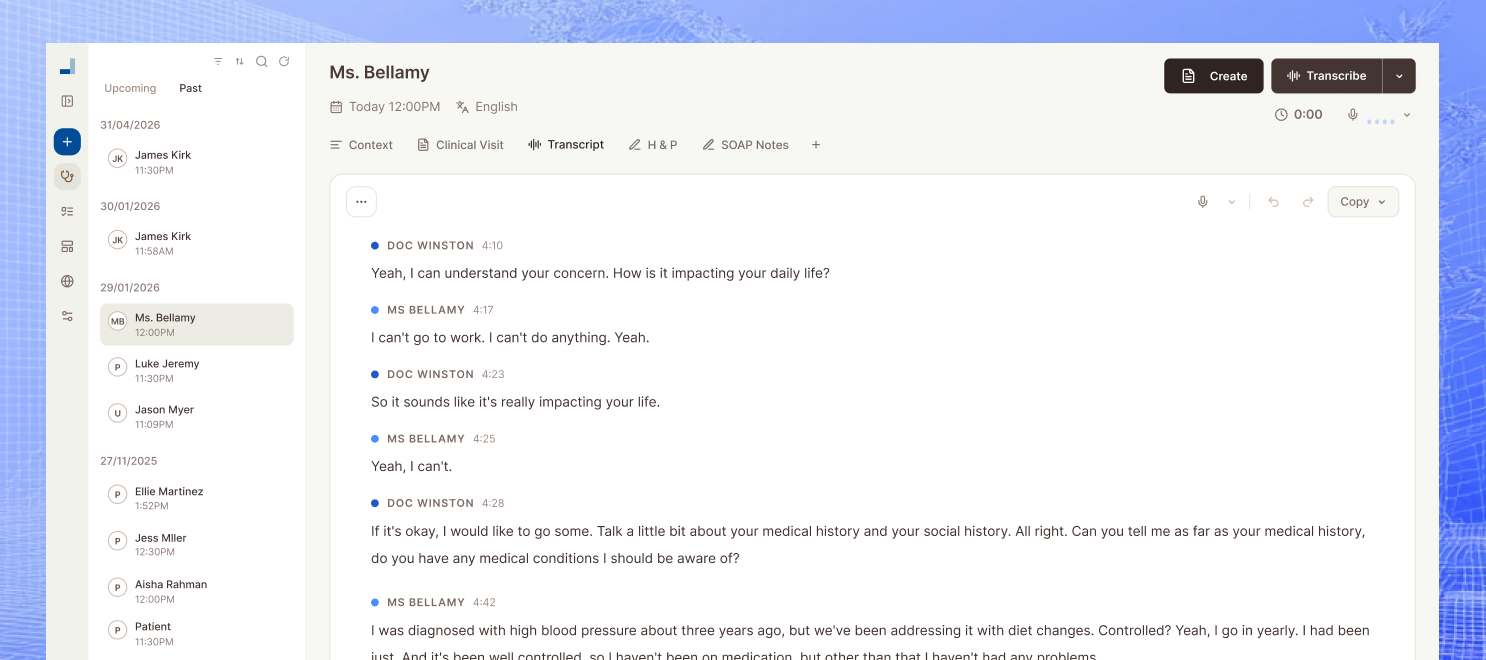
Medical dictation software is a tool that converts a clinician’s spoken words into written text. Instead of typing notes manually, doctors and nurses speak naturally into a microphone, mobile app, or desktop recorder, and the software transcribes the speech into formatted documentation. The technology is powered by speech recognition engines and medical language models trained to understand clinical terminology.
Dictation has existed for decades, but modern AI-powered dictation is far more accurate, real-time, and flexible. It understands accents, clinical phrases, medication names, and specialty-specific terminology. This makes it useful across primary care, dentistry, emergency settings, mental health, physiotherapy, and specialty clinics.
Why Medical Dictation Matters
The demand for medical dictation reflects a larger shift in healthcare. Clinicians are under increasing pressure from rising patient loads, complex reporting requirements, and digital record systems that require careful documentation. Typing slows clinicians down and increases cognitive fatigue. Dictation offers a more natural, faster way to capture information.
Instead of structuring every sentence or navigating through fields in an electronic health record, providers can simply speak as they think. This closing of the gap between thought and documentation reduces the friction of charting, especially at the end of a long shift.
For many clinicians, dictation software feels like going back to how medicine used to be practiced—except with all the advantages of modern digital systems.
How Medical Dictation Software Works
Although the experience feels simple, the underlying technology involves several advanced steps. Modern dictation systems go through a multi-layered process to ensure accuracy and clinical relevance.
First, the audio input is captured. This usually happens through a microphone, headset, mobile phone, or integrated hardware device. The sound is filtered to remove background noise and enhance clarity. Next, the audio passes through speech recognition models that map sound waves to phonemes and eventually to words. Medical language models add an extra layer of intelligence, helping the system understand medication names, procedures, and clinical vocabulary.
After that, natural language processing tools structure the text, applying punctuation and formatting. Some dictation systems stop here, but advanced ones also identify clinical concepts, organize information into SOAP sections, or integrate directly with EHR fields.
What the clinician receives is a clean, readable transcription produced in seconds.
How Clinicians Use Dictation in Daily Practice
Medical dictation software can be used almost anywhere in the clinical workflow. Providers dictate patient histories, exam findings, assessments, and plans during or after visits. Surgeons dictate operative summaries. Psychologists dictate session notes. Emergency physicians dictate rapid documentation before moving to the next patient.
Many clinicians dictate while walking between rooms, during handover, or immediately after a procedure. Because speaking is faster than typing, dictation speeds up the entire documentation cycle—especially in busy settings where time is precious.
Some hospitals integrate dictation within their EHR screens, while private practices use stand-alone tools on their phones or computers. The flexibility of modern dictation means clinicians can document wherever they are, without waiting for a workstation.
Example 1: Dictation for SOAP Notes
A primary care doctor might finish a consultation and immediately dictate a structured note. The system captures subjective complaints, physical exam findings, assessments, and plans. Instead of typing each section separately, dictation allows the clinician to articulate the full context quickly.
Example 2: Dictation for Specialist Reports
Specialists who produce detailed reports—such as cardiologists, dermatologists, psychiatrists, and endocrinologists—use dictation to outline test interpretations and treatment recommendations. Long, descriptive narratives become much easier to produce through speech than through typing.
Example 3: Dictation for Nurses and Allied Health
Nurses frequently document wound progress, patient updates, education instructions, and shift handovers. Dictation helps keep documentation consistent and reduces the time needed to write repetitive or descriptive notes.
Allied health professionals such as physiotherapists, occupational therapists, and dietitians use dictation to prepare progress reports, assessments, and plan updates with minimal typing.
Example 4: Acute Care and Emergency Medicine
In emergency departments, speed matters. Physicians often dictate immediate summaries or preliminary assessments while treating multiple patients at once. Dictation helps document rapidly evolving situations without slowing down care.
Example 5: Telehealth Visit Documentation
Telehealth has created new documentation demands. Dictation helps clinicians document remote encounters as they speak, ensuring that virtual visit summaries are completed promptly and accurately.
Benefits of Medical Dictation Software in Healthcare
The biggest advantage is speed. Speaking is three to seven times faster than typing. This time saves hours across an entire day, week, or month, especially for clinicians handling high patient loads.
Dictation also reduces burnout. Repetitive typing contributes to fatigue, wrist strain, and cognitive overload. Dictation allows clinicians to maintain a more natural workflow, improving overall satisfaction and decreasing end-of-day exhaustion.
Accuracy is another key benefit. Medical dictation software trained on clinical language models understands terminology far better than general-purpose dictation tools. Medications, lab values, diagnoses, procedures, and technical phrases are recognized with higher precision, reducing the chance of mistakes.
Better documentation quality is another reason clinicians adopt dictation. Spoken records often capture more nuance and contextual detail than typed notes. This leads to clearer communication across teams and more complete patient records.
Integration With AI and Automated Documentation
Medical dictation has evolved beyond simple transcription. Many platforms now combine dictation with advanced AI tools that structure the information automatically. For example, when a doctor dictates an entire encounter, the AI can transform it into SOAP notes, summaries, or formatted clinical documents.
One example is Mcoy AI, an AI medical scribe that includes dictation as part of its workflow. Mcoy AI records and transcribes patient encounters, turns them into SOAP notes, generates documents and letters, and supports over 200 customizable templates designed by healthcare professionals. For clinics and private practices, this type of integrated dictation and documentation system means less time fixing templates and more time on patient care.
The Future of Medical Dictation in Healthcare
As AI continues to advance, medical dictation will evolve even further. Future systems may automatically fill EHR fields during the encounter, identify missing data points, or suggest clinical insights based on dictated content. Real-time dictation during exams may become standard, removing the need for end-of-day charting altogether.
Another emerging trend is multimodal AI, where dictation integrates with audio, images, and structured data. For example, a clinician may dictate findings while the AI simultaneously analyzes scans or test results. This holistic integration will elevate documentation accuracy and clinical efficiency.
Mobile-first dictation is also becoming more common. Clinicians can document from anywhere—clinic rooms, hallways, home, or between rounds—using only their phone. This mobility supports modern healthcare environments that are increasingly dynamic and fast-paced.
As documentation requirements continue to grow, medical dictation will play a central role in reducing administrative load across the entire care spectrum.
What a serious review table should cover
| Decision area | Common mistake | Better clinic-ready approach | Metric to watch |
|---|---|---|---|
| Workflow design | Treat medical dictation software: how it works in healthcare as a one-off documentation task | Build a repeatable process with clear ownership and review points | Time to complete documentation |
| Team adoption | Assume every clinician will naturally use the same process | Train for consistency and define exception handling early | Active user adoption |
| Quality review | Only check notes when a problem is reported | Audit a sample of notes weekly and review edge cases | Edit rate per note |
| Operational follow-through | Leave admin actions outside the documentation workflow | Use the same encounter data for referrals, letters, and follow-up tasks | Completion rate for next-step tasks |
Related reading
If you are working through medical dictation software: how it works in healthcare, it helps to read this alongside AI & Medicine: How to Simplify Clinical Notes for Busy Doctors, AI & Medicine: How Doctors Can Improve SOAP Notes, and AI & Medicine: Keep Notes Short but Defensible With AI | Full Guide. Those guides cover adjacent workflow, implementation, and evaluation questions so the decision does not sit in isolation.
FAQ
How accurate is medical dictation software today?
Modern medical dictation has reached very high accuracy thanks to advanced AI models trained on clinical vocabulary. These systems understand medical terminology, acronyms, procedure names, and drug lists, making them far more reliable than older dictation tools.
Can medical dictation software integrate with EHRs?
Many dictation systems integrate directly with EHR platforms, allowing clinicians to dictate notes directly into patient charts. Even when full integration is not available, most providers can copy and paste dictations easily into their preferred systems.
Do clinicians need special hardware to use dictation software?
Most modern dictation tools only require a microphone or mobile phone. Some providers use headsets for better clarity, but dedicated hardware is no longer necessary.
Is dictation suitable for specialists with complex terminology?
Yes, medical dictation software is specifically trained to understand specialty vocabulary. This makes it useful for fields like cardiology, neurology, orthopedics, psychiatry, and dermatology, where technical language is common.
Can dictation replace full documentation workflows?
Dictation can significantly reduce typing time, but when combined with AI-generated summaries and templates, it can replace most of the manual documentation process. Many providers now use dictation in combination with AI scribes for complete documentation support.