AI & Medicine: Do clinicians need special hardware to use dictation software?
Do clinicians need special hardware for dictation software? Full guide for doctors and clinics on requirements, compatibility, and modern AI scribe tools.
For years, clinicians assumed speech-to-text tools required complicated hardware — special microphones, desktop stations, hospital-grade accessories, and even dedicated computers. That belief came from the early generations of medical dictation systems, which were expensive, locked behind proprietary devices, and often required on-premise installation. But modern AI dictation has evolved dramatically. Today, most clinicians can use dictation software with nothing more than a smartphone, laptop, or tablet they already own.
Healthcare moves fast. Clinical documentation has become heavier, patient loads have grown, and the pressure to reduce burnout while preserving accuracy has never been higher. So naturally, clinicians want to know: Will adopting dictation software complicate workflows even more? Will they need extra equipment? Or can they finally streamline documentation without a learning curve or an IT shopping list?
This guide breaks down everything clinicians should know about hardware requirements for medical dictation software — what’s necessary, what’s optional, and what’s now completely obsolete.
Understanding the basics: How modern dictation systems work
Modern medical dictation tools use cloud-based speech recognition. That means the “heavy lifting”— processing audio, converting it into structured text, and interpreting medical terminology — happens on remote servers powered by advanced AI models.
Because processing no longer happens on the device itself, clinicians no longer need powerful computers or specialized equipment. A lightweight app or browser window becomes the gateway, and the device only needs to capture audio clearly enough for the AI engine to interpret it.
For most clinicians, this means the barrier to entry is incredibly low. If they can open a browser or use an app, they can dictate. Period.
This simplicity is intentional. Modern health tech understands that care environments are busy, unpredictable, and spread across multiple locations like clinics, hospitals, telehealth sessions, and even home visits. Tools that require complex setups simply do not survive in the realities of clinical practice.
Do clinicians need special microphones? Not anymore
In the past, “dictation microphones” were a must — large handheld recorders, USB hardware, or wired headsets designed specifically for transcription workflows. While these tools still exist, they are no longer required.
Today’s AI dictation systems are designed to work with:
• Built-in laptop microphones• Smartphone microphones• Tablet microphones• Bluetooth earbuds (optional)• USB headsets (optional)
These everyday devices are already optimized to capture voice with clarity. Modern AI models are far more tolerant of background noise and variations in tone, accent, speech speed, and room acoustics.
Many doctors are surprised to learn that their smartphone microphone often produces better transcription accuracy than older “professional” dictation hardware. Years of consumer demand — video calls, voice assistants, social media audio — have pushed phone microphone engineering to extremely high standards.
Internet connection: The real requirement
The single most important requirement for cloud-based dictation software is a stable internet connection.
Because speech recognition happens in the cloud, the device must be connected to upload audio and receive real-time transcription. Fortunately, healthcare environments already have solid connectivity, and in cases of home visits, clinicians can rely on mobile data.
A strong internet connection matters more than microphone hardware. If connectivity is consistent, the transcription engine can operate smoothly. If not, clinicians may experience delays or buffering, but this still does not require any special equipment — only connection stability.
What hardware do most clinicians already use?
Clinicians typically rotate between three main devices during their workday, and fortunately, all three are fully compatible with AI dictation tools:
Smartphones
Many doctors dictate notes immediately after an encounter while walking between rooms. Smartphones are ideal for this because they are portable and have excellent microphones.
Laptops
Used widely for EHR access, telehealth, and report writing. Most web-based dictation tools run perfectly on modern browsers like Chrome or Safari.
Tablets
Increasingly popular in private practices and outpatient settings. Tablets balance portability with screen space, making them ideal for quick dictation plus review.
Notably, none of these require an upgrade to use AI dictation. If the device is capable of making a Zoom call, it is capable of running a medical dictation tool.
Optional hardware for clinicians who want enhanced accuracy
Although special hardware is not required, some clinicians prefer optional accessories to improve consistency or reduce fatigue. These include:
• A noise-canceling USB headset for shared clinical spaces• Dedicated Bluetooth microphones for telehealth scenarios• Wireless earbuds for hands-free communication
These accessories are not mandatory. They simply offer ergonomic or workflow convenience for clinicians who regularly dictate in high-noise environments.
But thanks to AI models trained on varied audio contexts, even background noise is no longer a major barrier. A busy clinic, hallway conversations, and equipment sounds rarely disrupt transcription today.
What about hospital-grade or “medical-only” dictation equipment?
Specialized medical dictation hardware still exists, but it’s mostly legacy technology. Many of these devices succeeded in the early 2000s because older transcription engines required extremely high-quality audio to avoid errors. Today, they are obsolete.
Modern cloud-based AI transcription systems:
• Do not require on-premise hardware• Do not require local installation• Do not require special recording devices• Do not require hospital networks or VPNs• Do not require expensive “dedicated dictation stations”
This shift saves clinicians thousands of dollars in unnecessary equipment.
How small clinics and private practitioners benefit from hardware-free dictation
Private practitioners, especially in university clinics, GP rooms, and small specialist centers, often prefer lightweight, cost-friendly technology. They rarely have budget for enterprise hardware or complex IT infrastructure.
Fortunately, modern dictation tools fit perfectly into these environments:
• No installation fees• No special devices• No technician setup• No equipment maintenance• No hidden costs
A clinic can adopt AI dictation immediately using the devices they already own. This reduces both adoption friction and cost — a major reason AI scribes are rapidly replacing legacy dictation systems.
A quick word about Mcoy AI
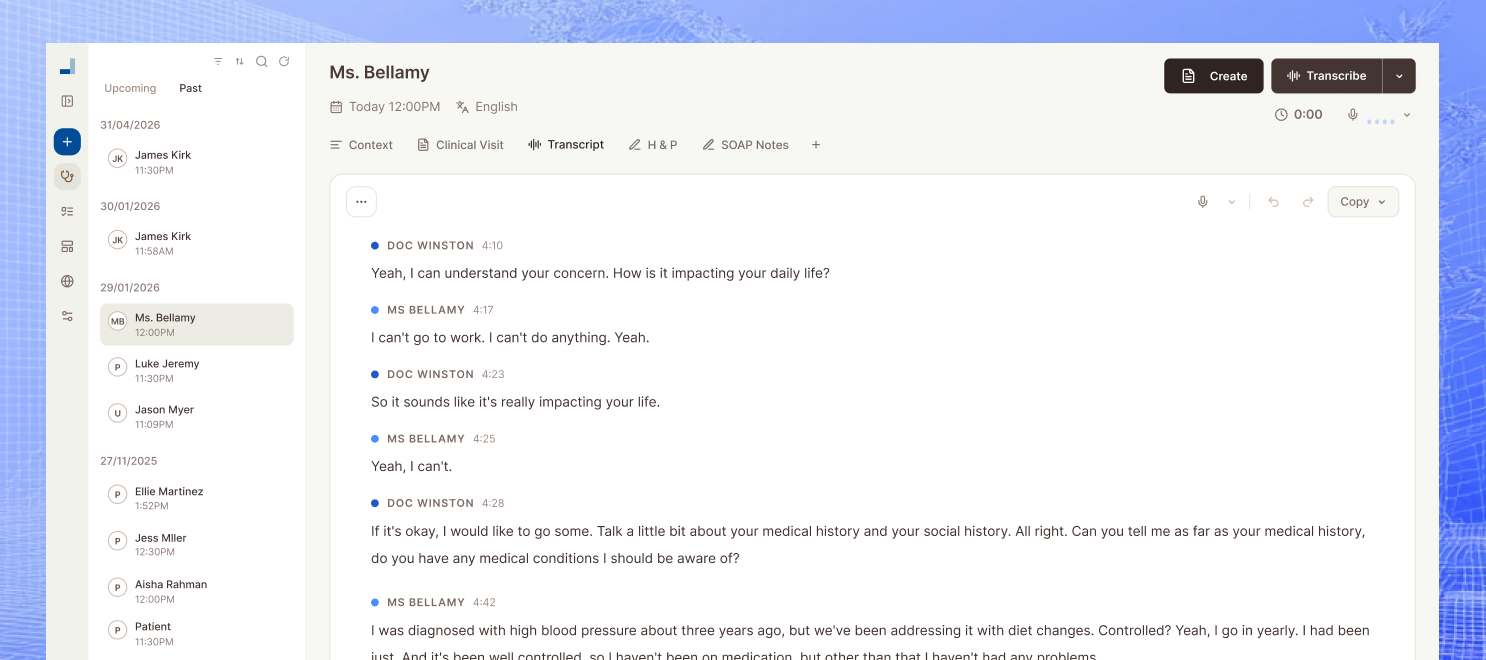
Many clinicians discover that modern tools like Mcoy AI allow them to dictate directly from their phone or laptop without any hardware upgrades. Mcoy AI records patient encounters, transcribes them with medical-grade accuracy, and automatically turns them into SOAP notes, referrals, letters, care instructions, and more. It comes with over 200 customizable templates built for different specialties. Doctors can even chat with their encounter to generate any document instantly, helping them cut administrative hours and focus more on face-to-face patient care. All of this works with everyday devices — no special microphone or workstation required.
Common misconceptions about hardware requirements
Because dictation technology has changed so quickly, several myths still circulate in healthcare environments.
“I need a premium microphone.”
Not true. While you can use one, everyday device mics work well.
“It won’t work in noisy environments.”
Modern AI handles noise better than legacy models. Whispering, bedside dictation, and hallway speech are all manageable.
“Dictation needs a desktop or on-premise setup.”
Cloud systems eliminated this requirement years ago.
“The hospital IT team must install something.”
Most tools run from the browser. No installation is needed.
“I need new devices if my tech is older.”
If your device can open a browser, it can dictate — even 5-year-old laptops work.
Clinicians often underestimate how accessible speech-to-text technology has become.
Why hardware-light dictation is transforming patient care
The biggest advantage of low-hardware AI dictation is not convenience — it’s clinical impact.
When clinicians no longer need to sit at a desk or carry specific equipment, documentation becomes fluid. Doctors can dictate in real time after encounters, reducing the cognitive burden of remembering details hours later. They can complete documentation between consults, not at the end of an exhausting day.
And because the tools are accessible anywhere, clinicians practicing across multiple sites — hospitals, private rooms, telehealth, outreach clinics — finally enjoy consistent workflows. This flexibility is central to reducing burnout and accelerating documentation accuracy.
The bottom line: No, clinicians do not need special hardware
Modern dictation software has dematerialized the traditional equipment “barrier.” Clinicians can start with the devices they already use every day. No special microphones. No dictation stations. No proprietary accessories.
Cloud-based AI models have replaced hardware complexity with universal accessibility.
For any clinical environment — university clinics, private practices, hospitals, or telehealth — adopting dictation is now a simple decision: open an app, press record, and speak.
Documentation becomes faster, cleaner, and far more human when the tools disappear into the workflow.
Clinicians don’t need more equipment. They need less friction. And that’s exactly what modern AI dictation delivers.
What a serious review table should cover
| Decision area | Common mistake | Better clinic-ready approach | Metric to watch |
|---|---|---|---|
| Workflow design | Treat do clinicians need special hardware to use dictation software? as a one-off documentation task | Build a repeatable process with clear ownership and review points | Time to complete documentation |
| Team adoption | Assume every clinician will naturally use the same process | Train for consistency and define exception handling early | Active user adoption |
| Quality review | Only check notes when a problem is reported | Audit a sample of notes weekly and review edge cases | Edit rate per note |
| Operational follow-through | Leave admin actions outside the documentation workflow | Use the same encounter data for referrals, letters, and follow-up tasks | Completion rate for next-step tasks |
Related reading
If you are working through do clinicians need special hardware to use dictation software?, it helps to read this alongside AI & Medicine: How to Simplify Clinical Notes for Busy Doctors, AI & Medicine: How Doctors Can Improve SOAP Notes, and AI & Medicine: Capture HPI Automatically with AI Scribe: A Doctor’s Guide. Those guides cover adjacent workflow, implementation, and evaluation questions so the decision does not sit in isolation.
FAQ
Do I need a special microphone for medical dictation software?
No. Most modern AI dictation tools work perfectly with the built-in microphones on your laptop, smartphone, or tablet. While a noise-canceling headset can be helpful in loud environments, it is completely optional. Clinicians do not need to purchase dedicated dictation microphones anymore.
Can dictation software work on older devices?
Yes. If your device can open a modern web browser or run a basic app, it can support medical dictation. Even laptops that are five or six years old still perform well because the processing happens in the cloud, not on the device itself.
Is a stable internet connection required for dictation?
A stable internet connection is the only essential requirement for cloud-based dictation. The AI engine processes speech in real time through the internet. If your connection is slow, you may experience small delays, but no additional hardware is needed.
Will dictation work in noisy clinic environments?
Modern AI dictation tools are trained on diverse audio conditions and can handle background noise far better than older systems. Conversations, hallway movement, and machine sounds rarely disrupt accuracy. A headset may help in extremely noisy settings, but it is not mandatory.
Can clinicians use dictation tools on their smartphones?
Absolutely. Many doctors prefer using their smartphones because they are portable, fast, and equipped with advanced microphones. Most AI scribes — including Mcoy AI — fully support mobile recording and live transcription.
Do hospitals need special IT installations or servers?
No. Most AI medical dictation software is cloud-based and runs directly in the browser or app without local installation, servers, or hardware setups. Hospital IT teams generally do not need to deploy anything special unless the organisation requires custom integrations.
Is special telehealth equipment required for dictation?
No. If your device already supports telehealth calls, then it supports dictation. A simple laptop mic or mobile device is enough to record and convert speech into text during virtual consultations.
Will I get better accuracy with premium hardware?
Premium microphones may offer slightly cleaner audio, but modern AI models can produce highly accurate transcription from very ordinary microphones. The difference in accuracy is often negligible for most clinical use cases.
Can multiple clinicians share the same device for dictation?
Yes. Most dictation platforms support secure login or user profiles, allowing shared devices without compromising patient information. The hardware does not restrict multi-user access.
Does Mcoy AI require any special hardware?
No. Mcoy AI works on everyday devices — phones, tablets, and laptops. It records patient encounters, transcribes them into SOAP notes, and generates documents using over 200 medical templates without requiring any additional equipment. This makes it easy for even small clinics and private practitioners to adopt immediately.