Compare & Choose: AI Medical Scribe Cost: Is It Worth the Price? A Full Guide for Doctors and Clinics
A well-structured system ensures that deadlines are met, priorities are clear, and teamwork flows seamlessly.
The conversation around AI medical scribes has shifted dramatically in the last two years. What started as a niche experiment is now one of the most discussed cost-saving opportunities in private practices, university clinics, specialist rooms, and even small group practices. Many doctors are now asking the same question: “How much does an AI medical scribe cost, and is it genuinely worth switching from traditional manual scribes?”
Healthcare today is strained by rising overheads, workforce shortages, and increasing documentation demands. For doctors who feel like they’re spending more time typing than treating, the economics behind AI scribes matter—not in theory, but in real daily workflow impact. A tool that promises to reduce admin time, cut costs, and improve accuracy must be evaluated carefully. This article breaks down exactly how much AI scribes cost, how they compare to manual medical scribes, and whether the switch is financially justified.
Understanding the Real Cost of Manual Scribes
On paper, manual medical scribes appear straightforward: hire a trained individual to sit with you during patient encounters and document in real-time. In reality, the cost structure is heavier and more complicated.
Manual scribes typically cost:
- $2,500 to $4,500 per month for full-time support
- $30 to $60 per hour if hired on hourly terms
- Additional costs for recruitment, onboarding, supervision, and turnover
Even medical students or part-time scribes at university clinics often charge $18–$25 per hour, which still results in substantial monthly expenses when used daily.
But cost goes beyond wages. Manual scribes also bring:
- Inconsistent accuracy depending on skill
- Dependency on a single person’s speed
- Risk of burnout or turnover
- Limited availability outside clinic hours
- Additional time needed for corrections or clarifications
Many doctors underestimate one major hidden cost: the time spent double-checking notes. Even with a “fast” scribe, physicians often report spending an additional 20–45 minutes per day proofreading and editing. Over a month, that is equivalent to 10–20 hours of lost clinical or personal time.
When you combine:
- Scribe salary
- Training and turnover
- Quality inconsistencies
- Additional editing time
Most clinics end up spending $3,000 to $5,000 per month for manual documentation support—often without achieving the accuracy or consistency they truly want.
Why AI Medical Scribes Are Gaining Momentum
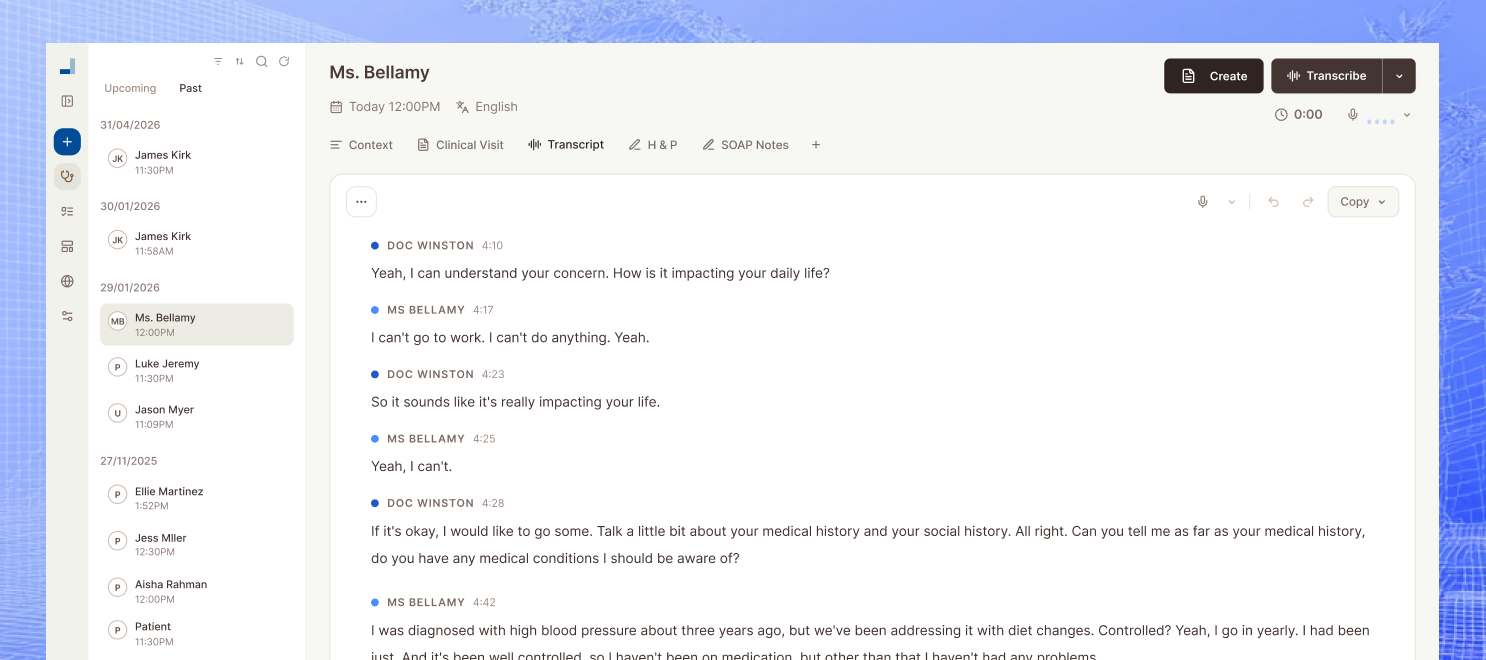
AI medical scribes emerged as a response to documentation overload. They record the encounter, process the audio, generate SOAP notes, produce documentation, and help doctors finalize records faster. But their biggest appeal comes down to cost efficiency.
At an average of $40–$200 per month, AI scribes offer nearly 80–90% cost reduction compared to human scribes.
Doctors want to know whether the savings compromise on quality. The answer depends on the platform, but modern medical-grade AI models have reached clinical accuracy high enough to be used safely for structured documentation, summaries, letters, and encounter notes.
AI Medical Scribe Cost Breakdown
The typical pricing ranges for popular AI scribes:
- Low-tier AI scribes: $30–$60 per month
- Mid-tier: $60–$150 per month
- Enterprise AI scribes: $200–$600 per provider per month
Most platforms charge based on features such as templates, audio minutes, integrations, and additional document generation tools.
Compared to manual scribes, the difference is enormous:
- Manual scribe: $3,000–$5,000 per month
- AI scribe: $40–$200 per month
Even at the highest tier, AI scribes are still 10x cheaper than hiring a full-time human scribe.
What About Mcoy AI’s Pricing?
This is where the affordability conversation becomes clearer. Mcoy AI, an AI-powered medical scribe built for doctors and clinics, sits at the lower end of the pricing spectrum:
- $65 per month (monthly plan)
- $40 per month (yearly plan, billed annually)
For this price, doctors get access to:
- An AI medical scribe that records and transcribes patient encounters
- Automated SOAP notes
- Document and letter generation
- Over 200+ customizable medical templates
- AI assistant to chat with encounters and generate follow-up documents
It removes typing, reduces admin time, and ensures consistent documentation quality with very low overhead. For many private practitioners, especially in university clinics or solo practices, this cost level makes AI scribes finally accessible without enterprise-level pricing.
Cost Comparison: Manual Scribe vs AI Scribe
Let’s break the comparison down in a clearer, more practical way.
Manual Medical Scribe (Human)
Monthly Cost: $3,000–$5,000This includes hourly wages, ramp-up time, training, and supervision.
Hidden Costs:
- Turnover
- Inconsistency in note quality
- Need to re-check every note
- Limited availability
- Slow note revision when busy
Common Pain Points:Many doctors report notes being “fine but not great,” requiring extra editing. Others struggle with privacy concerns, reliability, or the awkwardness of having a person in the room during sensitive exams.
AI Medical Scribe
Monthly Cost: $40–$200 depending on platformFor Mcoy AI specifically, $40–$65 per month.
Hidden Costs:
- Minimal
- Occasional proofreading (but much less than manual)
- A short learning curve
Benefits:
- Instant documentation
- Consistent formatting
- Available 24/7
- No HR overhead
- No supervision
- No turnover
- Scales easily to multiple providers
Annual Cost Savings
A doctor using a manual scribe could spend up to $60,000 per year.
A doctor using an AI scribe at $40 per month spends $480 per year.
Even at $65 per month, that’s $780 per year.
The savings are drastic:
Annual Savings: $59,000+ per doctor
Even if you use conservative estimates, switching to AI frees up thousands, not to mention the time regained.
Time Is Part of the Cost Equation
Doctors often forget that documentation is not just a financial burden—it’s an emotional and cognitive drain. The repetitive typing, template-fixing, and formatting eat away at the mental energy needed for patient care.
Time saved per day using AI scribes typically ranges from:
- 45–90 minutes for most doctors
- Up to 2 hours for specialists handling complex notes
Multiply that across a month and you easily regain 20–40 hours—almost a full week of time.
This is not theoretical. It shows up in:
- More focused patient interactions
- Higher capacity for new consults
- Reduced evening workload
- Lower burnout levels
When evaluating cost, time regained is often more valuable than dollars saved.
Affordability for Clinics and Multi-Provider Setups
University clinics, small private practices, and community clinics often operate on tight budgets. Human scribes don’t scale well when you need multiple providers supported—costs can explode.
AI scribes, however, scale linearly and cheaply.
If a clinic has:
- 3 doctors
- Using manual scribes
- At $3,500/month each
That clinic spends over $126,000 per year on documentation support.
Switching to AI scribes at $40–$65 per month immediately reduces that to $1,440–$2,340 per year for all three providers.
The difference is staggering.
When AI Scribes Are Not Worth It
AI scribes aren’t perfect for every scenario. They may be less suitable if:
- A doctor requires extremely complex medical dictation beyond AI structure
- The clinic insists on handwritten or niche documentation formats
- Audio environment is extremely noisy
- Providers don’t want to adapt even a small workflow change
However, the majority of primary care, outpatient specialists, and university clinics benefit significantly. For general practitioners, dermatologists, physiotherapists, psychiatry, ENT, and community clinic physicians, AI scribes offer more value than cost.
Is the Price Worth It?
If the question is purely financial, the answer is almost always yes.
A cost reduction from $3,000 per month to $40–$65 per month is nearly impossible to argue against. But the true worth is not in the price—it’s in the freedom it gives.
Physicians report:
- Reduced burnout
- Shorter workdays
- Better patient interactions
- More predictable workflow
- Faster follow-ups
- Improved documentation consistency
The financial savings alone justify the switch. The lifestyle improvements seal the deal.
What a serious review table should cover
| Decision area | Common mistake | Better clinic-ready approach | Metric to watch |
|---|---|---|---|
| Workflow design | Treat ai medical scribe cost: is it worth the price? a full guide for doctors and clinics as a one-off documentation task | Build a repeatable process with clear ownership and review points | Time to complete documentation |
| Team adoption | Assume every clinician will naturally use the same process | Train for consistency and define exception handling early | Active user adoption |
| Quality review | Only check notes when a problem is reported | Audit a sample of notes weekly and review edge cases | Edit rate per note |
| Operational follow-through | Leave admin actions outside the documentation workflow | Use the same encounter data for referrals, letters, and follow-up tasks | Completion rate for next-step tasks |
Related reading
If you are working through ai medical scribe cost: is it worth the price? a full guide for doctors and clinics, it helps to read this alongside Compare & Choose: Best Tools Doctors Use to Save Time on Clinical Notes, Compare & Choose: Medical Scribing Services: Are They Worth It?, and Specialty Guides: Master Assessment and Plan Faster: AI Medical Scribe Guide. Those guides cover adjacent workflow, implementation, and evaluation questions so the decision does not sit in isolation.
FAQ
Are AI medical scribes really cheaper than manual scribes?
AI scribes are significantly cheaper because they remove the need for hourly wages, training, and supervision. While manual scribes often cost thousands per month, AI scribes typically range from $40 to $200 per month depending on features. Even the most advanced AI scribe still costs a fraction of what a human scribe would require, making it a considerably more affordable option for most clinics and private practices.
Do AI scribes provide accurate and reliable notes?
Modern AI scribes are built on medical-grade transcription models that achieve high accuracy in capturing patient encounters. They produce structured notes, SOAP formats, and summaries with consistency that does not vary from day to day. Doctors may still review and adjust sections, but the amount of editing is far less than what is required with manual scribes, making AI notes both dependable and time-saving.
Can AI medical scribes handle specialty-specific documentation?
Yes, most AI scribes are designed to work across multiple specialties. Systems like Mcoy AI offer hundreds of customizable templates created by healthcare professionals, allowing doctors to generate documents that match their workflow. Specialties such as dermatology, psychiatry, ENT, physiotherapy, and primary care typically get the highest benefit from AI-driven documentation tools.
Is patient privacy maintained when using AI scribes?
AI scribes that follow healthcare data protection standards keep recordings and transcripts secure using encryption and access controls. Platforms that comply with medical privacy requirements ensure that patient encounters are processed in a safe manner, with no public data exposure. Providers should always confirm that their chosen AI solution meets their region’s health data requirements to maintain proper privacy safeguards.
How much time can AI scribes actually save?
Most doctors report saving between 45 minutes and 2 hours per day after switching to an AI scribe. This time comes from reduced typing, fewer formatting tasks, automatic document generation, and less need to manually fix templates. Over a month, this can result in an entire week of extra time that doctors can dedicate to clinical care, research, or personal breaks.
What if a clinic has multiple doctors or providers?
AI scribes scale easily because each provider can have their own account without the heavy financial burden of human scribes. A clinic with several doctors may spend tens of thousands annually on manual scribes, while the same setup with an AI scribe solution might cost only a few hundred per month. This makes AI scribes ideal for university clinics, private practices, and multidisciplinary teams aiming to reduce admin work and standardize documentation.
Are AI scribes difficult to learn or integrate into a clinic’s workflow?
Most AI scribes are designed to be very intuitive. Doctors typically start by pressing record during a patient encounter, and the system automatically transcribes and formats the note. After a few sessions, many providers find that the AI fits naturally into their consultation routine without disrupting the flow of conversation. The learning curve is mild, and the long-term benefits outweigh the initial adjustment.